
Sovereignty by Design: Mobilizing Action to Reshape Canada’s Science, Technology, and Innovation Capacity
CSPC is thrilled to announce that the Panel Submissions for this year’s conference have exceeded expectations. CSPC received 97 Panel proposals and 27 Short Talk submissions. The review process is currently ongoing and successful proposals will be informed in early June.
THE DEADLINE FOR PANEL SUBMISSIONS HAS PASSED
Thank you to all who have submitted!
At a time of geopolitical realignment, fiscal constraint, productivity challenges, and rapid technological disruption, Canada has a generational opportunity to strategically mobilize its full knowledge base to advance national priorities. The conference will examine how Science, Technology and Innovation (STI) can strengthen economic resilience, support sovereignty and security, accelerate economic transformation, modernize public institutions, reinforce democratic resilience and social cohesion, and position Canada as a trusted and competitive global partner. The focus is not only on ideas, but on building capacity, long-term capability, coordination, and implementation. The focus is on action-oriented discussions.
For this conference, CSPC adopts the Council of Canadian Academies’ definition of the STI ecosystem (figure below). All conference tracks and topics are inclusive of all scientific and technological disciplines, all sectors, and all regions of the country. That includes natural sciences and engineering, social sciences and humanities, health sciences, Indigenous knowledge, and spans all sectors: defence, energy and natural resources, health and life sciences, agrifood, advanced manufacturing, trade, AI, quantum and emerging technologies, service sector, and all others.
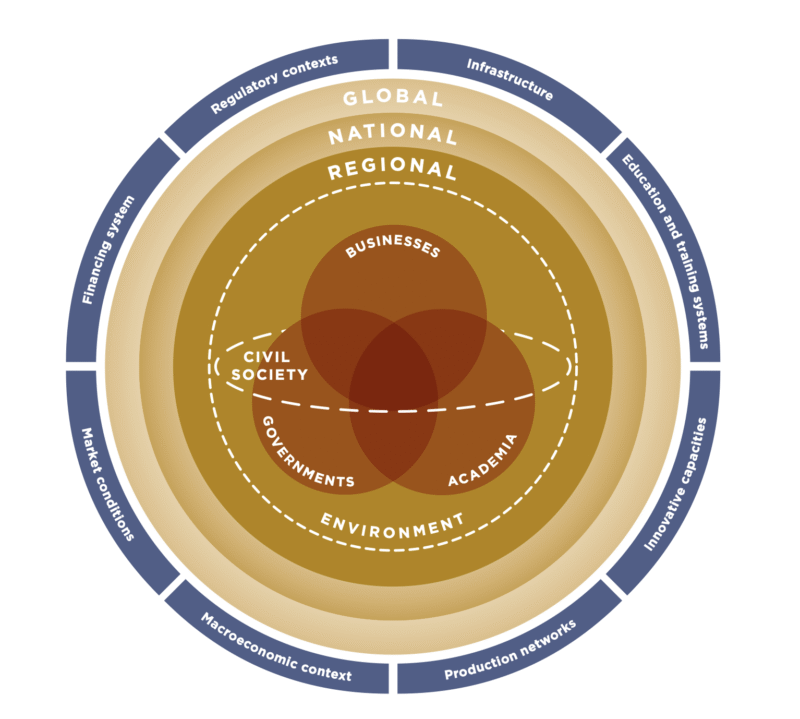 Figure source: Council of Canadian Academies (2025). The State of Science, Technology, and Innovation in Canada 2025. Ottawa, ON: Expert Panel on the State of Science, Technology, and Innovation in Canada, CCA.
Conference Tracks
1. STI, Sovereignty, and National Capability
Canada is increasingly framing innovation through the lenses of sovereignty, resilience, and strategic autonomy. This includes research enterprises and research infrastructure; defence industrial strategy and modernization; Arctic and northern development; critical minerals; supply chains; advanced technologies with dual civilian and security applications, such as AI, quantum, and cybersecurity; and all core sectors of the economy, including natural resources, advanced manufacturing, life sciences, agri-food and others.
This track will explore actions to build a more agile STI ecosystem and a Connected and coherent industrial strategy aligned with Canada’s national interests. It will explore how the STI ecosystem, economic policy, defence industrial strategy, national security, innovation capacity, and international partnerships must operate in closer alignment to enable Canada to act decisively and strategically in a more contested and uncertain world.
2. The Challenge of Implementation – Coordination and Collaboration
A persistent challenge in Canadian STI policy is not ambition, but the effectiveness of execution. Budget 2025 emphasizes delivery under fiscal constraint, requiring greater interdepartmental coordination, regulatory agility, procurement innovation, inter-sectoral collaboration and an aggressive outcomes orientation.
This track will examine structural and governance reforms needed to improve the implementation of innovation and cultural change across federal departments, provinces and territories, municipalities, academia, industry, civil society and indigenous communities. It will explore new models for collaboration, mission-driven approaches, and performance accountability to ensure that public investments in science and innovation translate into measurable national outcomes.
3. Productivity, Competitiveness, and Economic Transformation
Productivity and competitiveness are central to Canada’s economic strategy. But many questions remain about how STI and STI policy contribute to commercialization, scaling up firms, attracting investment, diversifying trade, and enhancing long-term social and economic resilience.
This track will examine how more efficient translation of research excellence and stronger commercialization pathways, and accelerated technology adoption can lead to productivity gains and globally competitive firms. It will explore how coordinated industrial strategy, defence industrial strategy, AI and Quantum strategies, and regulatory alignment can reduce friction for scaling companies, support market creation, and enable faster diffusion of emerging technologies across sectors. By better integrating innovation policy with industrial strategy and regulatory frameworks, Canada can strengthen its economic resilience, enhance competitiveness, and position itself for sustained, inclusive growth.
4. Civil Society, Public Trust, Social Cohesion, and Democratic Resilience
Societal challenges lie at the heart of sustainable economic growth and sustainable development. Addressing issues such as inequality, access to education, public health, and social stability is essential for long-term prosperity and progress. Societies that successfully cultivate trust and cohesion generate stronger institutional performance, higher adaptivity and improved socio-economic resilience.
This track will explore how Canadian public and private sector institutions could design and coordinate science, technology and innovation activities better, in order to improve citizen needs for: Affordability (housing, food, etc.); Accessibility (healthcare, education, employment, transportation, social services); Sustainability (environment, energy use, etc.); Community safety, and national security; and Social cohesion and equity.
5. Talent Development and Future Skills
Canada’s innovation capacity ultimately depends on its people. In a context of demographic shifts, global talent competition, and rapid technological change, developing and retaining world-class talent is a national imperative. At the same time, for those in the first fully online generation there is a deepening employment challenge. How much is structural; how much is a result of deepening skills mismatches?
This track will explore education reform, interdisciplinary training, mobility across sectors, research career pathways, entrepreneurship, and inclusion. It will examine how Canada can cultivate highly skilled talent across all disciplines, scientific, technical, social, and humanistic, to support productivity growth, public-sector modernization, and long-term national resilience.
6. Science and Innovation Diplomacy and Geopolitical Shift
Science and innovation are increasingly central to foreign policy, trade strategy, and geopolitical alignment. As global alliances shift and technological competition intensifies, Canada must strategically position itself within international research and innovation networks, supply chains, and international institutions.
This track will examine how science and innovation can advance Canada’s economic interests globally, strengthen alliances, and diversify trade. It will explore how scientific and technological collaboration can better support the reinforcement of multilateral engagement, bilateral partnerships, and the advancement of Canada’s global engagement.
7. Northern and Arctic Knowledge and Innovation – Key to Canadian Sovereignty?
Arctic and Northern sustainable development, Indigenous self-determination, and resilient communities are central to Canada’s long-term sovereignty and sustainable growth strategy.
This track will examine how Indigenous knowledge systems, community-led innovation, long-term capacity building, and infrastructure development intersect with national defence, climate adaptation, resource development, community resilience, economic diversification, and national security. It will emphasize co-development and respectful collaboration, and long-term capacity-building as foundations for advancing Northern and Arctic knowledge and innovation.