
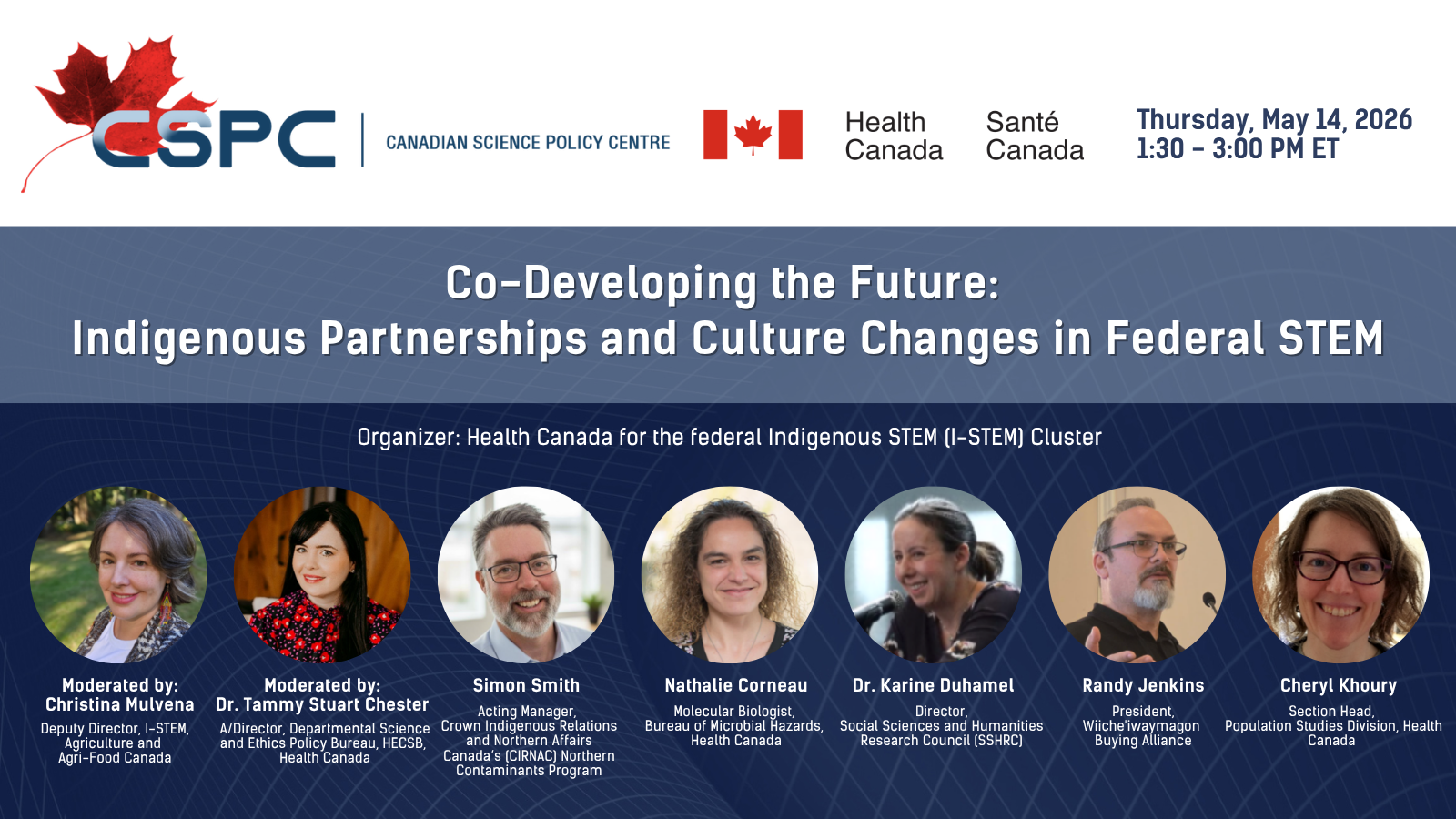
Co-Developing the Future: Indigenous Partnerships and Culture Changes in Federal STEM
May 14 @ 1:30 pm - 3:00 pm EDT
Organizer:
Health Canada for the federal Indigenous STEM (I-STEM) Cluster.
This panel builds on the multi-year arc of the federal Indigenous-Science, Technology, Engineering and Mathematics (I-STEM) Cluster discussions at CSPC (2022-2024), which shifted conversations from “integrating” Indigenous Knowledge into existing systems toward engaging Indigenous and Western sciences as parallel, intact knowledge systems within ethical space. This reframing recognizes that meaningful partnership requires cultural, structural, and procedural transformations – including Indigenous governance of knowledge, distinctions-based partnership models, data sovereignty, and institutional conditions that uphold Indigenous rights and self-determination.
Extending the call made in Bridging Knowledge Systems in Regulatory Research – Creating the Conditions for Change – CSPC, this 2026 virtual panel highlights how federal departments are beginning to operationalize these shifts through co-developed approaches that share authority, re-design internal STEM practices, and reorient science towards relational accountability. Through examples from the Tri Council agencies’ co developed evaluation approaches, the Northern Contaminants Program’s community-led monitoring model, and the Wiiche’iwaymagon–Health Canada partnership advancing Indigenous food safety technologies, panelists will examine how concrete institutional changes—funding structures, timelines, governance processes, and ethics practices—enable ethical, trusted, and context responsive science.
By making visible the cultural and governance conditions required to support parallel knowledge systems, the panel will offer science-policy practitioners practical pathways for creating ethical space, strengthening co-governance, and advancing federal commitments to reconciliation and Indigenous rights. These lessons are intended to support federal organizations seeking to design science and regulatory practices that are more legitimate, transparent, and accountable to the communities they serve.
Expected Outcomes:
- Participants will be able to identify new approaches and tools that can be adapted across sectors and disciplines to support inclusive and impactful change.
- Science policy practitioners will demonstrate enhanced understanding about the innovative potential of Indigenous knowledges in addressing complex, real-world challenges, such as, including co-developed Indigenous research training, evaluation approaches, climate change impacts on human health, and food security.
- Greater recognition of the importance of culture change within organizations, particularly in terms of fostering inclusivity and responsiveness to Indigenous needs and priorities and benefits for all Canadians.
- Strengthened collaboration between Indigenous communities, government agencies, and other stakeholders in addressing shared challenges.
Key Areas of Focus:
- Transforming the Research Ecosystem in Federal Research Funding (SSHRC, NSERC, and CIHR)
In 2019, the Canadian Institutes of Health Research, the Natural Sciences and Engineering Research Council, and the Social Sciences and Humanities Research Council published Setting New Directions to Support Indigenous Research and Research Training in Canada, a strategic plan co-developed with Indigenous partners in support of improving the research ecosystem for Indigenous researchers in Canada. On the eve of the sunsetting of this ambitious strategy, this presentation will share important examples of innovation in science policy, as well as exciting new approaches being co-developed with Indigenous partners to evaluate the impact of the Strategy that can help to support meaningful shifts in research policy and practice within Canada’s science policy space. - Northern Contaminants Program: Joint presentation from HC and CIRNAC. This presentation will highlight how the Northern Contaminants Program (NCP) supports community-led, culturally grounded research and monitoring of contaminants in traditionally harvested foods. It will showcase the vital role of Indigenous and northern partners in shaping and sharing knowledge to protect health and ecosystems, aligning with the panel’s focus on collaborative, cross-cultural approaches to science and policy.
- Indigenous Food Safety Tool (HPFB, HC & The Wiiche’iwaymagon Alliance): Joint presentation from HC and The Wiiche’iwaymagon Alliance. Health Canada (HC), the National Research Council (NRC), and the Wiiche’iwaymagon Alliance are partnering on the development of “lab-on-a-chip” technology to enable on-site wild game testing. These deployable devices aims to replace traditional large-scale laboratories, allowing harvesters to detect viral and bacterial contaminants linked to climate change and resource development. This presentation will highlight how the team is braiding knowledge systems to create a more comprehensive and understanding approach to western science.
Key Takeaways for Science Policy Practitioners:
- Bridging Indigenous Knowledge: The value of respecting and incorporating Indigenous knowledge into policy-making and program design through meaningful collaboration with Indigenous rights holders and Knowledge Keepers.
- Cultural Shifts in Organizations: How internal cultural changes in organizations (e.g., HC/HP) can lead to more inclusive, effective policies and practices.
- Practical Tools for Change: How actionable tools like the Indigenous Food Security Tool can guide policy and drive positive outcomes in Indigenous communities.
- Collaborative Approaches: The importance of building partnerships across sectors and involving Indigenous communities in the co-design of solutions to address challenges like food security and air quality.
By showcasing these successful practices, we aim to foster greater understanding and collaboration, while also sharing promising practices that can be applied across government programs and beyond.
Speaker information coming soon!
Moderators:


Presenters: