

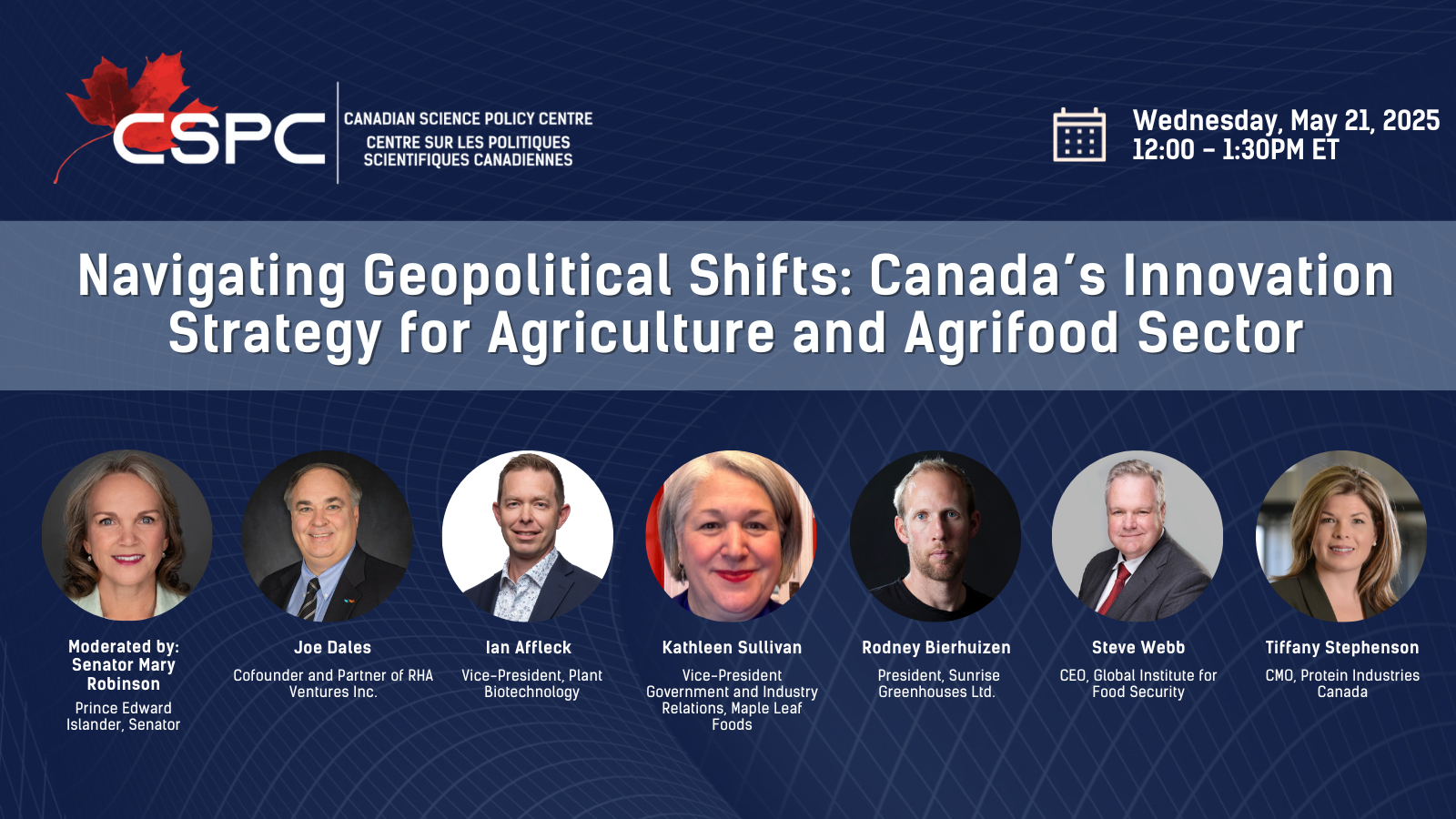
Navigating Geopolitical Shifts: Canada’s Innovation Strategy for Agriculture and Agrifood Sector
May 21, 2025 @ 12:00 pm - 1:30 pm EDT
Executive Summary
This panel discussion highlighted significant hurdles to innovation within the agri-food sector, alongside strategic opportunities for Canada. A primary concern was the complex and unpredictable regulatory environment, which deters investment and slows progress. Panelists also pinpointed a critical innovation infrastructure gap, particularly between pilot-scale development and commercialization, often leading to drain of intellectual property and companies to other countries. Access to late-stage capital for scaling innovations was identified as another major challenge, despite the availability of early-stage funding. Finally, fragmentation in collaboration across the agri-food value chain was seen as hindering effective innovation.
In response, panelists urged the government to streamline regulations, making them more predictable and transparent. They also called for coordinated industry requests to ensure a unified voice in advocating for necessary changes. Targeted investment in R&D infrastructure was recommended to bridge the pilot-to-commercial gap. To enhance private sector R&D, suggestions included revamping tax incentives like the SR&ED program to better support small businesses and strengthening industry-academic partnerships. Initiatives to create accessible capital pools were also proposed to address funding shortages.
Looking ahead, Canada has a strong opportunity to emerge as a trusted global supplier, leveraging its sustainable agriculture practices and commitment to food security amidst shifting geopolitical landscapes. Embracing technological advancements like AI and robotics in agriculture and strategically prioritizing the agri-food sector for investment were also emphasized as key to future success.
Summaries from the panel (4–6 bullets per question — anonymized, ordered by emphasis)
Q — What are the top three challenges currently hindering innovation in your sector?
- Regulatory Burden and Uncertainty: Panelists frequently emphasized that Canada’s regulatory framework is not predictable, transparent, or science-based, hindering innovation and investment. Examples include Canada’s low ranking in OECD countries for regulatory performance and significant delays in approvals for new products (e.g., PMRA Category A products). This uncertainty often drives companies to seek approval and commercialization in other countries.
- Lack of Scale-Up Infrastructure and Access to Late-Stage Capital: There is a critical gap between pilot processing and commercial scale, with facilities for “toll processing” often located in the United States. This forces Canadian innovators to commercialize their intellectual property elsewhere. Additionally, while early-stage innovation receives some support, there is insufficient late-stage capital for significant investments like “brick and steel in the ground,” leading companies to leave Canada.
- Industry Fragmentation and Lack of Coordinated Collaboration: The agri-food sector is highly fragmented, making it difficult for the industry to present a unified voice and clear priorities to the government. This siloed approach to innovation across the value chain, from genetics to farm gate to finished food processing, limits overall effectiveness and competitive standing.
- Geopolitical Uncertainty and Tariffs: Shifting geopolitical dynamics and the threat of tariffs (such as the “Trump tariffs”) create “chaos” and unpredictability. This significantly disrupts small businesses and farmers, leading to frozen investment and venture capital as organizations become hesitant to deploy funds without clear “rules of engagement.”
- Limited Government Understanding of the Agri-Food Sector: Some panelists noted that federal and provincial governments often perceive the sector narrowly as “agriculture” (farming) rather than a comprehensive “food system.” This limited understanding hinders the development of holistic policies, investment strategies, and regulatory frameworks that recognize and support the entire supply chain and its full economic contribution.
Q — How should government and industry respond to enable long-term innovation and competitiveness?
- Regulatory Reform and Mindset Shift: Panelists emphasized the need for a predictable, transparent, and science-based regulatory framework. This includes updating regulations to keep pace with new advances in products and processes. Panelists highlighted that regulatory agencies, while prioritizing safety, should also consider economic impact and operate with a “safety first in the mission of delivering food security” approach. A Panelist added that addressing the underlying “sentiment of distrust” towards industry within government and fostering a less risk-averse culture is crucial.
- Enhanced Collaboration and Integrated Systems Approach: Innovation was repeatedly described as a “team sport.” Panelists called for reimagining collaboration across the entire agri-food value chain—from genetics to farm gate to processing—rather than operating in fragmented silos. A Panelist suggested a “what’s in it for us” mindset, fostering partnerships between academia, government, and industry (e.g., the yellow peas consortium or Gifts bridging role) to drive innovation and close the $44 billion food export gap. A Panelist stressed the importance of the industry coordinating its “ask” to government more effectively.
- Strategic Investment and Capital Flow: There is a critical need for government and industry to ensure access to late-stage capital for commercialization and “brick and steel in the ground” investments, as current facilities for scale-up are often in the United States. A Panelist pointed out the disproportionately low funding for the agri-food sector compared to others (e.g., a $200 million fund for food processing versus $2 billion for the auto industry). A Panelist advocated for revamping tax credit programs, such as “shred tax,” to better support small to medium-sized businesses that are key innovators.
- Clear Government Direction and Long-Term Execution: Panelists urged the government to establish clear, high-level “North Stars” or strategic priorities for the sector, which would guide policy, regulatory frameworks, and funding decisions. Panelists noted that while reports (like the Barton report) have identified opportunities, there’s a consistent lack of sustained commitment to implementation and execution. A Panelist added that the system needs to “unlock the power of our smart people” and get out of their way, supporting young entrepreneurs and innovators with an ecosystem approach, rather than through slow, cumbersome government processes.
Q — Key recommendations / next steps to boost private-sector R&D investment in Canada
- Create a Supportive Regulatory and IP Environment: To encourage R&D, Canada’s regulatory systems must keep pace with new advances in products, processes, and equipment, providing a clear and accepting framework. Furthermore, improving the intellectual property (IP) environment and educating the entire ecosystem (academia, government, industry) on the “path to impact” for research findings is crucial for commercialization.
- Enhance Access to Strategic Capital and Tax Credits: Beyond early-stage funding, there is a critical need for late-stage capital to support commercialization and “brick and steel in the ground” investments for R&D scale-up, as current facilities are often outside Canada. Revamping programs like SR&ED tax credits to better suit small to medium-sized businesses, which are key innovators, is also essential, as current large grants like SIF are inaccessible to most food manufacturers.
- Foster Cross-Sectoral and Industry-Academia Collaboration: Encouraging “team sport” innovation by fostering partnerships between academia, government, and industry is vital for translating R&D into market-impacting innovations. This includes supporting models like the Fraunhofer Institutes for applied science and scale-up, and building an ecosystem that connects young entrepreneurs (even from non-agricultural backgrounds) with farmers and resources.
- Leverage Canada’s Global Advantages for R&D Attraction: Canada can capitalize on its reputation as a stable, climate-friendly, and sustainable food producer to attract R&D investment. Proactively accelerating bilateral regulatory harmonization with other international markets can signal Canada as a science-based regulatory environment, making it an attractive destination for global intellectual capacity and labs.
- Establish Clear, Executable “North Stars” for the Sector: Government needs to provide clear strategic priorities or “North Stars” that align all policy, regulatory frameworks, and funding programs towards enhancing R&D and innovation. A consistent commitment to execution, learning from past reports like Barton, is necessary to translate vision into sustained R&D growth and competitive advantage.
Q — What new opportunities / comparative advantages can Canada exploit?
- Exploiting Canada’s “Trusted Supplier” Status and Sustainable Production: Panelists highlighted Canada’s stability, climate-friendly agriculture, and sustainable practices as significant advantages in a globally uncertain landscape. This positions Canada as a preferred and reliable source, attracting renewed international interest for its products and ingredients.
- Harnessing Emerging Technologies and Nurturing Tech Talent: There is a substantial opportunity to leverage cutting-edge technologies like artificial intelligence, robotics, data analytics, and the Internet of Things. This requires building an ecosystem that supports young, innovative entrepreneurs—including those from non-agricultural backgrounds—by providing capital, R&D support, and direct connections to farmers.
- Increasing Domestic Value-Adding and Processing: To mitigate vulnerability to geopolitical shifts and tariffs (e.g., “Trump tariffs” or China’s actions), Canada should focus on increasing domestic processing and adding value to raw commodities. By selling finished goods rather than bulk products, the sector can create more intellectual property and retain greater economic benefit within Canada.
- Strategic International Regulatory Alignment: Given potential future instability in traditional trading relationships (e.g., with the US), Canada has an opportunity to proactively accelerate bilateral regulatory harmonization with other international markets. This would streamline market access and signal Canada as a stable, science-based regulatory environment, attracting global intellectual capacity and investment.
- Adopting an Integrated “Team Sport” Approach and Executing a Clear Plan: The agri-food sector must overcome its historical fragmentation and adopt a more unified, collaborative approach across the entire value chain (from genetics to processing). This internal alignment, combined with a clear, long-term strategic plan (like the Barton report’s vision) and a strong commitment to its execution, is essential for Canada to regain and enhance its global competitive standing.
This summary has been generated with the assistance of AI tools.