
Abstract:
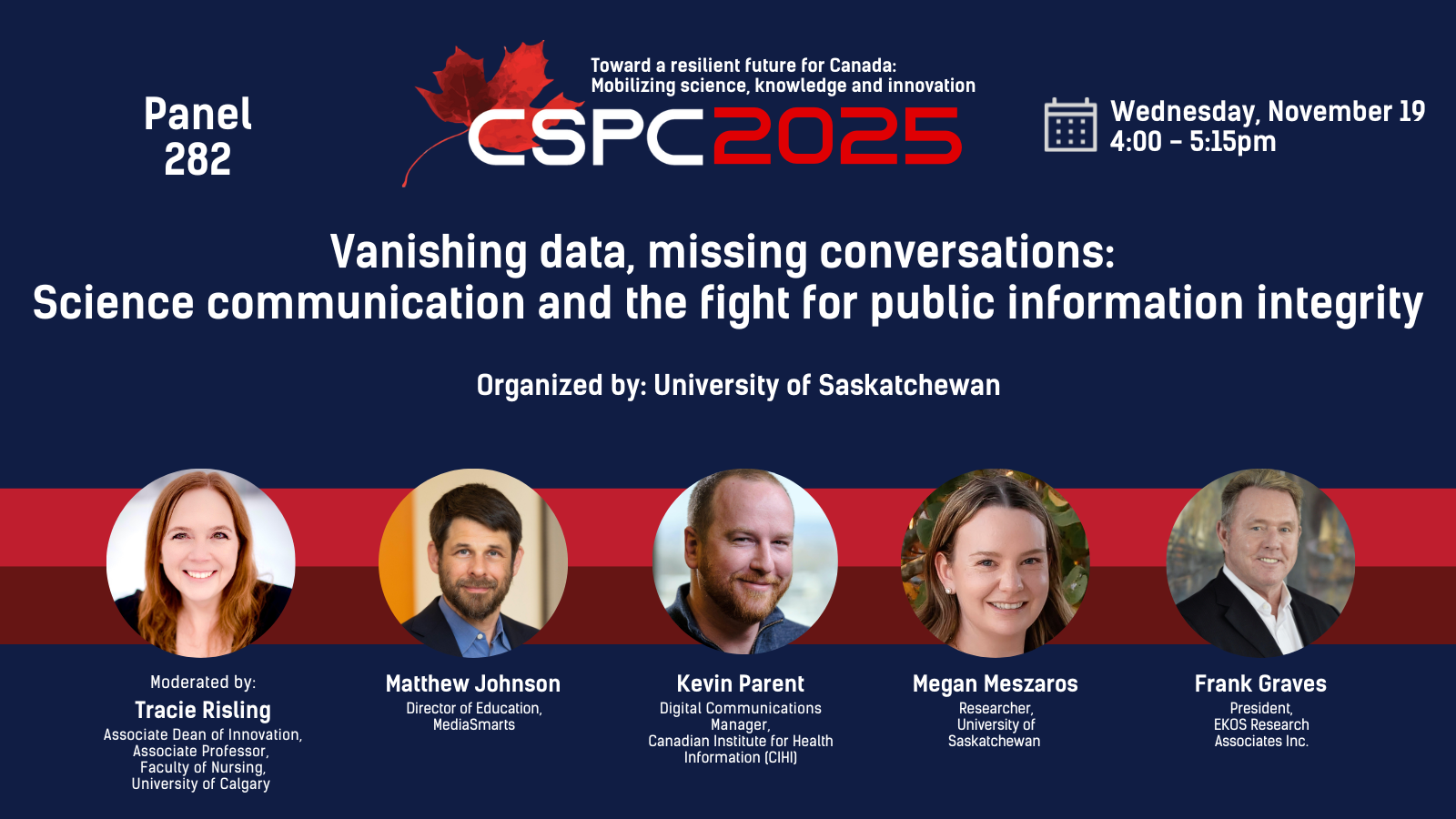
Across North America, public data is being erased, delayed, or buried, leaving vital information inaccessible and the public vulnerable to misinformation. This panel explores the widening gap between data availability and accessibility, drawing on cross-border examples to examine institutional barriers, political constraints, and missed communication opportunities. Panelists from public health, academia, policy, and digital media will discuss how to operationalize public data for public dialogue, the role of social media in safeguarding transparency, and what policy changes are needed. At stake is more than access, it’s public trust, democratic accountability, and the conversations we urgently need to have.
Summary of Conversations
The discussion centered on the critical intersection of data availability, public trust, and science communication in an era of increasing information volatility. Speakers explored the consequences of “vanishing data”—where vital public datasets are lost or obscured—and how this facilitates the spread of misinformation. A major theme was the erosion of trust in traditional institutions and the challenge of communicating scientific nuance in a polarized digital landscape where algorithms often prioritize emotional engagement over factual accuracy. Participants analyzed the psychological dynamics of polarization, distinguishing between a radicalized minority and a “moveable middle” capable of dialogue. The conversation highlighted the inadequacy of the “deficit model” of communication, arguing instead for strategies that resonate with personal values and community needs. Ultimately, the dialogue underscored the urgency of protecting data integrity while simultaneously rebuilding the social infrastructure necessary for meaningful, evidence-based public discourse.
Take Away Messages/Current Status of Challenges
- Erosion of Public Data Infrastructure: There is a concerning trend of “data erasure” as public datasets become burdened by bureaucracy rather than operationalized to catalyze public dialogue and policy discussions.
- Algorithmic Amplification of Polarization: Social media platforms and AI algorithms are designed to maximize engagement, often by prioritizing rage-inducing content and misinformation, which deepens societal divides and obscures scientific consensus.
- The Crisis of Trust in Expertise: A significant challenge is the declining credibility of scientific and governmental institutions, where “elite” status is increasingly viewed with suspicion, leading the public to seek information from non-expert influencers who validate their existing biases.
- Ineffectiveness of Fact-Checking Alone: Simply correcting false information is insufficient because misinformation often targets identity and values rather than logic; facts alone rarely change minds once emotional or ideological narratives have taken root.
- Vulnerability of the “Moveable Middle”: While a small percentage of the population is deeply radicalized and unreachable, a larger “moveable middle” remains uncertain and vulnerable to manipulation, yet this group is often neglected in communication strategies.
- Information Overload and Fatigue: The sheer volume of conflicting information creates cognitive overwhelm, causing individuals to disengage from complex topics or default to simple, albeit incorrect, explanations that offer a sense of certainty.
- Siloed Communication Efforts: Scientific and academic communities often communicate within their own echo chambers, failing to reach broader audiences or translate complex data into narratives that are accessible and relevant to everyday life.
- Psychological Barriers to Dialogue: The discussion highlighted that a segment of the population (estimated at 7-10%) exhibits traits such as a lack of empathy and a desire for chaos, acting as catalysts for disruption that complicates constructive public discourse.
Recommendations/Next Steps
- Target the “Moveable Middle”: Communication strategies should prioritize the large, undecided segment of the population that retains “elasticity” and capacity for change, rather than expending limited resources trying to convert the deeply radicalized minority.
- Adopt Values-Based Communication: Experts must move beyond simply presenting data to framing scientific evidence in ways that align with the audience’s core values, shared identities, and community concerns to build authentic connections.
- Engage Communities Directly: Instead of expecting the public to come to academic or government spaces, scientists and policymakers need to physically and digitally go “where the people are,” such as community centers, faith groups, and popular online platforms, including social media.
- Enhance Professional Training: There is a critical need to equip healthcare professionals—doctors, nurses, and pharmacists—with advanced science communication skills, enabling them to act as trusted intermediaries who can effectively debunk misinformation.
- Prioritize Narrative over Raw Data: To compete with misinformation, accurate scientific information must be packaged in compelling narratives that are emotionally resonant and easy to understand, making the truth as “sticky” as the falsehoods.
- Strengthen Data Preservation Policies: Advocacy is required to protect and restore vital public datasets (like census data and environmental records) to ensure that historical records are safeguarded and future policy is data-informed. future policy decisions and historical records .
- Foster Interdisciplinary Collaboration: Addressing the crisis requires breaking down silos between hard sciences, social sciences, and humanities to better understand the sociological and psychological drivers of trust and information consumption.
- Create Safe Spaces for Deliberation: Institutions should facilitate representative, values-based public forums where citizens can engage in safe, facilitated deliberations about complex issues, fostering collective learning amid the tides of misinformation.
* This summary is generated with the assistance of AI tools