
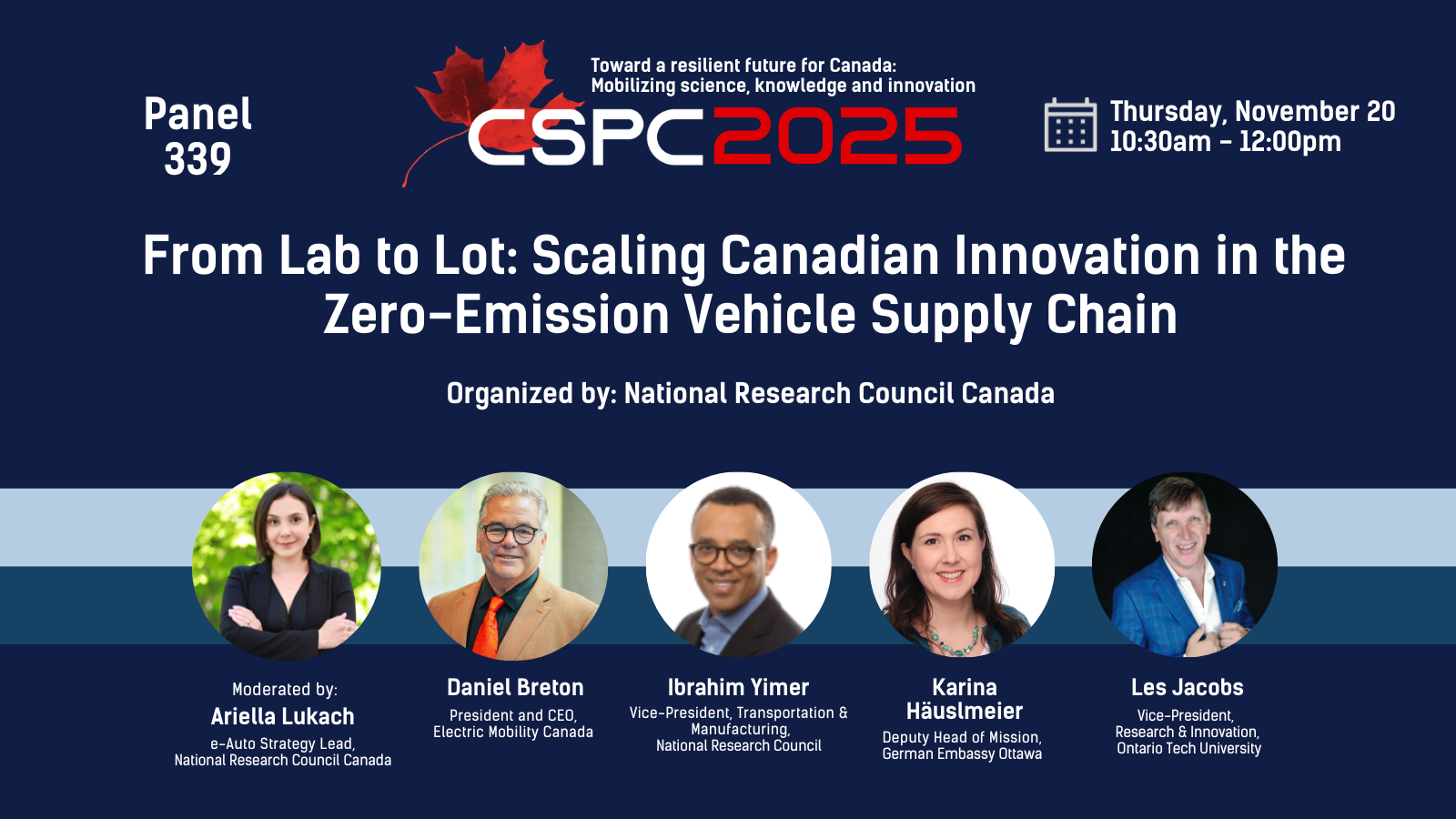
Panel Abstract:
Canada’s productivity challenge is closely tied to its difficulty scaling domestic innovation. As the world shifts to zero-emission vehicles, Canada needs to lead by supporting innovation across the electric vehicle (EV) value chain. This panel explores how coordinated support – spanning public research, talent, investment, and international collaboration – can de-risk commercialization and scale-up. Panelists will share early lessons from real-world implementation, offering insights on how Canada can align science, technology, and industrial policy to enhance competitiveness, build global partnerships, and drive innovation-led growth in the clean transportation sector. Panelists will encourage dialogue with the audience to explore pathways for EV innovation support.Canada’s productivity challenge is closely tied to its difficulty scaling domestic innovation. As the world shifts to zero-emission vehicles, Canada needs to lead by supporting innovation across the electric vehicle (EV) value chain. This panel explores how coordinated support – spanning public research, talent, investment, and international collaboration – can de-risk commercialization and scale-up. Panelists will share early lessons from real-world implementation, offering insights on how Canada can align science, technology, and industrial policy to enhance competitiveness, build global partnerships, and drive innovation-led growth in the clean transportation sector. Panelists will encourage dialogue with the audience to explore pathways for EV innovation support.
Summary of Conversations
The conversation centered on accelerating the electric vehicle transition and establishing a robust domestic supply chain. Major constraints highlighted include widespread disinformation and lingering “range anxiety,” which persists despite technological advancements in battery capacity. The high upfront cost for consumers, inconsistent government incentives, and discouraging dealership experiences are also significant barriers to mass adoption. Addressing these challenges requires overcoming institutional path dependency in policy and legacy educational programs in universities, and funding research and innovation. Long-term competitiveness relies on strategic investment in niche, high-value areas like electric motors and power electronics, as well as developing a resilient domestic supply chain for critical minerals, including comprehensive battery recycling. Finally, cultivating a strong innovation ecosystem, with accessible core testing facilities and a highly-skilled workforce, is essential to compete globally and ensure new technologies successfully reach the market.
Take Away Messages/Current Status of Challenges
- Pervasive Misinformation and Half-Truths: A significant societal challenge is the constant dissemination of disinformation, which exploits unfounded fears about range, particularly in cold climates and a large country, actively slowing consumer adoption.
- Uncoordinated and Patchy Charging Infrastructure: The current approach to rolling out public charging stations is non-coordinated across provinces and municipalities, leading to inconsistent reliability and perpetuating range anxiety among potential buyers.
- High Upfront Costs and Lack of Sustained Incentives: The high initial price of new vehicles, both gas and electric, coupled with the reduction or elimination of significant government incentives, creates a major financial deterrent for average buyers despite electric vehicles having a lower cost of ownership overall.
- Dealer Resistance and Negative Consumer Experience: Dealership personnel frequently discourage customers or present electric vehicles as an exclusive “luxury item,” resulting in a negative purchasing experience that limits mainstream adoption.
- Institutional Path Dependency: Deeply entrenched legacy decisions affect policy, research funding, and academic engineering programs, limiting the agility and speed with which the economy can pivot to the electric vehicle sector.
- Failure to Bridge the Innovation “Valley of Death”: While Canada excels at early-stage research (e.g., in battery chemistry), there is a critical systemic failure in scaling these technologies and moving them from the lab to commercial production and the global market.
- Critical Mineral Recycling Deficiency: The national focus is heavily skewed toward upstream mineral extraction, neglecting the crucial downstream processing and later, battery recycling capabilities, required to secure the supply chain for economic and national security.
- Geopolitical Risk from Shifting Trade Policy: There is a significant risk that aligning with anti-electrification movements, particularly in the US, could undermine Canada’s long-term investments and partnerships with global allies committed to the transition.
Recommendations/Next Steps
- Implement a Coordinated National Charging Strategy: Develop and execute a master plan for charging infrastructure across all levels of government to eliminate uncoordinated deployment, standardize payment systems, and ensure reliable service nationwide.
- Strategically Invest in Niche, High-Value Technologies: Focus R&D funding and investment on targeted, advanced electric powertrain components such as electric motors, power electronics, and unique high-grade nickel battery chemistries where Canada can secure a global advantage.
- Refine Post-Secondary Education and Training: Enable academic leaders to rapidly reform legacy engineering and vocational training programs to reflect the new economy and actively cultivate a talent pipeline for battery research and software development, including attracting international talent.
- Mandate and Invest in Battery Recycling Infrastructure: Prioritize the development of domestic facilities for recycling and transforming critical minerals from spent batteries to close the circular economy loop, enhancing national security and economic independence.
- Establish Accessible Core Research and Testing Facilities: Invest in neutral, high-quality testing facilities and R&D “sandboxes” that are openly accessible to small and medium-sized enterprises (SMEs) to de-risk innovation and accelerate market entry.
- Expand International Supply Chain and Innovation Partnerships: Deepen collaboration with key countries like Germany on critical minerals and innovation to build resilient supply chains and ensure market access outside of potential US trade policy volatility.
- Explore and Incentivize Adjacent Electrification Markets: Leverage battery and power advancements to invest in emerging sectors like electric boats, ferries, and vehicle-to-load capabilities to create new industrial opportunities and enhance grid stabilization.
- Address Consumer Experience and Affordability Directly: Implement effective policies to lower the overall cost of vehicle ownership and devise methods to counter or transform the discouraging sales and information tactics currently prevalent at the dealer level.
* This summary is generated with the assistance of AI tools