
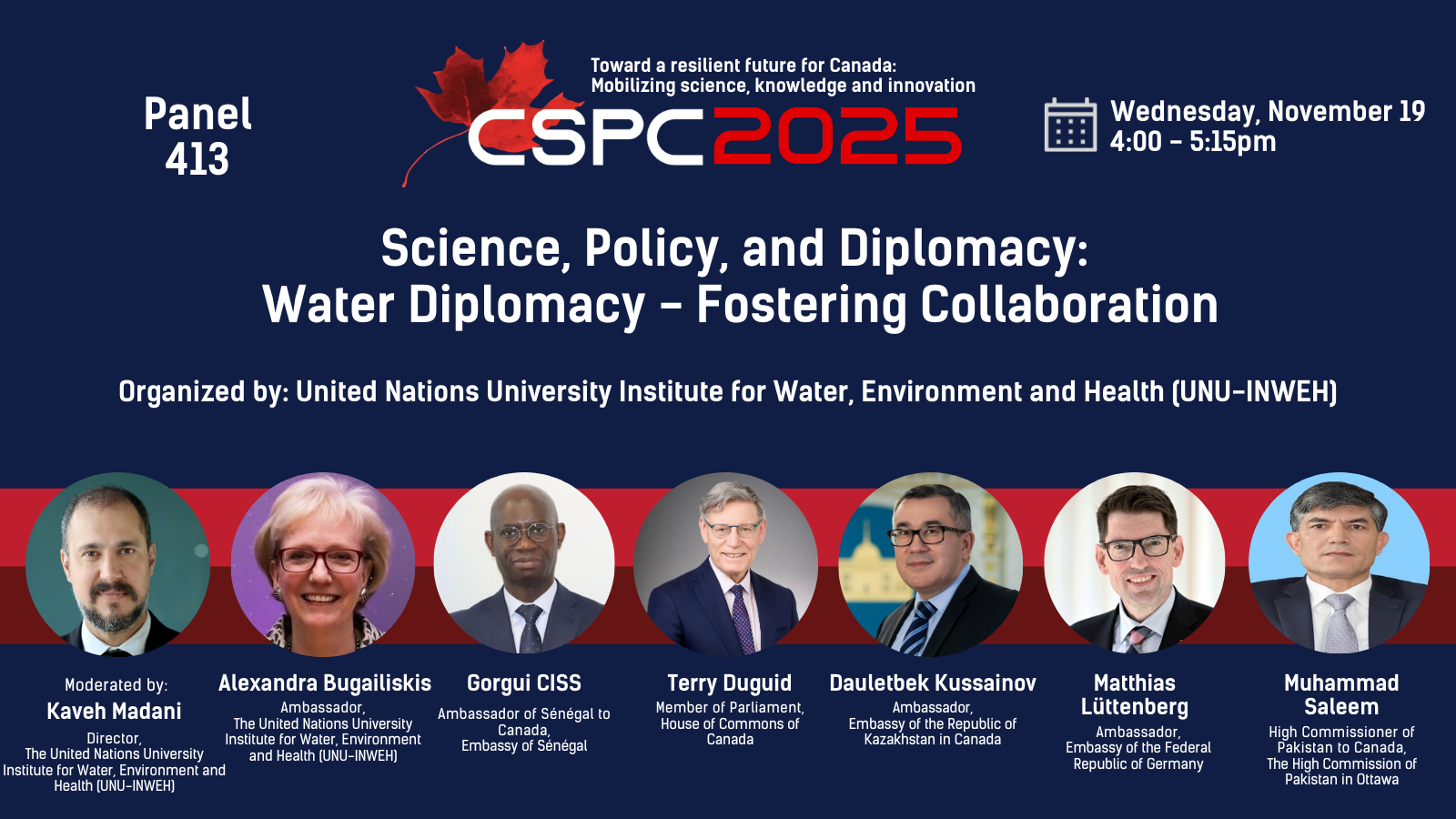
Panel: 413
Science, Policy, and Diplomacy: Water Diplomacy - Fostering Collaboration
Abstract:
Water has emerged as a critical theme that connects human security, environmental stability, and sustainable development, offering a pathway that advances global commitments and priorities. This panel, Water Diplomacy – Fostering Collaboration, will explore how advancing
shared water security can strengthen policy coherence, science-based decision-making, and international collaboration amid climate change, geopolitical tensions, and rapid urbanization. Through a roundtable moderated by Professor Kaveh Madani, Director of the United Nations
University Institute for Water, Environment and Health (UNU-INWEH), also known as the “UN’s Think Tank on Water,” ambassadors from diverse regions and countries leading on water diplomacy will share their experiences and insights on leveraging water to enhance cooperation, build partnerships, and shape innovative solutions to shared challenges.
Summary of Conversations
The discussion focused on the critical and complex challenges facing global water security, emphasizing the need to shift from fragmented management toward integrated Water Diplomacy and a culture of peace. Participants stressed that water is not merely a technical issue, but a deeply cultural, political, and human rights matter tied to dignity and geopolitical stability. They highlighted mounting pressures from climate change and population growth, increasing the urgency of transboundary cooperation. The conversation underscored the persistent “missing link” between scientists, policymakers, and diplomats, calling for stronger efforts to translate expertise into actionable policy and diplomatic solutions. The role of the United Nations University Institute for Water, Environment and Health (UNU-INWEH), the “UN’s Think Tank on Water,” was recognized as central to this work. Particular emphasis was placed on valuing Indigenous water knowledge and fostering leadership in multilateral water initiatives to advance global sustainability.
Take Away Messages / Current Status of Challenges
- Fragmented Governance: Water responsibility is often scattered across various government departments and sectors, hindering cohesive national and international policy development.
- Geopolitical Stress Multiplier: Climate change and rapid population growth are severely straining finite water resources, escalating transboundary tensions and acting as a multiplier for geopolitical conflicts.
- The “Missing Link” Gap: There is a significant disconnect between the world-class expertise of scientists and the practical needs of policymakers and diplomats, preventing evidence-based knowledge from translating into effective foreign policy.
- Dehumanization of Water: Current approaches often treat water merely as a commodity or a technical engineering challenge, overlooking its fundamental connection to human dignity, culture, and religious belief systems.
- Absence of Political Will: Despite the critical nature of water security, there is a pervasive lack of sustained political commitment and dedicated funding to elevate water issues on the global diplomatic agenda.
- Exclusion of Indigenous Knowledge: Traditional and Indigenous water management practices, which offer holistic and sustainable models, are frequently marginalized from mainstream policy and diplomatic negotiations.
- A Need for Shared Vulnerability: Nations currently struggle to move past immediate self-interest to recognize and act upon the shared, universal vulnerability to water scarcity and degradation.
Recommendations / Next Steps
- Elevate Water Diplomacy: Intentionally integrate water security into foreign policy objectives, ensuring that diplomatic, scientific, and policy streams work collaboratively to achieve cooperative frameworks.
- Strengthen Multilateral Leadership: Commit to enhancing presence, funding, and expertise in key international forums (e.g., UN Water Conferences of 2026 and 2028) to drive the global water agenda and cooperation.
- Implement Integrated Policy Frameworks: Establish cross-sectoral governance mechanisms domestically and internationally to unify water management responsibilities and reduce institutional fragmentation.
- Leverage Scientific Expertise: Create dedicated mechanisms (e.g., embedded scientific advisors) to ensure high-quality research and data are directly and effectively translated into diplomatic strategies and policy briefs.
- Centre Indigenous Perspectives: Mandate the meaningful inclusion of Indigenous knowledge and governance models in national water policy design and transboundary dispute resolution processes.
- Prioritize Water as a Human Right: Shift the paradigm in policy to explicitly acknowledge water’s role in human dignity, culture, and rights, ensuring equity and access are primary considerations.
- Invest in Capacity Building: Provide dedicated training and resources for diplomats and policymakers in water diplomacy and water resource economics.
Promote Shared-Risk Narratives: Develop communication strategies that highlight the mutual risks posed by water scarcity, fostering a foundation for empathy and shared action among nations.
* This summary is generated with the assistance of AI tools