
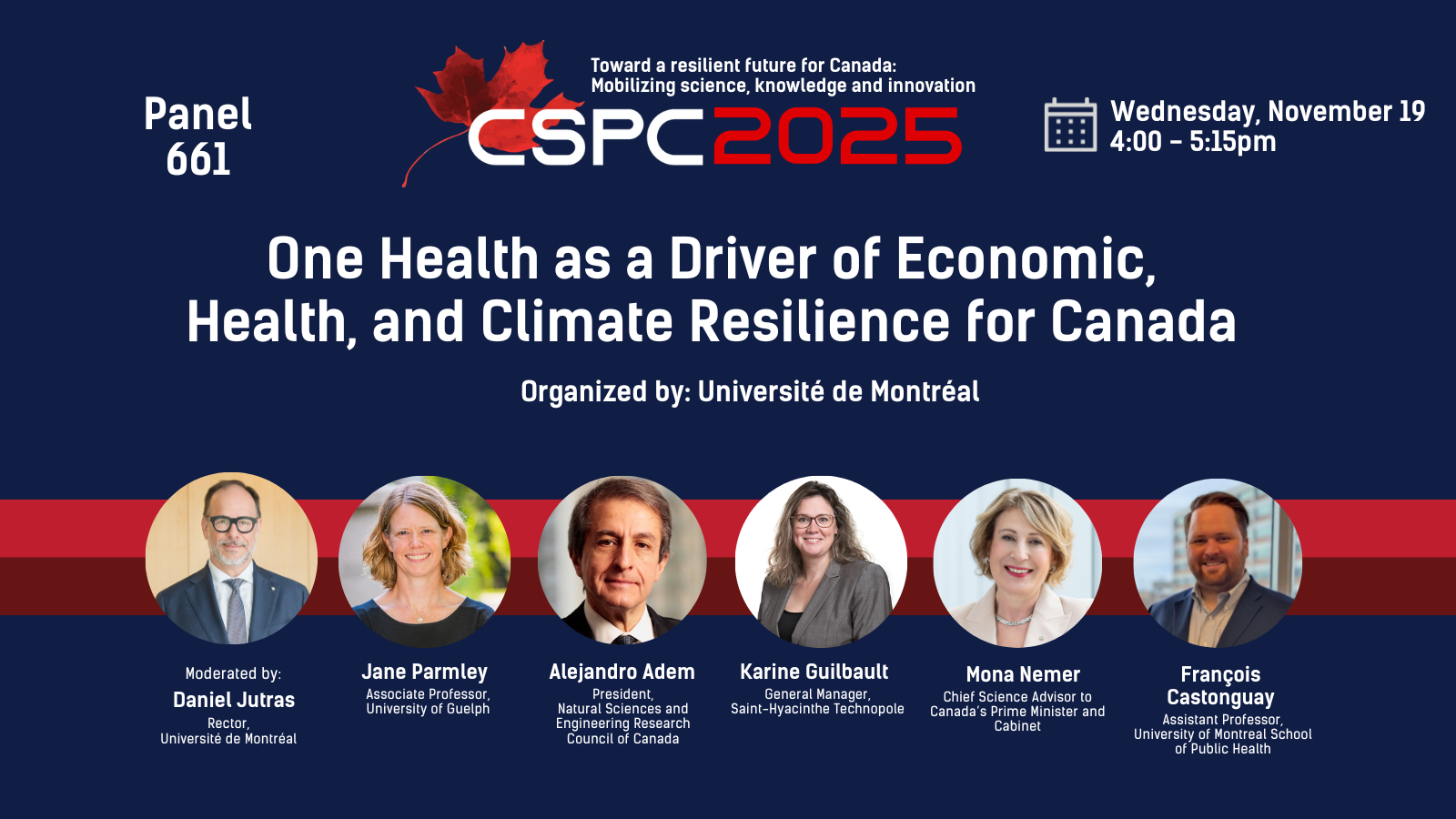
Abstract:
This panel will explore how the One Health approach can strengthen Canada’s resilience to emerging crises such as pandemics, emerging contaminants, climate change, and food insecurity. By recognizing the interdependence between human, animal, and environmental health, the One Health approach offers integrated, cross-sectoral solutions to better anticipate crises and mitigate their impacts. The panel will highlight four concrete and interconnected levers (prevention, training, research, and economics) to operationalize this approach. The goal is to generate collective courses of action and recommendations to guide science policy in a context of increasing interconnectedness and complexity of 21st-century challenges.
Summary of Conversations
The discussion centered on the One Health approach as a vital framework for Canada’s economic, health, and climate resilience. The core premise is that health issues like pandemics, climate change, and antimicrobial resistance transcend disciplinary boundaries, necessitating an intersectoral approach that views humans, animals, and the ecosystems as an integrated whole. An integrated strategy is argued to be a “framework for collective efficiency”, with evidence showing that four out of five One Health initiatives generate a positive economic return. Experts highlighted the costs of inaction and siloed decision-making. Key themes included: One Health economic benefits through prevention and optimized investment, the urgent need for training and competency building in systemic and integrated thinking, the challenges of government silos in emergency preparedness (e.g., H5N1, COVID-19), and the potential of industry and innovation to drive collaboration, using examples like the Saint-Hyacinthe Technopole. The need to incorporate social sciences, Indigenous knowledge, and equity was also emphasized.
Take Away Messages/Current Status of Challenges
- Persistent Silos: While the One Health concept is acknowledged, different sectors, including, but not limited to, governmental departments and agencies, universities and colleges, and industries, frequently operate in silos, leading to a lack of coordination, increased costs, and duplication of efforts, especially during crises.
- Lack of Automatic Coordination Reflex: The necessary framework and “reflex” for automatic, natural, and durable intersectoral conversation and public policy making is currently absent, forcing groups to start from scratch every time a new crisis hits.
- Gaps in Knowledge and Data Access: Practical application is hampered by gaps in knowledge, difficulty accessing existing data, and a lack of interoperable systems across sectors.
- Need for Competency Building and Training Gaps: There is a need to build a new generation of experts with the integrated thinking reflex, moving beyond traditional disciplinary programs to create dedicated spaces for collaboration and skill practice.
- Economic Argument Requires Concrete Metrics: To convince public policy makers, a stronger, evidence-based rationale is needed, quantified using tangible metrics such as cost per case avoided or policy return on investment (ROI).
- Challenge of Sustained, Intentional Action: Efforts tend to be reactive, with emergency situations (like pandemics) forcing people to coordinate, but a sustained, organized, and intentional system for mission-driven, integrated research is lacking.
- Difficulty Valuing Time and Space for Reflection: Current systems often lack the valued time and space required for reflection, networking, and engaging in the “uncomfortable conversations” necessary for integrated, long-term solutions.
- Regulatory and Logistical Barriers: Researchers face practical obstacles, such as difficulty obtaining permits or vaccines, illustrating a profound disconnect between different regulatory bodies (e.g., CFIA and PHAC).
Recommendations/Next Steps
- Establish a Durable and Intentional Coordination Pancanadian Structure: Develop a long-term, organized strategy for coordination across government, academia, and industry that is not merely responsive to crises.
- Establish Independent, Multilingual Governance: Institute an independent governance model, involving government, industry, academia, and research, to ensure the One Health strategy is not overly influenced by a single sectoral perspective.
- Develop Concrete Economic Indicators: Quantify the economic value and societal well-being gains of the One Health approach using tangible metrics to create a compelling, evidence-based rationale for policymakers.
- Prioritize Mission-Driven Research: Create a priority-setting device and framework for mission-driven research that unites all government resources and talent from universities and industry to address Canada’s strategic priorities.
- Rethink Training Programs and Competencies: Build capacity by creating new training programs and consolidating existing ones (such as those at the Université de Montréal, University of Calgary, University of Saskatchewan and University of Guelph) that explicitly foster interdisciplinary skills, collaborative leadership, and a community of practice.
- Integrate EDI into the Framework: Ensure the One Health approach actively promotes equity and addresses communities disproportionately affected by health problems.
- Foster Cross-Sectoral Infrastructure Sharing and Collaboration: Facilitate the pooling of resources, expertise, and infrastructure (e.g., core labs) across government, academia, and industry to limit duplication and improve efficiency.
- Broaden Outreach and Community Awareness: Develop strategies to bring the One Health approach beyond political and academic circles, sharing its value and applicability with community members and workers in critical sectors, including healthcare, agriculture, wildlife management, food systems, environmental stewardship, and local governance.

Simultaneous translation for these panels was provided thanks to the support of the Secrétariat du Québec aux relations canadiennes
* This summary is generated with the assistance of AI tools