
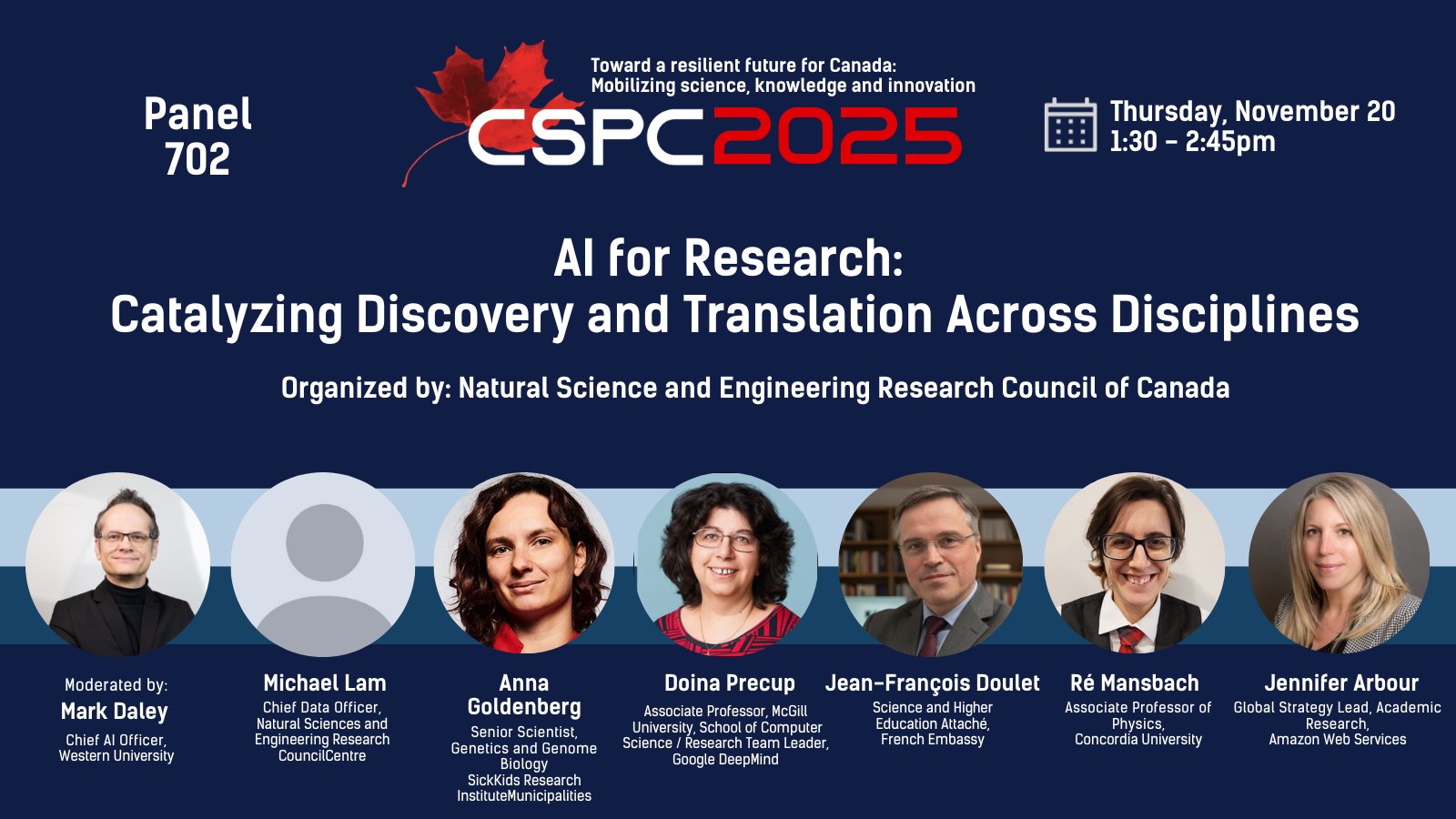
Abstract:
AI is transforming research and discovery, but moving smoothly from laboratory breakthroughs to societal benefit remains a bottleneck. Interdisciplinary AI collaboration centers, dedicated funding streams, and innovation pipelines to move promising AI research into practical use have been identified as ways to address this challenge. The panel will address questions such as: How can federal agencies, universities and industry coordinate efforts in these areas to accelerate AI for research? How do you ensure AI-driven research delivers real world impact while upholding ethical standards and inclusivity? How are researcher skills/capabilities defined when AI systems become active partners in discovery?
Summary of Conversations
The discussion centered on the transformative potential of artificial intelligence in scientific research, rooted in recent high-level collaborations among leading research nations. Participants explored the intersection of AI and scientific discovery, emphasizing the urgency of moving beyond theoretical applications to address complex, “wicked problems” facing society. A significant portion of the dialogue focused on shifting paradigms from reactive frameworks—such as treating established illnesses—to proactive, data-driven approaches that leverage real-time information from sources like wearable technology. Key themes included the critical importance of interdisciplinary translation, the identification of high-impact research streams, and the necessity of joint global action. The conversation also highlighted deep-seated data gaps, particularly in historically under-researched areas like women’s health, illustrating how AI can expose and potentially rectify systemic biases in scientific understanding. The consensus pointed toward utilizing AI not just as a tool for efficiency, but as a catalyst for fundamentally redefining concepts of health, discovery, and data utility.
Take Away Messages & Current Status of Challenges
- Predominance of Reactive Systems: Current research and operational infrastructures, particularly in healthcare, are entrenched in reactive models that respond to critical failures (sickness) rather than preventing them, creating a barrier to implementing proactive AI solutions.
- Data Gaps in Demographics: There is a significant lack of comprehensive historical data regarding specific populations, such as women; this limits the ability of AI models to provide accurate, inclusive insights and results in “health” being defined too narrowly based on limited datasets.
- Complexity of “Wicked Problems”: The grand societal challenges being addressed are multi-faceted and deeply interconnected, making it difficult to identify single-point AI solutions that can effectively resolve them without encountering unforeseen complexities.
- Integration of Non-Clinical Data: Integrating continuous physiological data from consumer-grade wearable devices into clinical or formal research environments presents ongoing technical challenges regarding data quality, standardization, and interoperability.
- Ambiguity of Baseline States: Scientific research has historically focused on defining and cataloging pathological states (sickness) rather than rigorously understanding the baseline parameters of a “healthy” state, complicating the training of anomaly-detection models.
- Translation Across Disciplines: Bridging the gap between technical AI expertise and domain-specific scientific knowledge remains a hurdle, often hampered by the lack of a shared vocabulary and differing priorities between computational scientists and domain experts.
- Global Coordination Complexities: Aligning research priorities, ethical standards, and “joint points of action” across multiple nations involves navigating diverse regulatory landscapes and funding mechanisms.
- Identifying Impactful Applications: Distinguishing between theoretically interesting problems and those that offer genuine, scalable societal impact remains a challenge for funding bodies and research leads.
Recommendations & Next Steps
- Adopt Proactive Paradigms: Institutions should shift research focuses from reactive responses to predictive modeling, utilizing AI to identify early warning signs and intervene before critical thresholds are reached.
- Leverage Real-World Evidence: Research strategies must actively incorporate data from non-traditional, continuous sources—such as wearables and environmental sensors—to create a more holistic and dynamic view of the subject matter.
- Address Historical Data Biases: Prioritize data collection and model training initiatives that specifically target underrepresented groups (e.g., women’s health) to ensure AI systems are equitable, robust, and universally applicable.
- Redefine Success Metrics: The scientific community should move beyond defining success solely by the absence of negative outcomes (curing sickness) to characterizing and optimizing positive states (maintaining health).
- Foster International Alignment: Continue and formalize cross-border collaborations to harmonize research goals, facilitate data sharing, and execute the “joint points of action” identified by international bodies.
- Focus on High-Impact “Wicked” Problems: Direct AI resources and funding specifically toward complex, high-stakes global challenges where traditional linear problem-solving methods have historically failed.
- Promote Interdisciplinary Fluency: Create educational and working structures that encourage AI experts and domain scientists to collaborate closely, ensuring that computational tools are effectively tailored to specific scientific inquiries.
- Accelerate Translation to Practice: Establish clear, streamlined pathways for moving successful AI pilots from the research environment into practical, real-world applications that deliver immediate societal benefits.
* This summary is generated with the assistance of AI tools