
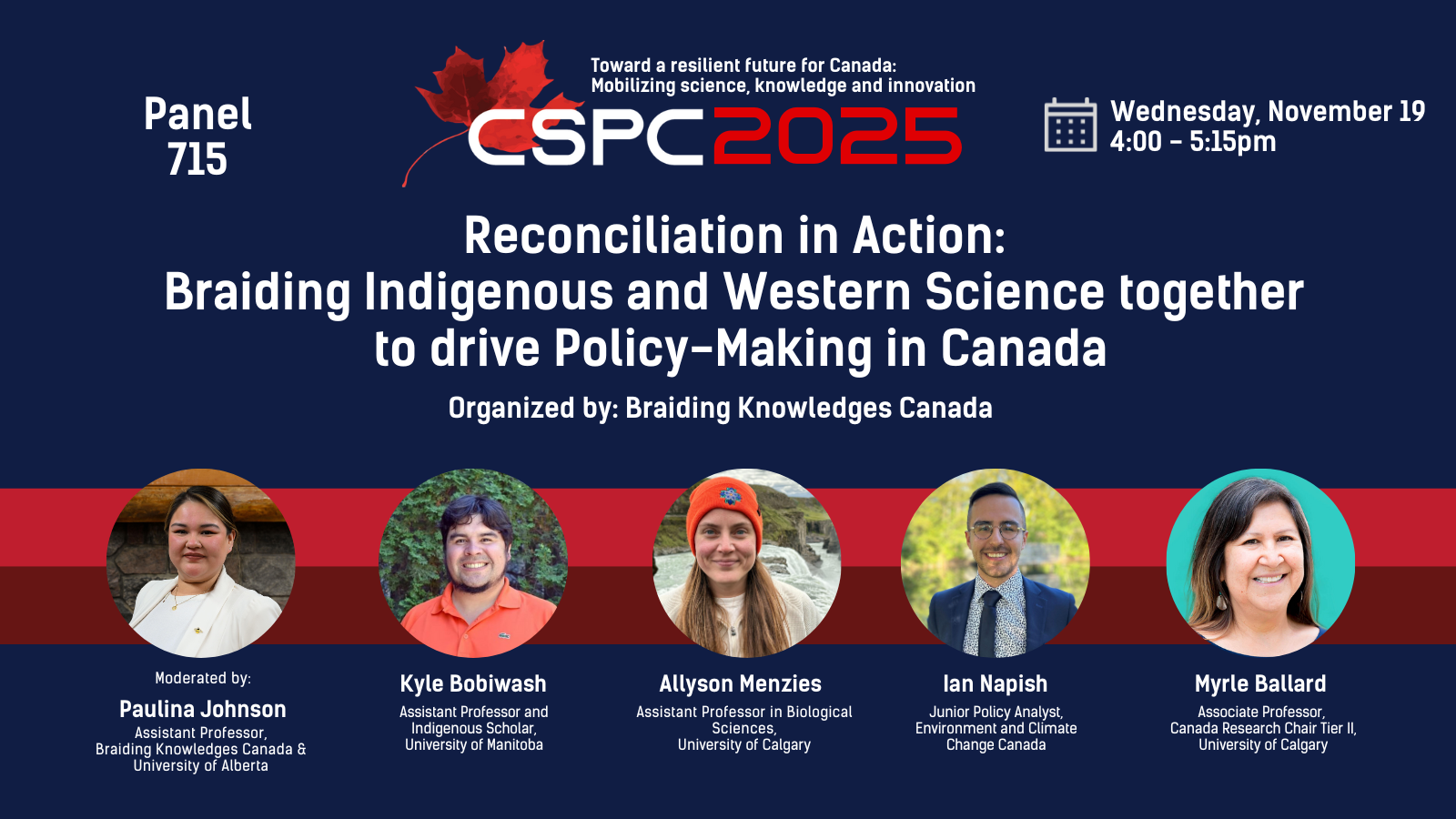
Abstract:
Indigenous Science offers the ability to learn through various practices that better inform policy and relationships between Indigenous and settler peoples. As Braiding Knowledges Canada, we support Indigenous and Western Science, bringing dynamic perspectives to create a more sustainable future. Our initiatives braid these sciences to improve dialogue across disciplines and to incorporate the unique perspectives of Indigenous communities across Canada. We share ways to bring these sciences together, including the challenges, to inform policy through our mandates towards Reconciliation. From our Knowledge Hubs to Impact Connectors, we share how the research we support informs policy for a resilient tomorrow.
Summary of Conversations
The discussion centered on integrating Indigenous and Western science, often referred to as “braiding” knowledge systems, to inform policy and research in Canada. Panelists, working in areas like environmental science, wildlife ecology, and agro-ecosystems, shared their work emphasizing the importance of relationships, reciprocity, and respect. Indigenous science was described as deeply place-based and tied to values and worldviews, requiring humility and adaptation when working across systems. Key examples included the establishment of a dedicated government division to bridge, braid, and weave knowledges, and community-partnered research empowering local data gathering. The challenge of scaling up localized, context-rooted work to national policy was a recurring theme.
Take Away Messages/Current Status of Challenges
- Difficulties in Scaling Place-Based Knowledge: The inherent challenge of deploying national policy when Indigenous science and knowledge are fundamentally place-based, diverse, and context-dependent.
- Navigating Bureaucratic and Logistical Barriers: Institutional policies, particularly within government, create significant logistical obstacles related to funding, compensation (honoraria), and administrative requirements that conflict with creating a welcoming environment and respecting Indigenous protocols.
- Lack of Policy Capacity for Indigenous Ways of Knowing: The federal public service currently lacks sufficient policy capacity and appropriate pathways to effectively analyze, interpret, and drive evidence-based decision-making from knowledge systems outside of traditional Western science frameworks.
- Systemic Barriers to Indigenous Employee Advancement: Official language policies requiring proficiency in colonial languages (French/English) act as a major barrier to career progression for Indigenous employees, neglecting the value of their ancestral languages which are fundamentally tied to Indigenous science.
- Maintaining Data Sovereignty in New Technology Contexts: The introduction of new technologies, such as Artificial Intelligence (AI) in the workplace, raises critical, unaddressed questions regarding the use, control, and consent for Indigenous data, threatening the integrity of OCAP principles.
- Researcher Fatigue and Navigating Competing Demands: Indigenous and ally researchers face constant pressure to lead advocacy, mentorship, and research while navigating personal, academic, and community responsibilities without a clear guidebook, leading to questions of meaningful impact versus academic benefit.
- Gaps in Knowledge Braiding Capacity and Regulatory Rigidity: Identifying areas, such as regulatory science, where existing Western systems lack the methodologies and conceptual frameworks (e.g., specific apical endpoints) to effectively utilize or weave in Indigenous science, indicating a need for new tools and capacity.
Recommendations/Next Steps
- Prioritize the Hiring and Retention of Indigenous Employees: Implement changes to recruitment and career progression policies to actively increase the number of Indigenous employees and create genuinely welcoming, supportive spaces within government departments.
- Recognize and Support Indigenous Languages in the Workplace: Formally recognize the value of Indigenous languages as assets, providing training time, funding, and potential compensation for their use, thereby supporting the integral link between language and Indigenous science.
- Decolonize and Update Administrative/Financial Policies: Revise government policies on honoraria, participant expenses, and logistics to remove bureaucratic red tape and align administrative processes with Indigenous protocols for respect and reciprocal engagement.
- Implement Transparency and Self-Determination in Research Design: Ensure research questions and themes incorporate both Western and Indigenous concepts from the outset, aligning fundamental assumptions and building hypotheses based on locally relevant Indigenous knowledge systems.
- Establish Relationships and Protocols Before Policy Needs Arise: Develop ongoing systems, committees, and relationships with Indigenous communities to ensure trust and protocols are in place, enabling a more meaningful and accessible engagement when policy or research needs occur.
- Foster Parallel Processes for Policy Development: Advocate for the creation of parallel, transparent processes within the policy sphere that allow for slower, more meaningful relationship-building, inclusion of protocol, and shared authority, especially for high-level regulatory decisions.
- Support Academic Recognition of Differential Outputs: Update promotion and tenure guidelines within academic institutions to formally acknowledge and value the unique, non-conventional outputs and community-driven work resulting from Indigenous-Western science collaborations.
- Utilize Policy to Create Space for Indigenous Science Development: Leverage policy documents (e.g., Scientific Integrity Policy, inclusive science guidelines) to mandate the consideration of Indigenous fundamentals and principles, driving the resourcing and funding needed to develop Indigenous science capacity in areas where it is currently lacking.
* This summary is generated with the assistance of AI tools