
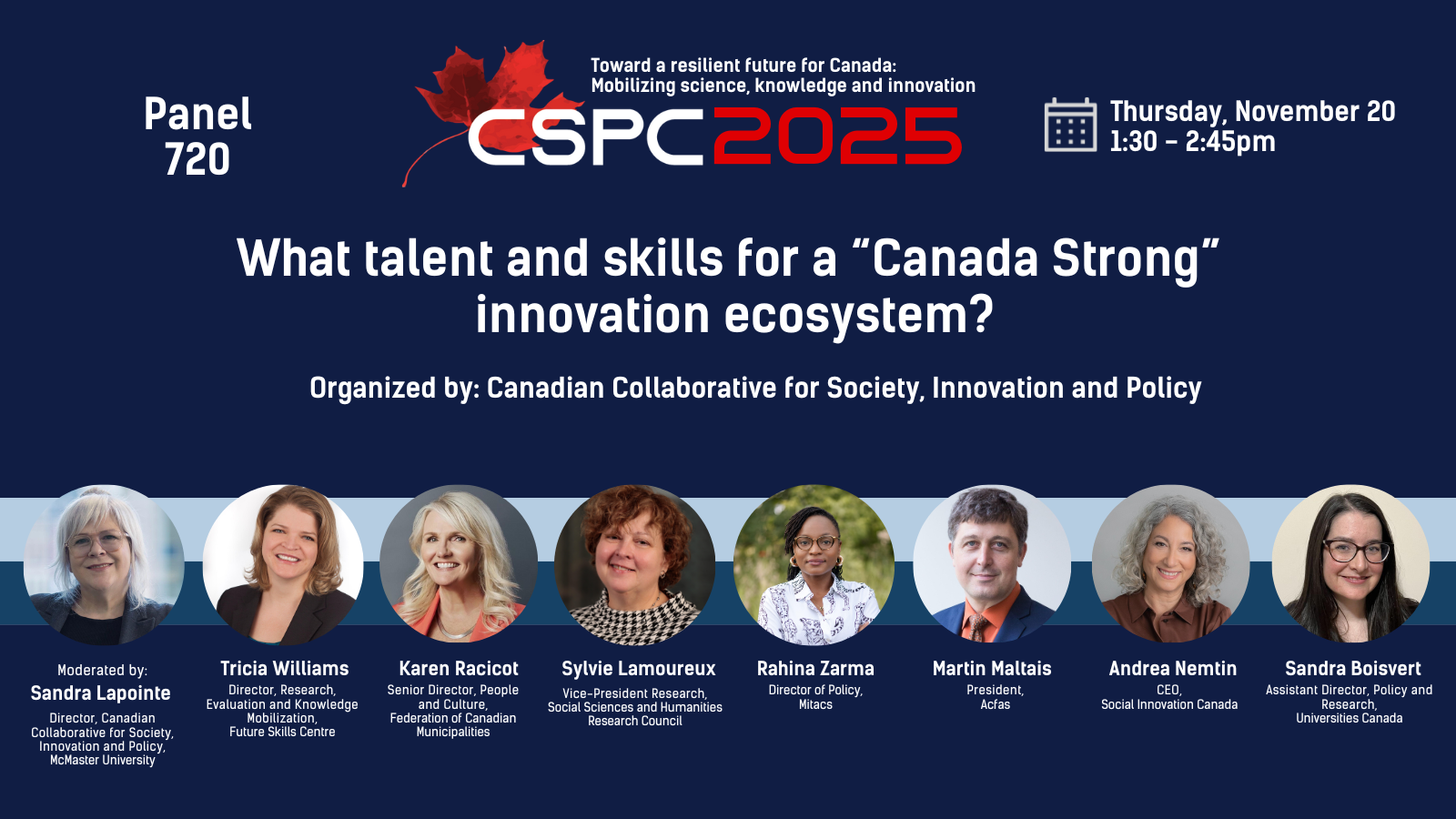
Panel: 720
What talent and skills for a “Canada Strong” innovation ecosystem?
Abstract:
Addressing emerging economic and societal challenges requires approaches to innovation that depart radically from the standard R&D models and are designed to tackle complexity, emergence and uncertainty. But what does this mean for the next generation? What does the focus on mission-oriented innovation mean for research talent? How is experiential learning evolving to meet the skills needs of innovation actors across sectors. How are we building capacity for interdisciplinary and cross-sectoral collaborations to bolster ecosystem intelligence in innovation contexts? These are some of the questions that will guide this roundtable discussion.
Summary of Conversations
The discussion centered on expanding and evolving Canada’s innovation ecosystem to better incorporate social innovation and the nonprofit sector, and bridging the gap between current academic training and the training needed to build the talent needed to support social innovation work and prepare students for diverse careers. Panelists emphasized that innovation requires more than technical expertise; it demands foundational, or transferable skills, such as communication or “multilingualism”, which allow scientists, humanists, and policymakers to communicate and collaborate effectively. A key theme was the misalignment in graduate education, where training prioritizes academic reproduction despite most graduates going into non-academic career tracks. Participants highlighted the necessity of integrating “soft” skills like intercultural awareness, plain language communication, and systems thinking directly into curricula rather than treating them as optional add-ons, which often exacerbates inequality. Social innovation was positioned as equally vital societal advancement, but social innovation and research need to shift from focusing on diagnosing problems to actively prescribing solutions. Examples such as cross-sector housing labs and interdisciplinary energy programs illustrated how breaking silos and fostering inclusivity can drive meaningful prosperity.
Take Away Messages/Current Status of Challenges
- Disconnect Between Training and Workforce Realities: There is a critical mismatch where graduate programs focus on reproducing academics, yet the vast majority of graduates enter non-academic sectors, leaving them ill-equipped with necessary “workforce-ready” skills.
- Silos Impeding Innovation: A significant barrier is the inability of experts from different disciplines (e.g., sciences vs. humanities) to effectively communicate, creating a “linguistic” divide that stifles the multidisciplinary collaboration required for complex problem-solving.
- Undervaluation of Applied Research: The academic culture often prioritizes theoretical outputs over applied, solution-oriented work, creating resistance to “impact-driven” research and discouraging students from pursuing practical problem-solving pathways.
- Diagnostic Bias in Social Sciences: Fields like social sciences and humanities frequently suffer from a “diagnostic bias,” focusing heavily on analyzing problems and critiques rather than developing and proposing long-term, prescriptive solutions.
- Inequity in Skill Development: Reliance on co-curricular activities to teach essential skills (like collaboration or leadership) creates systemic inequity, as only privileged students with financial support and time can access these voluntary opportunities.
- The “Valley of Death” for Implementation: Even when excellent solutions or technologies are developed, they often fail to be adopted because the broader systems, policies, and markets are not primed to integrate these innovations.
- Limited Definition of Innovation: The current innovation discourse overly focuses on STEM and economic growth, neglecting the vital roles of social innovation, the non-profit sector, and the contributions of diverse communities like Indigenous peoples and women.
Recommendations/Next Steps
- Integrate Skills Training into Core Curricula: Institutions must embed essential skills training—such as collaboration, communication, and project management—directly into mandatory degree requirements to ensure equitable access for all students, rather than leaving it as optional.
- Promote Interdisciplinary “Multilingualism”: Education should prioritize teaching students how to translate complex ideas across disciplines, fostering “intercultural awareness” that allows scientists, humanists, and policymakers to work together effectively.
- Expand Graduate Work-Integrated Learning: Universities should aggressively scale work-integrated learning opportunities for graduate students to expose them to real-world contexts and help them build professional networks alongside their research training.
- Shift to Solution-Oriented Research: Academic funding and culture need to pivot towards valuing and incentivizing prescriptive, solution-focused research that addresses real-world challenges rather than solely rewarding theoretical diagnostics.
- Co-Create Programs with Industry and Community: Academic institutions must collaborate directly with industry, government, and non-profits to design programs that reflect current and future labor market needs, similar to the Calgary energy science model.
- Articulate and Validate Transferable Skills: Better career guidance mechanisms are needed to help graduates recognize, value, and articulate the transferable skills they acquire during advanced degrees, such as critical analysis and project management.
- Foster Inclusive Innovation Ecosystems: Strategies must be implemented to actively include and value diverse perspectives, including Indigenous knowledge and French immersion competencies, to broaden the scope and impact of innovation.
* This summary is generated with the assistance of AI tools