
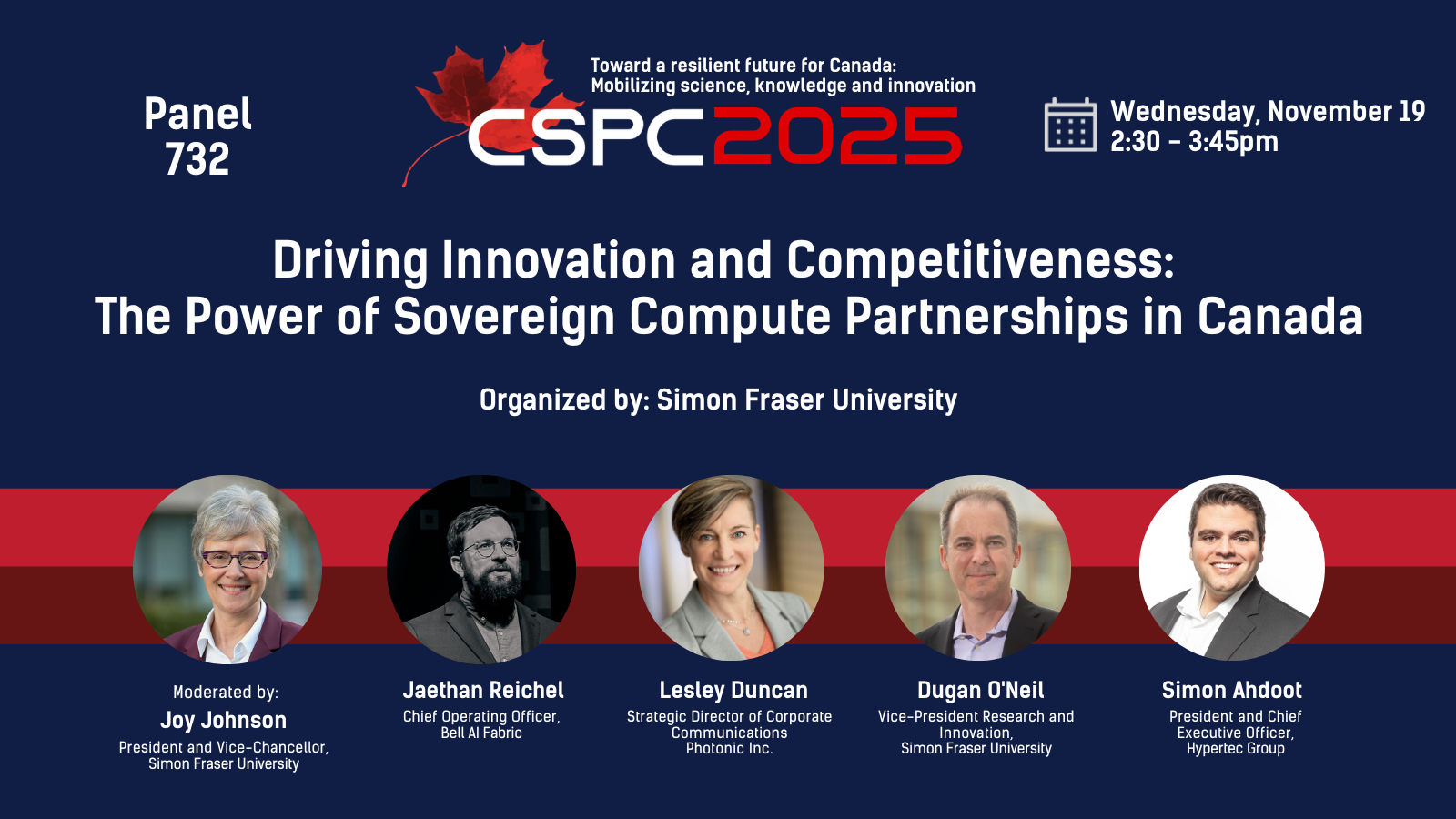
Panel Abstract:
Sovereign compute is key to Canada’s competitiveness in the global innovation economy. After years of fragmentation, Canadian industry, government, and academia are uniting to secure our advantage in AI and quantum. This panel convenes leaders expanding Canada’s capacity to help scale homegrown companies, boost adoption, create jobs, and secure digital sovereignty. Panelists will explore how shared national infrastructure, made-in-Canada innovation, and strategic partnerships are driving competitiveness across sectors—from health to energy, logistics to defense—and enabling a resilient digital economy. Learn how Canada can lead the next wave of technological transformation by building sovereign compute capacity, for Canadians, by Canadians.
Summary of Conversations
The discussion emphasized that building domestic, self-governing infrastructure for advanced computing is vital for national interests, primarily to ensure data privacy and security by preventing Canadian information from being processed under foreign jurisdiction and laws. Although Canada is a global leader in foundational research for artificial intelligence and quantum technologies, the national ecosystem is lagging in the crucial area of commercialization and widespread industrial adoption. Key obstacles include the immense energy requirements for new data centers, a lack of sufficient private capital, and systemic socio-technical challenges such as institutional distrust and regulatory friction that slow down deployment across critical sectors. Strategic public-private collaboration is essential to move beyond the current policy moment and foster a robust domestic supply chain, which includes adopting a balanced ‘buy Canadian’ approach that encourages domestic growth without hindering access to world-class technology.
Take Away Messages/Current Status of Challenges
- Foreign Data Sovereignty Risk: A foundational challenge is that Canadian data, when processed by most current AI tools, is routed to, stored, and processed in foreign data centers, making it subject to foreign laws and creating significant national data security and control concerns.
- Critical Power Shortages and Allocation: Scaling up domestic computing capacity is fundamentally limited by the availability of power; the traditional “first come, first served” approach to energy allocation is being challenged by provinces seeking to prioritize high-value AI infrastructure over low-value uses like cryptocurrency mining.
- Commercialization Gap and Global Competition: Despite Canada’s strong foundation in AI and quantum research, the country is significantly behind international competitors, particularly the U.S., in commercializing and achieving broad industrial adoption of these emerging technologies.
- Socio-Technical and Trust Barriers: Widespread deployment is hindered by non-technical issues, including a lack of trust in new systems, organizational inertia within large institutions, and outdated federal and provincial regulations governing data transit and sharing.
- Capital and Talent Flight Risk: A critical shortage of domestic capital investment and incentives risks the migration of emerging, world-class quantum and AI companies—and their expertise—to more aggressively funded foreign jurisdictions seeking to draw them south.
- Incomplete Sovereign Value Chain: A failure to build and activate the entire domestic AI value chain, from core power and data centers to advanced applications, risks reducing the country to a “tenant” economy that pays continuous “rent” to other nations for foreign-developed AI solutions.
- Quantum Education and Procurement Diligence Gap: The transition of the quantum field from basic science to commercialization is exposing a critical need for education within government and industry to ensure entities understand commercial use cases, make informed procurement decisions, and differentiate between competing quantum computer architectures.
Recommendations/Next Steps
- Establish Strategic Power Partnerships: Immediately and aggressively pursue public-private partnerships to unlock and secure the massive power generation and distribution capacity required to sustain the development and scaling of national AI and compute infrastructure.
- Reform Energy Allocation for Public Benefit: Implement clear policy directives that strategically allocate finite energy resources by prioritizing data center projects that create tangible economic value, innovation capacity, and improved public services for citizens.
- Drive Public Sector Adoption as a Market Creator: The federal and provincial governments should act as the anchor customer by immediately adopting sovereign compute and AI for their own critical use cases, thereby building trust, establishing a guaranteed domestic market, and providing a blueprint for wider industry adoption.
- Leverage Public Procurement as an Accelerator: Public institutions, notably universities, must assume a strategic role as risk-takers by using their procurement power to become the first customer for Canadian technology vendors, helping to de-risk and organically foster the domestic supply chain for compute and storage.
- Implement Policy-Driven Investment Incentives: Create new, effective policy instruments, such as mandatory Industrial and Technological Benefits (ITB) commitments for large public contracts, to compel investment back into the Canadian technology supply chain and fund emerging companies.
- Invest to Build Out Domestic Supply Chain: Actively fund and collaborate to ensure a robust domestic supply chain for both classical and quantum computing, guaranteeing that a Canadian-built option exists for key technologies to prevent total reliance on foreign vendors for critical national infrastructure.
- Prioritize National Education and Knowledge Transfer: Launch a concerted, multi-stakeholder effort focused on educating government, industry, and the public on the practical, commercially-relevant applications of AI and quantum, ensuring diligent procurement and a deep understanding of where these technologies can create superior value.
* This summary is generated with the assistance of AI tools