
Research Investment and Scientific Output: Canada’s Place in the Global Innovation Landscape
Author(s):
Hamed Taherdoost

Disclaimer: The French version of this text has been auto-translated and has not been approved by the author.
Research investment and scientific publication output are widely recognized as essential drivers of national innovation, economic competitiveness, and societal advancement. Countries that strategically allocate resources to research and development (R&D) often demonstrate higher rates of technological innovation, patent generation, and knowledge production, which in turn foster industrial development, address societal challenges, and support evidence-based policymaking. According to the Organization for Economic Co-operation and Development (OECD), gross domestic expenditure on R&D (GERD) is a critical indicator of a country’s commitment to innovation. Nations with consistent and high R&D investments, such as South Korea, Israel, and the United States, tend to lead in scientific output, global innovation indices, and commercialization of research outcomes (Figure 1) [1].
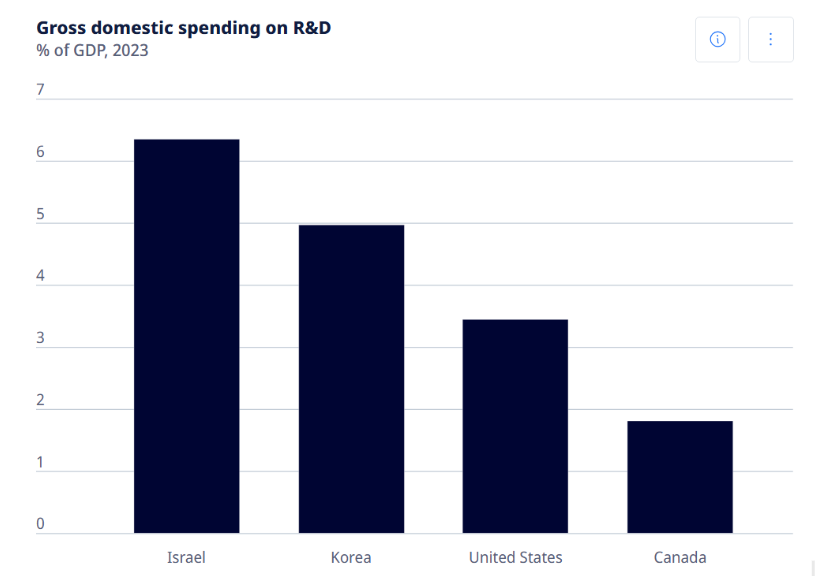
Figure 1. Gross Domestic Spending on R&D
Scientific publications serve as a tangible outcome of research activities and reflect both the volume and impact of scholarly work. Metrics such as the number of peer-reviewed publications, citation counts, and field-weighted citation impact (FWCI) provide insight into a country’s research performance and global visibility [2]. These metrics are especially important in evaluating the effectiveness of public and private research funding and are used by governments and institutions to benchmark national progress against international standards [3].
Canada, known for its robust higher education sector and public research funding mechanisms, has long invested in science and innovation. However, its performance in recent years has prompted debate, particularly around the stagnation of R&D intensity and the country’s position relative to global leaders. While Canada consistently performs above the world average in citation impact, its R&D spending as a percentage of GDP remains below the world average, raising questions about funding efficiency and long-term sustainability (Figure 2) [4,5].
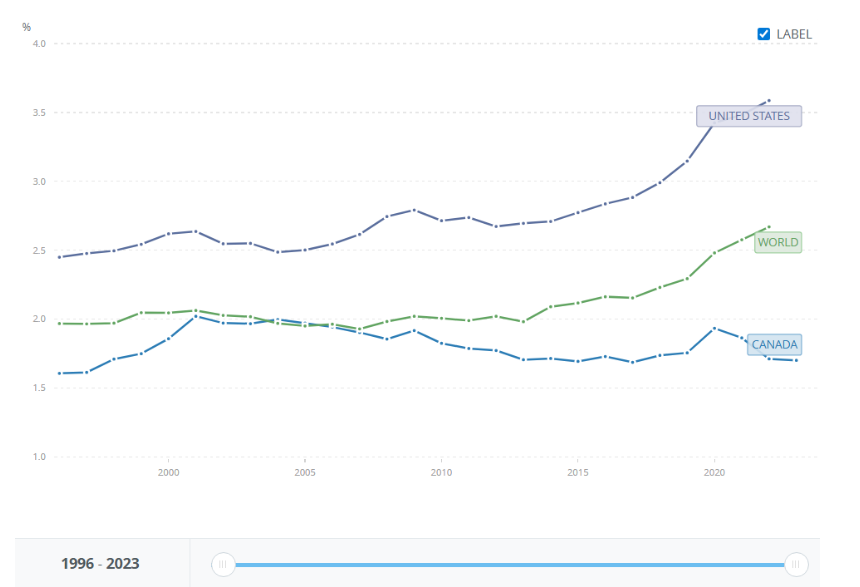
Figure 2. Gross domestic expenditure on R&D (GERD) as a percentage of GDP, 1996–2023, for Canada, the United States, and the World
If research investment and scientific publishing are key drivers of innovation and economic growth, why is Canada, despite its strong academic institutions and talented researchers, falling behind global leaders in R&D spending and output? And what does this mean for the country’s future competitiveness on the world stage?
Research Funding Trends by Country
Global R&D funding has grown significantly, with countries increasingly investing in science and technology to drive innovation. R&D expenditure as a percentage of GDP is a key indicator of national commitment to knowledge and technological progress [1]. Leading investors include the United States, China, and Japan, while countries like Israel and South Korea consistently allocate over 4% of their GDP to R&D, among the highest globally [5].Driven by both public and private sectors, global R&D spending continues to rise, with an average of around 2.3% of GDP (OECD, 2024b). High-investment countries dominate in publications, patents, and innovation output.
Canada, in contrast, spends about 1.7% of its GDP on R&D, below the OECD average. In 2022, its gross expenditure on R&D (GERD) was approximately CAD 38 billion, with over 30% coming from government sources [5]. While Canada invests significantly in areas like health, AI, and environmental technologies, private sector participation lags behind that of innovation leaders such as South Korea and the United States (Figure 3) [4].
Canada’s reliance on government funding, coupled with weaker public-private collaboration, results in lower overall R&D intensity compared to nations where private investment plays a more dominant role.
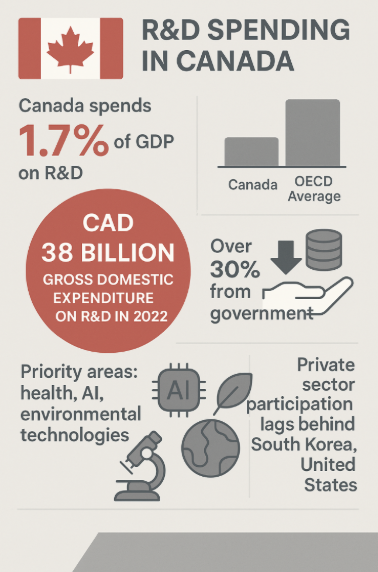
Figure 3. R&D Spending in Canada
Scientific Publication Trends (Canada vs. Global)
Globally, the total number of scientific publications has consistently increased [2]. This rise in publications reflects the growing investment in research and development (R&D) by both public and private sectors worldwide.
Canada has shown a steady growth in its scientific publication output over the past decade. According to data from Scopus, Canada’s number of publications increased significantly from 92,987 in 2010 to 135,701 in 2022, with a notable growth trend from 2019 to 2021.
The total number of publications in Canada reached 73,539 in 2025 (projected), with 133,776 in 2024, and 132,054 in 2023 (Data Extracted from Scopus). This growth is consistent with global trends but reflects a period of higher productivity over the last 5-6 years, especially in health sciences, engineering, and social sciences.
While Canada’s research output is impressive, it remains smaller in comparison to global giants like the United States and China, which produce a significant share of the world’s scientific publications. For instance, the United States published more than 700,000 articles in 2022, while China surpassed 1,000,000 articles (Data Extracted from Scopus). However, Canada has seen a consistent rise in its annual publications, surpassing the growth rate of global publication output, especially in sectors like biomedical sciences, sustainability, and AI (Figure 4).
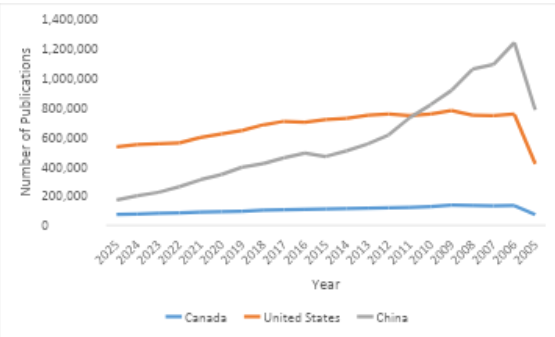
Figure 4. Number of Publications from 2005-2025 in Canada, United States and China
Discussion
The global research landscape is becoming increasingly competitive, with innovation central to national strategies. While Canada has historically maintained a strong research presence, its momentum is slowing. Research output peaked in 2021 but is now projected to decline to levels seen a decade ago, reflecting deeper structural and funding challenges.
A significant concern is the disproportionate allocation of government research funding to the U15 Group of Canadian Research Universities, leaving private and non-traditional institutions under-resourced. This concentration may limit innovation diversity and exclude emerging contributors.
Canada’s R&D funding has also stagnated. Government Budget Allocations for R&D (GBARD) declined from a peak index of D110.4 in 2020 to D102.3 in 2022 [6], and national R&D spending remains below 2% of GDP, lagging behind countries like Germany and China (World Bank, 2024).
These trends place excessive pressure on public universities and limit Canada’s ability to adapt to emerging sectors like AI, green technology, and healthcare. A more balanced innovation strategy would involve redistributing funds to include non-traditional institutions, incentivizing private sector R&D, ensuring funding stability, and promoting inter-sectoral mobility.
Canada has the talent and partnerships to lead in global research, but a strategic shift in funding priorities is essential to remain competitive and inclusive in a rapidly evolving innovation landscape. Without targeted investment and structural reforms, Canada risks falling further behind its global peers, undermining both economic growth and societal resilience in the face of future challenges.
References
[1] OECD. (2024a). Main Science and Technology Indicators: R&D Expenditure. Retrieved from https://stats.oecd.org/Index.aspx?DataSetCode=MSTI_PUB
[2] Elsevier. (2020). Research Performance Metrics: A Global Perspective on Scholarly Output and Impact. Retrieved from https://www.elsevier.com/research-intelligence/resource-library/research-performance-metrics
[3] UNESCO. (2021). UNESCO Science Report: The Race Against Time for Smarter Development. Retrieved from https://unesdoc.unesco.org/ark:/48223/pf0000377433
[4] OECD. (2024b). Gross domestic spending on R&D (indicator). doi: 10.1787/d8b068b4-en
[5] World Bank. (2024). Research and Development Expenditure (% of GDP). Retrieved from https://data.worldbank.org/indicator/GB.XPD.RSDV.GD.ZS
[7] OECD. (2024). Main Science and Technology Indicators (MSTI Database). Retrieved from https://stats.oecd.org/Index.aspx?DataSetCode=MSTI_PUB
More on the Author(s)
Hamed Taherdoost
University Canada West
Associate Professor & Chair of RSAC