
The Missing Pillar: AI for All Funds Trust Signals, Not Trustworthiness
Author(s):
Jean-Christophe Bélisle-Pipon, PhD

Disclaimer: The French version of this text has been auto-translated and has not been approved by the author.
Canada’s new National AI Strategy declares that trust is its north star. On this, the government is right: nothing else in the document works without it. AI for All is candid about the problem. Canadians rank 42nd of 47 countries on trust in AI systems and 44th on AI literacy, and business adoption sits at 12 percent. The strategy’s response is a causal chain stated with unusual clarity: for Canadians to benefit from AI, they must use it; to use it, they must trust it.
Read that sequence again. Trust appears as an input, something to be built so that adoption can proceed. What the strategy never asks is the prior question: what would make Canadian AI worthy of trust in the first place? Trust manufactured ahead of trustworthiness is not confidence, it is rather exposure (see Figure 1).
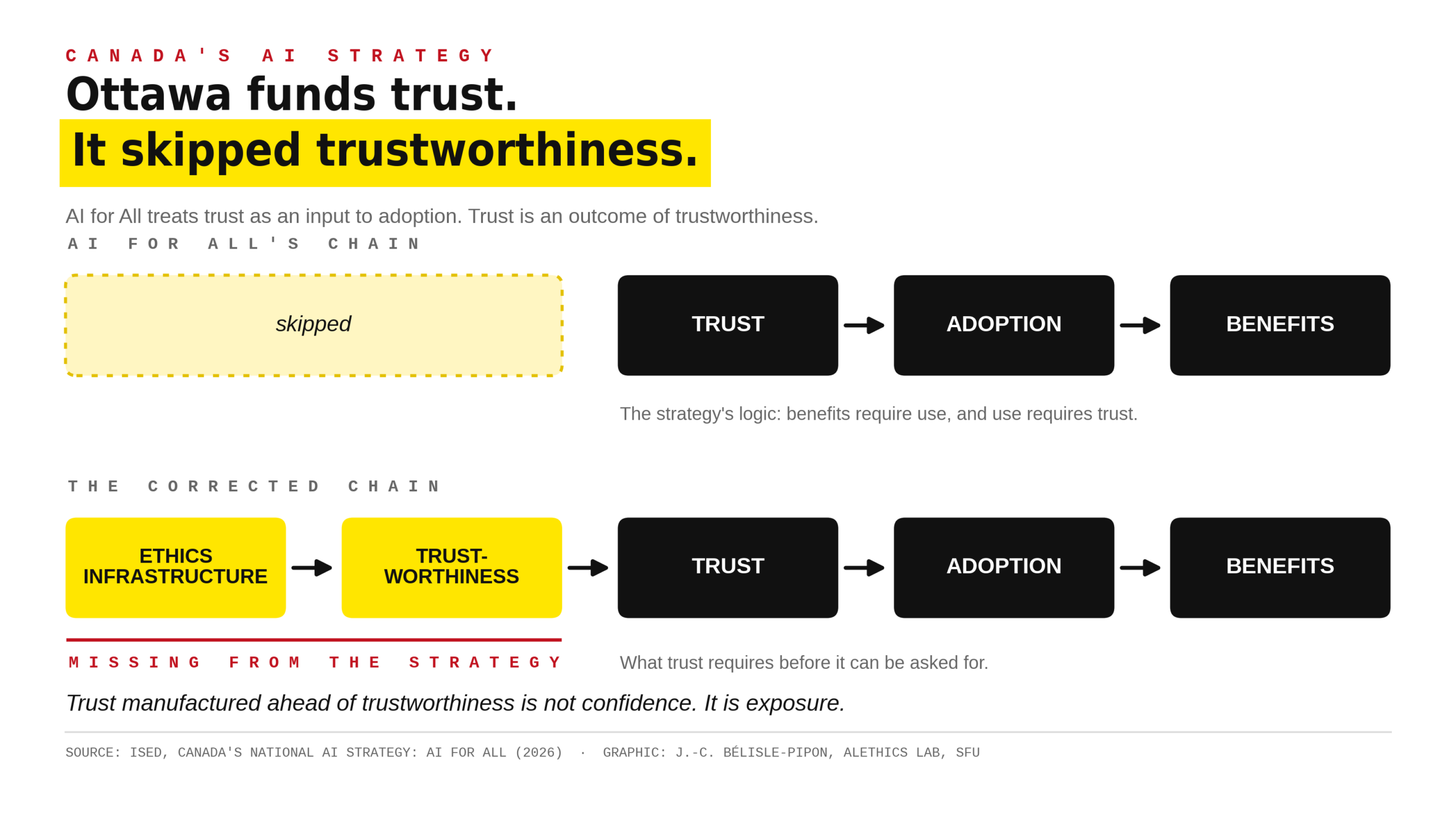
Figure 1
To its credit, the strategy funds real protective instruments. Fifty million dollars expands the Canadian AI Safety Institute. A Trusted AI Certification program will help Canadians identify trustworthy products in the marketplace. Online safety legislation (Bill C-34) and privacy modernization (Bill C-36) are now before Parliament. Watermarking, standards renewal, incident reporting: the checklist is serious. But every one of these is a trust signal, an instrument that attests to trustworthiness. Signals are only as good as the substance behind them.
I call the failure mode vibe compliance: organizations producing the artifacts of responsibility, the certifications, safety plans, dashboards, and principle statements, without the underlying practices, and accumulating what I have described as ethical technical debt, which compounds quietly until it is called in. A certification program can verify substance or laminate appearance. Which one Canada gets depends on infrastructure the strategy never mentions.
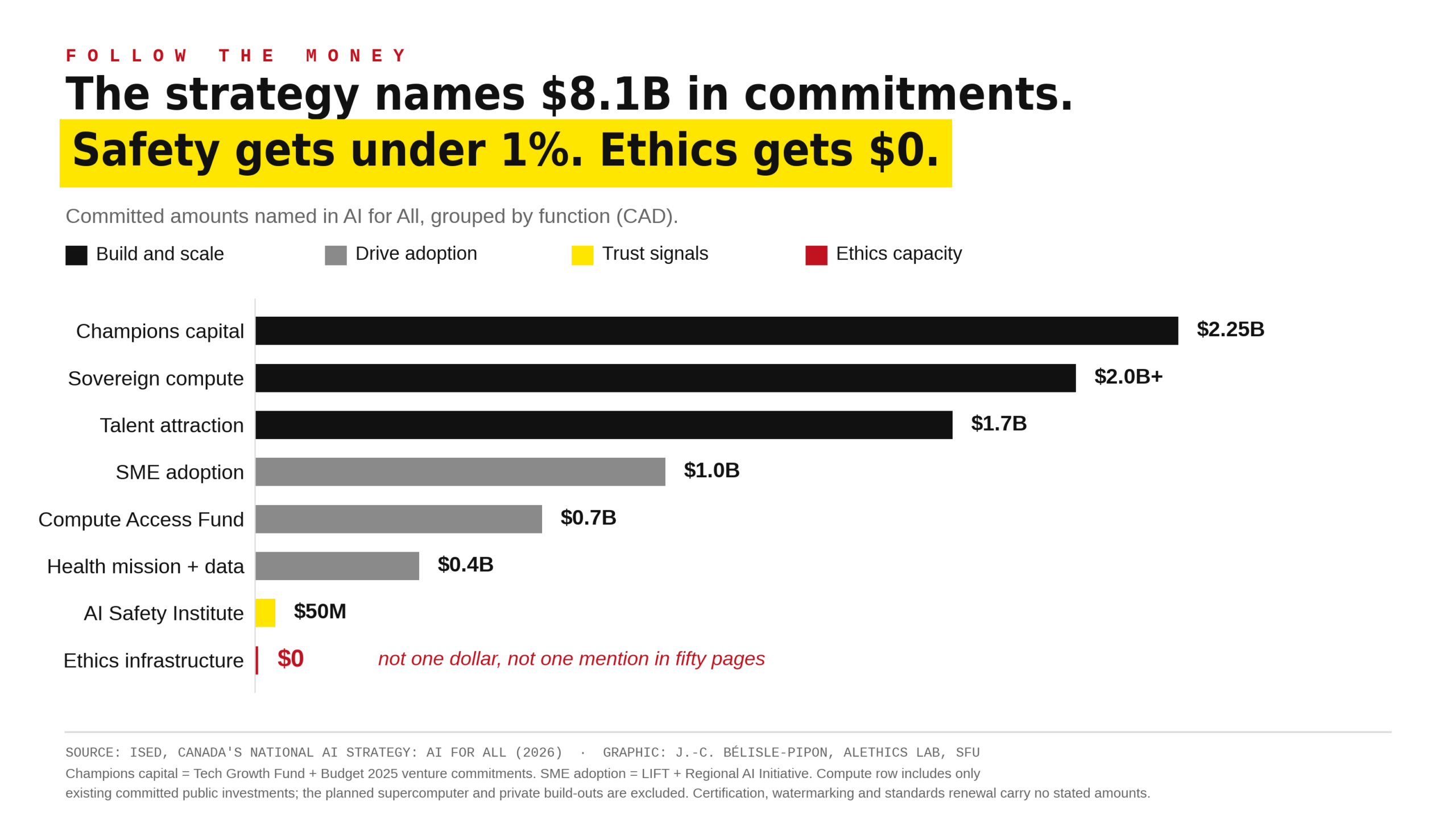
Figure 2
Count what AI for All funds (see Figure 2). Billions in compute: a world-leading supercomputer, 850 megawatts of sovereign capacity scaling toward 2.3 gigawatts, over a billion dollars in SME adoption supports, a national literacy initiative reaching a million students,a $200 million health mission and $200 million more in health data spaces. Now count the funding for ethics capacity: the people, processes, and standing bodies that determine whether a deployment is appropriate, whose values an evaluation encodes, and how harms surface and get acted upon. The number is zero. Research ethics boards, which will absorb the shock of AI-scale health data mobilization, are not mentioned once in fifty pages. Neither is any standing ethics advisory architecture for implementation. Genomics learned this lesson a generation ago and normalized dedicated funding for ethical, legal, and social implications research. Canada’s AI strategy has unlearned it.
The health mission makes the gap concrete. The strategy’s flagship example is CHARTWatch, an early-warning system at St. Michael’s Hospital associated with a 26 percent drop in unexpected ward deaths. That is a genuinely important result. But mortality is the easiest thing to count. A universal health system also owes patients dignity, communication, and the felt experience of being cared for, and the word compassion does not appear anywhere in a strategy whose first mission is healthcare. Elsewhere, the strategy celebrates an open-source AI scribe scaling from Alberta emergency rooms toward national rollout, with physicians seeing up to 20 percent more patients per shift, and attaches no governance framework to it: no consent standard for recorded consultations, no answer to the question patients now ask me in every venue where I discuss these tools: where does my voice go, to which server, in which country?
The adoption targets sharpen the risk. Sixty percent business adoption by 2034; government as anchor adopter of Canadian AI. Targets without appropriateness criteria create institutional pressure to deploy, including where deployment is the wrong answer. Adoption is not neutral: it redistributes outcomes, which is why I have argued that algorithmic systems should be treated as determinants of health in their own right. A strategy that measures adoption but never appropriateness will get adoption. Whether it gets better care, better services, and better work is a separate question the document treats as settled.
Then there is the legitimacy of evaluation itself. The Safety Institute will conduct transparent evaluations of AI models. Transparent to whom, against whose standards? When my colleagues and I analyzed how the world’s major AI ethics guidance documents were produced, only 38 percent reported any stakeholder engagement, and the private sector engaged least. If CAISI’s (U.S. Center for AI Standards and Innovation’s) benchmarks and the certification criteria are written the same way, behind closed doors by technical insiders, they will inherit precisely the legitimacy deficit that put Canada 42nd on trust to begin with.
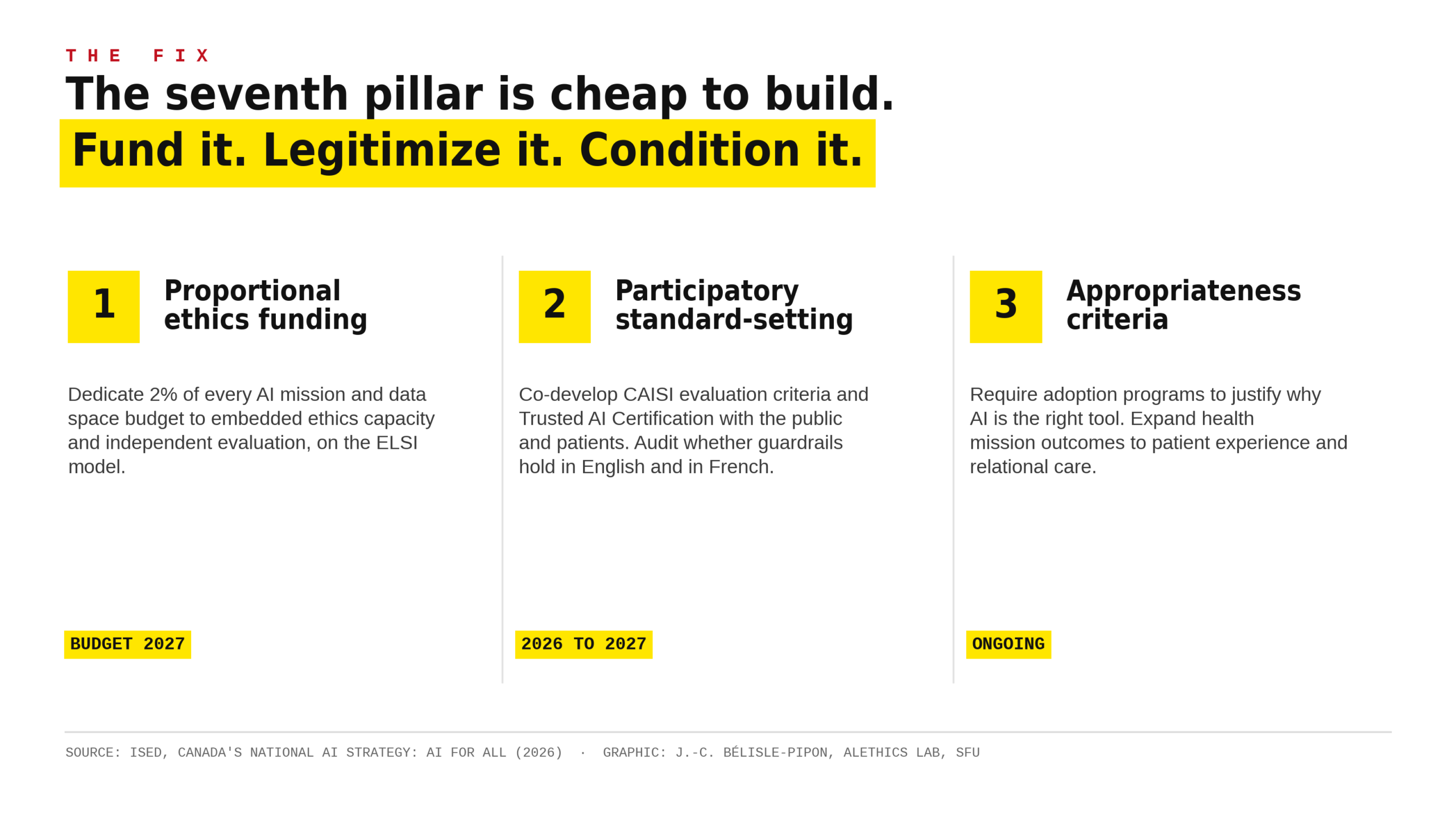
Figure 3
None of this requires a rewrite. It requires a seventh pillar (See Figure 2), and it is cheap relative to compute. Three commitments would build it (See Figure 3). First, proportional ethics funding: dedicate a fixed share, even two percent, of every AI mission and data-space budget to embedded ethics capacity, governance design, and independent evaluation. Second, participatory standard-setting: develop CAISI evaluation criteria and Trusted AI Certification requirements through documented public and patient engagement, in both official languages, and audit whether safety guardrails actually hold in French, since the strategy promises that government AI will perform equally well in both languages and someone must verify the claim. Third, appropriateness criteria: require every adoption program to justify why AI is the right tool for the context, and expand the health mission’s outcome measures beyond mortality to include patient experience and the relational quality of care.
The strategy insists that trust is not a brake on innovation but the foundation of confident adoption. Agreed. But foundations are designed, inspected, and maintained by people whose job it is to do so. AI for All has funded the tower and forgotten the inspectors. Six pillars can carry a great deal of weight. What they cannot do is stand in for the missing one.
Sources
- ISED, Canada’s National Artificial Intelligence Strategy: AI for All (2026): https://ised-isde.canada.ca/site/ised/en/canadas-national-artificial-intelligence-strategy-ai-all
- Gillespie, Lockey, Ward, Macdade and Hassed, Trust, Attitudes and Use of Artificial Intelligence: A Global Study 2025, University of Melbourne and KPMG (DOI 10.26188/28822919): https://mbs.edu/faculty-and-research/trust-and-ai and https://kpmg.com/ca/en/home/media/press-releases/2025/06/study-shows-canada-among-least-ai-literate-nations.html
- Bill C-34 (Safe Social Media Act, chatbot duties), analyses: https://www.michaelgeist.ca/2026/06/everything-all-at-once-bill-c-34-combines-platform-duties-a-kids-social-media-ban-ai-chatbot-regulation-and-a-powerful-digital-safety-commission-into-a-risky-trust-us-bet/ and https://www.torys.com/our-latest-thinking/publications/2026/06/bill-c-34
- Bill C-36 (privacy reform tied to the strategy’s goals), analysis: https://mcmillan.ca/insights/publications/canada-proposes-major-reforms-to-federal-laws-governing-privacy-ai-chatbots-and-other-online-services/
- Verma et al., Clinical evaluation of a machine learning based early warning system for patient deterioration, CMAJ 2024;196(30):E1027 to E1037: https://doi.org/10.1503/cmaj.240132
- Bélisle-Pipon, Monteferrante, Roy and Couture, Artificial intelligence ethics has a black box problem, AI and Society: https://doi.org/10.1007/s00146-021-01380-0
- The Epidemiology of Artificial Intelligence (preprint; AI as an algorithmic determinant of health): https://arxiv.org/abs/2604.14086
- Radio-Canada Panorama, IA en consultation médicale (Nov 2025): https://ici.radio-canada.ca/ohdio/premiere/emissions/panorama/segments/rattrapage/2236004/ia-et-transcription-rendez-vous-medicaux-jean-christophe-belisle-pipon
- NHGRI ELSI Research Program: https://www.genome.gov/Funded-Programs-Projects/ELSI-Research-Program
- Context: Khawaja and Bélisle-Pipon, Your robot therapist is not your therapist (2023): https://www.frontiersin.org/journals/digital-health/articles/10.3389/fdgth.2023.1278186/full; Tumbler Ridge governance vacuum op-ed: https://theconversation.com/danger-was-flagged-but-not-reported-what-the-tumbler-ridge-tragedy-reveals-about-canadas-ai-governance-vacuum-276718; digital compassion (with Rouleau): https://doi.org/10.1080/15265161.2025.2525776