
AI for All Means Designing a National Policy that works for Industry Leaders, Government, Academia, and Civic Society
Author(s):
Dr. Vidhi Thakkar

Disclaimer: The French version of this text has been auto-translated and has not been approved by the author.
Artificial Intelligence is a new technology that has further developed in 2026. With the emergence of new tools such as Co-Pilot, Claude, and Chat GPT, executive leaders, policymakers, academic leaders and government partners are still learning how to use it effectively. AI is no longer confined to university research laboratories; it is rapidly becoming part of the infrastructure through which governments deliver services to citizens. Canada’s National AI Strategy-AI for All- recently released by Minister Evan Solomon, is a $2.3 billion dollar plan or framework that focuses on 6 core pillars:
1) Protecting Canadians & safeguarding democracy;
2) Empowering Canadians: expanding access to AI education and training for high-quality jobs;
3) Powering shared prosperity: targeting the adoption AI among small and medium sized enterprises (SMEs) that can transform public service;
4) Scaling Canadian champions: seeing to unlock growth capital to help scale leading Canadian AI companies; and
5) Building trusted partnerships and global alliances (1).
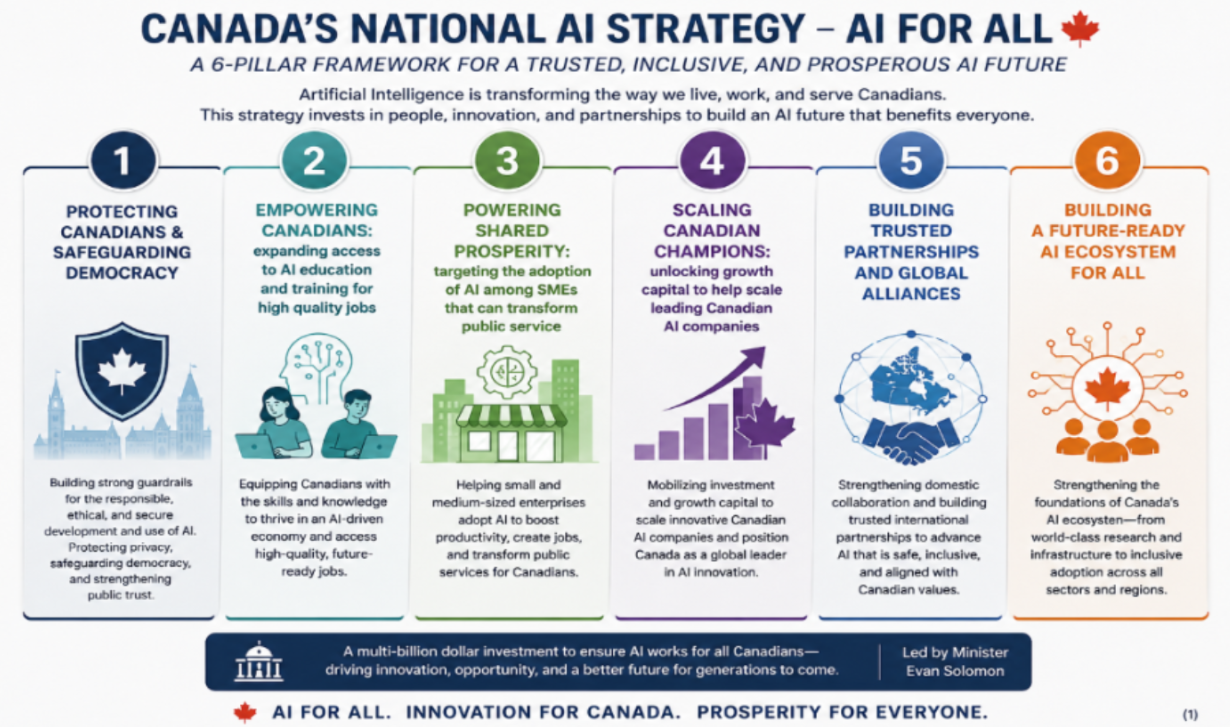
Figure 1. Canada’s National AI Strategy, AI for All, and its six core pillars.
Source: Adapted by the authors from Government of Canada (2026).
Minister Solomon’s vision recognises AI not simply as an economic opportunity, but as a defining force shaping Canada’s competitiveness, sovereignty, and social and economic well-being. The strategy’s six pillars demonstrate that Canada understands the multidimensional nature of AI. Recent investments in hospitals, new medical programs in BC and Ontario, and health-sector technology initiatives demonstrate the value of computing infrastructure, commercialization, talent development, adoption, and governance (1,2). Beyond the technology, public trust acknowledges that leadership in AI requires more than scientific excellence – it requires coordinated national capability with executive leaders across many sectors in higher education, academia, government, and healthcare.
Ambition alone will not determine the success of this federal strategy. The question Canada must now answer is not whether we can develop world-class AI, but whether we can develop AI that meaningfully improves the lives of Canadians, while preserving the democratic values upon which our society depends.
Empowering Canadians from Industrial Leadership to Citizen Adoption
Canada has a long-standing history of AI innovation. Canadian institutions and industry have helped build the scientific and commercial foundations of modern AI, supported by growing sovereign AI infrastructure and partnerships such as TELUS’s investment in Canadian AI capacity (2, 3). Canadian universities such as the University of Waterloo and University Canada West have also contributed to the broader research ecosystem by supporting talent development, interdisciplinary research, and digital innovation.
Ironically, while Canada became a birthplace of AI innovation, many of the economic benefits have flowed elsewhere. Compared with Canada, the United States and Europe have been more successful in translating AI research into large-scale commercialization and adoption because of their deep capital markets, strong research ecosystems, and highly skilled workforces. The United States has led in commercialization and platform scale, while Europe has increasingly positioned itself as a strong application and implementation ecosystem (4, 5, 6). Canadian discoveries have often matured into products commercialized outside the country, highlighting a persistent gap between research excellence and industrial scale.
The renewed strategy rightly places commercialization and adoption at the center of national priorities. However, commercialization should not be measured solely by the number of startups or venture capital investments. True AI leadership means widespread adoption across healthcare, public administration, education, manufacturing, natural resources, and small and medium-sized enterprises.
The greatest value of AI may ultimately emerge not from creating the next global technology giant, but from enabling thousands of Canadian organizations to become significantly more productive, innovative, and resilient.
The Missing Layer: AI Capability
One challenge deserves greater national attention at the federal and provincial policy level. Canada often discusses AI infrastructure, regulation, and innovation separately. What remains underdeveloped is a comprehensive strategy for AI capability building and training people in an organization. Technology alone does not transform organizations. People and leaders within organizations play a critical role in teaching others how to use AI effectively to streamline workflows. For example, in the United States Claude Corps by Anthropic is offering a 12-month full-time program for any citizen to learn AI and it pays US citizens $85,000 a year, paid out bi-monthly (7). Their policies might also be dangerous in some ways and require more ethical review. My question to our federal and provincial governments is this: Why are Canadian companies not offering these types of amazing training programs to our citizens to enable AI capability? Clearly, we are as advanced as the United States, or perhaps we need to catch up when we have the financial and economic infrastructure to do so.
Across government departments, universities, hospitals, municipalities, and private industry, many organizations are struggling with AI literacy, governance, implementation, procurement, and workforce readiness. Leaders are expected to make strategic AI decisions with limited knowledge of AI risks, opportunities, and organizational implications.
This capability gap represents perhaps the greatest barrier to successful adoption, and only increased knowledge, skills and competencies of Canadian citizens can solve this gap. National investment should extend beyond technical talent to executive education, interdisciplinary professional development, and organizational transformation. Canada requires not only AI engineers, but also AI-literate executives, healthcare leaders, educators, policy analysts, project managers, regulators, and public servants who can responsibly integrate AI into complex systems. In many respects, Canada’s AI future depends as much on leadership capability as technological capability.
Public Trust Is Canada’s Strategic Advantage
Global competition is increasingly framing AI as a technology arms race, much like the United States experienced a race to put a man on the moon. Private universities should also benefit from the federal, provincial, and local funding opportunities. Research investments could translate into AI adoption and strategy building within organizations. However, this time, in this technological evolution, Canada has an opportunity to lead differently, in a way that will benefit all our citizens. Rather than competing solely on computational scale or market capitalization, Canada can distinguish itself through trustworthy AI grounded in transparency, accountability, inclusion, and public values of the ethical use of AI.
Trust is often viewed as a regulatory constraint. Rather yet, trust in the public’s ethical use of AI should be seen as a competitive advantage. Boards and executive leaders in higher education, healthcare, and other industries can create organizations that earn public confidence and trust. These will be the companies that will be better positioned to deploy AI in sensitive domains such as healthcare, justice, education, immigration, and public administration. The public and citizens are far more likely to embrace AI when they understand at a basic level, how systems operate, how decisions are made, and how accountability is maintained.
Public trust cannot be legislated into existence. Public trust is earned through responsible federal and provincial governance, meaningful stakeholder engagement, partnership building, rigorous evaluation, and continuous commitments to transparency.
Complete list of authors: Dr. Vidhi Thakkar, Priyanka Sharma, Dr. Sandra Song, Dr. Vahideh Baradaran, Dr. Mohsen Ghodrat, Dr. Amirhossein Zaji, Dr. Raaj Tiagi, Dr. Mustafa Ornek, Dr. Ali Khazraei, Dr. Amit Kholi
Institutional Affiliation: University Canada West