
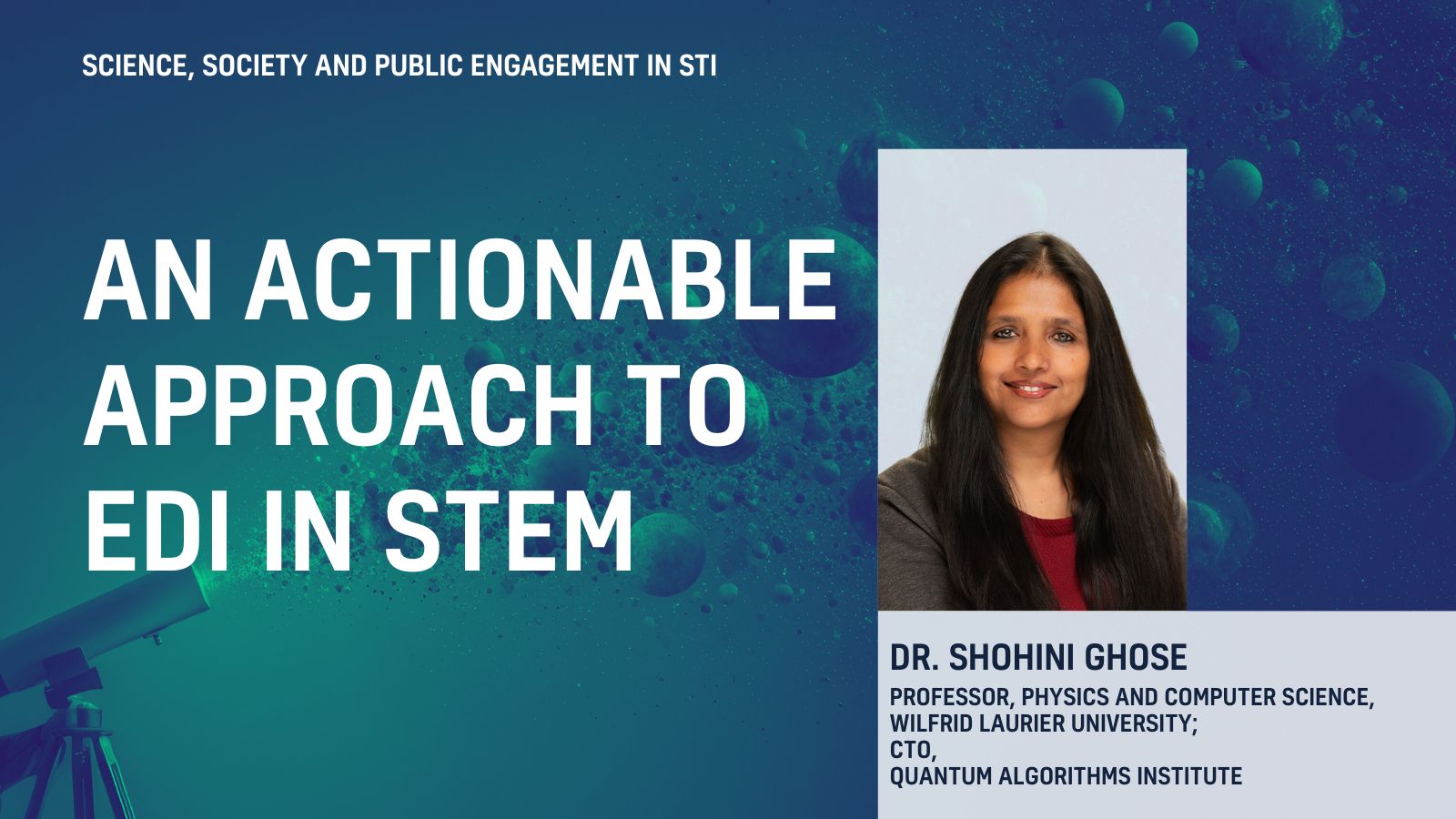
An actionable approach to EDI in STEM
Author(s):
Dr. Shohini Ghose
Wilfrid Laurier University
Professor, Physics and Computer Science
Quantum Algorithms Institute
CTO
Disclaimer: The French version of this text has been auto-translated and has not been approved by the author.
Science has never been just about equations on a blackboard or experiments in a lab. It has always been about people—who funds it, who it benefits, and who it leaves behind. As we charge ahead with artificial intelligence, gene editing, quantum computing, and green technologies, the question is not only what can we invent? but how do we invent, why do we invent and who gets to invent?
These questions centre equity, diversity, and inclusion (EDI) in STEM, not as buzzwords, but as the foundation for science that earns public trust and unlocks societal benefit. Let’s be clear: participation in and access to STEM is a human right. Article 27 of the UN Universal Declaration of Human Rights enshrines the right to participate in the cultural life of the community, including the arts and sciences. The pursuit of knowledge and the effort to understand the laws of the universe is a shared human endeavor and an integral part of our cultural life. Newton’s laws apply universally no matter who we are. Every person has the right to participate fully in science and innovation, regardless of gender, race, disability, class, or geography.
Science that excludes or marginalizes people is not only unjust, but also weaker. Take AI systems that misidentify Black faces, medical trials that exclude women and minorities, or green technologies priced out of reach for low-income households. These are not technical glitches but failures of imagination and inclusion. If the same narrow demographics and biases dominate labs, boardrooms, and policy tables, we shouldn’t be surprised when the outcomes don’t serve everyone. However, there is a danger in the argument that EDI results in better science. This often leads to EDI being justified not in terms of human rights, but in terms of organizational performance: “diverse teams are more innovative,” “inclusive workplaces boost productivity,” “equity improves the bottom line.” Even when these claims are backed by evidence, they undermine the cause of access to STEM as a human right. The danger is that EDI in STEM becomes conditional and embraced only when it “pays off”. But equity and inclusion are not strategies for better profits or patents; they are matters of justice and democracy. EDI is not conditional, transactional, or negotiable. Reducing it to a business case strips it of moral weight and risks abandoning it when the numbers don’t add up. True inclusion in STEM must allow for the option of failure or mediocrity, not just success and excellence. Just like our right to freedom or privacy does not depend on our workplace performance, our right to participate in STEM cannot be contingent on our IQ or our productivity.
It’s important to acknowledge that despite our right to engage in STEM, there remains a lack of diversity in the STEM community around the world. Decades of well-intentioned efforts such mentoring programs, professional development workshops, or leadership training for women and underrepresented groups have not delivered systemic change. That is disappointing but unsurprising. These measures largely focus on “fixing the individual” rather than the system. They imply that women, racialized scientists, or disabled researchers simply need more confidence, better networking skills, or additional training. In reality, the problem lies in biased structures: unequal pay, exclusionary hiring practices, hostile climates, and evaluation systems that discount community-engaged or interdisciplinary work. Mentoring may help individuals navigate hostile environments, but it does little to dismantle the hostility itself. Professional development polishes résumés, but it cannot substitute for equitable hiring, pay, and promotion practices. Until institutions change the rules of the game, asking marginalized scientists to keep playing harder will not create justice.
So how do we move beyond symbolic gestures and aspirations to real change? By building on decades of research and scholarship and creating an evidence-based framework. At the Laurier Centre for Women in Science, we work to integrate past research with our own data and findings to develop an actionable roadmap for promoting EDI in STEM through Compensation, Hiring, Action, Responsiveness, and Transformation (CHART).
- Compensation: Work with qualified experts to review compensation practices and ensure those from under-represented groups are paid fairly for their contributions. Token “volunteer consultation” entrenches inequity.
- Hiring: Diversity begins with who gets through the door. Review hiring and promotion practices and implement evidence-based procedures that prioritize equitable access, transparency, communication, and retention efforts.
- Action: EDI statements, acknowledgements and charters are not enough; institutions must act. Set goals, track and report progress, commit resources and build in accountability to ensure EDI frameworks are implemented, not just written.
- Responsiveness: Listen, address and adapt. If a research agenda is missing the mark, or a technology is causing harm, or a workplace is not inclusive, equip those in positions of responsibility to respond effectively.
- Transformation: EDI requires leadership to change the culture of science. From rethinking what counts as “excellence” to supporting multiple knowledge systems, transformation is the long-term goal. Build policies, strategies and leadership teams accordingly.
Unlocking the power of STEM for societal benefit requires science literacy for all. In an era where misinformation spreads faster than peer-reviewed evidence, and where political agendas routinely distort science, science literacy becomes a democratic necessity. Literacy empowers communities to ask better questions, demand accountability, and resist manipulation. STEM literacy must go beyond knowing facts to understanding the scientific method: how evidence is generated, why uncertainty exists, and how scientific knowledge is constantly updated as part of the process. An engaged and scientifically literate public can resist disinformation and fully participate in building a democratic society.
Climate activists have shifted global energy debates. Patient advocates have reshaped biomedical research. Indigenous knowledge holders have advanced sustainable land and water management. Science needs society’s collective voice. EDI is critical to make that happen.