
Beyond Patents: Rethinking Canada’s Approach to Commercializing University Research
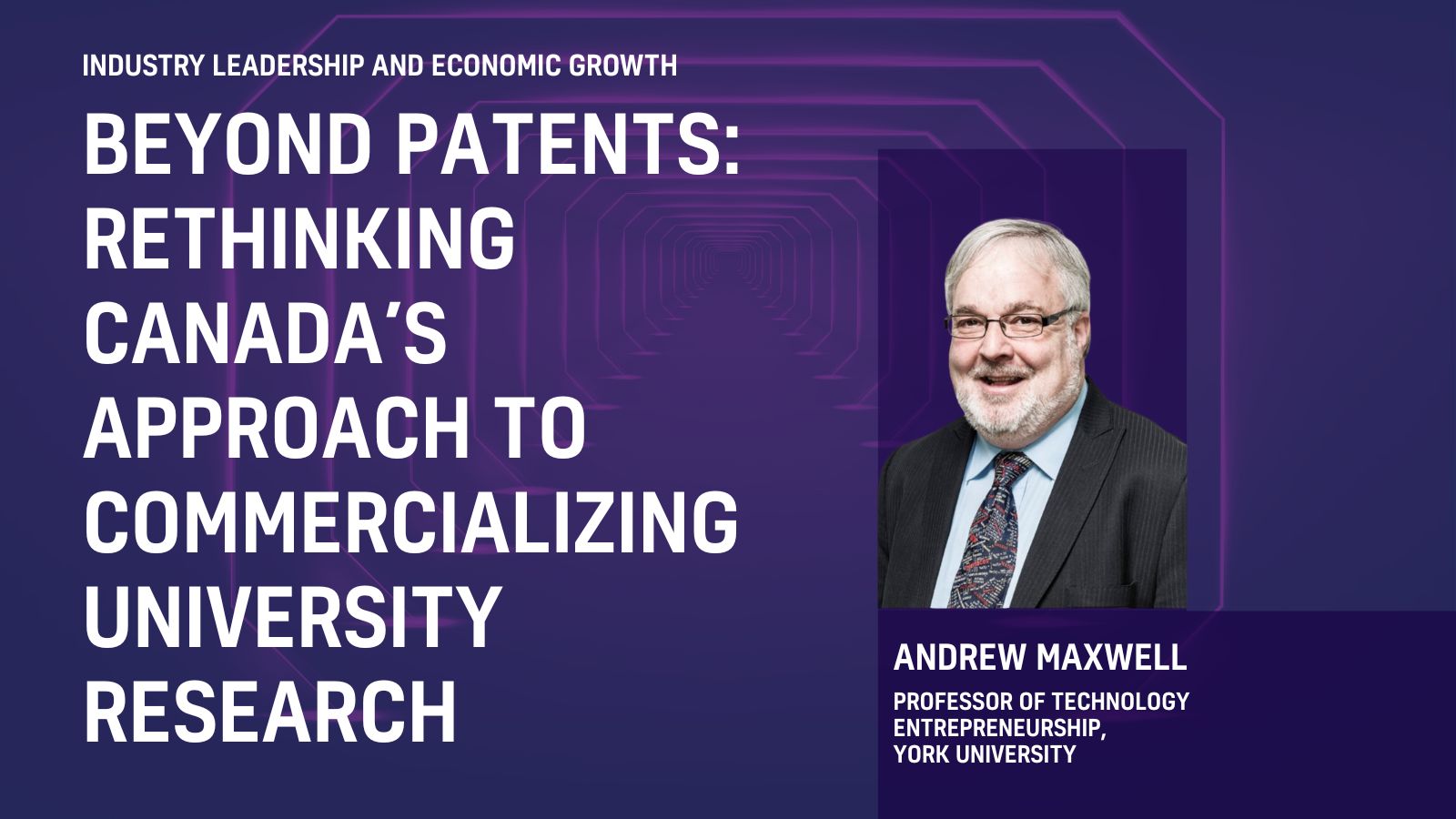
Author(s):
Andrew Maxwell
York University
Professor of Technology Entrepreneurship
Disclaimer: The French version of this text has been auto-translated and has not been approved by the author.
Canadian universities are central to our innovation ecosystem, yet the rate at which their discoveries become innovations that deliver economic and social impact remains stubbornly low. Despite substantial public investment each year, too few university-originated technologies reach users, and the regional benefits are often diluted. My own research over the past decade has examined why commercialization success rates remain low and how universities can redesign their approaches; from the design of technology incubators to frameworks that embed user discovery and market validation during research (Maxwell & Levesque, 20114, Maxwell, 20233).
Since the 1980s, many universities have built commercialization strategies around intellectual property (IP), especially patents, following the logic of Bayh–Dole. Technology Transfer Offices (TTOs) were established to file patents and license them to industry, and patent counts and licensing income became de facto metrics of success. Yet despite rising patent filings, fewer than five percent of university patents lead to a license agreement, and in most institutions licensing revenues do not cover the cost of operating the TTO (AUTM Licensing Survey1). Even when licenses are executed, value creation often occurs outside the region that funded the underlying research.
The deeper problem is that an IP-centric model does not reflect the changing nature of technology and competitive advantage. In fields such as software, artificial intelligence, clean technology, and digital health, patents are neither the only nor the most effective source of advantage. Speed of development, access to data, regulatory insight, user adoption, and business model innovation are frequently more decisive. A slow, linear, IP‑first process risks missing the market window altogether. Moreover, codified knowledge (patents, publications, data) must be complemented by tacit knowledge—the know‑how held by researchers, students, and users. When responsibility transfers to a TTO at disclosure, tacit knowledge often becomes disconnected from the commercialization effort, reducing the odds of adoption (Grimaldi et al., 20112).
A more effective approach is to treat commercialization as an entrepreneurial, iterative process rather than a single hand‑off event. New ventures are often the best vehicles for deploying disruptive technologies because they can pivot quickly, recruit focused leadership, and iterate business models in response to evidence. They also generate local benefits: hiring graduates, building receptor capacity, and attracting investment, when they grow near the university that produced the technology (Maxwell & Levesque, 20114).
Timing matters. Market adoption cycles move far faster than traditional research timelines. By the time a research project concludes, the market may have shifted, competitors may have emerged, or the value proposition may have changed. To keep pace, commercialization should start in parallel with research. Engaging potential users and partners during the research phase allows teams to incorporate adoption barriers, manufacturing realities, regulatory pathways, and business model options into technology design decisions. Evidence gathered from early problem framing, prototype testing, and validation of value propositions should be used to refine both the research trajectory and the path to market.
My group has developed and deployed two practical frameworks that operationalize this approach. TechConnect integrates user discovery, adoption‑barrier analysis, and value proposition testing into the research process, creating feedback loops that guide technology design. VentureStart provides an evidence‑based way to choose between licensing and venture creation by assessing market dynamics, disruptive potential, input factors, demand conditions, and barriers to entry. Together, these tools help universities move from a one‑size‑fits‑all licensing model to a multi‑path commercialization strategy aligned with user adoption criteria (Maxwell, 20233).
Real change will also require addressing skills and incentives. Few researchers receive formal training in user discovery, value proposition design, regulatory navigation, or business model experimentation. Tenure and promotion systems still reward publications and citations over translational work. Graduate training should therefore integrate entrepreneurship, design thinking, and market analysis so commercialization becomes a natural extension of discovery. Promotion criteria should recognize commercialization contributions—start‑ups, industry partnerships, and community‑engaged innovations—alongside scholarly outputs (NSERC Guidelines5). Universities should expand collaborations with industry, investors, and public-sector partners to ensure viable pathways to adoption.
Policymakers can catalyze this shift by aligning funding with an iterative, evidence‑based commercialization process. Grant programs should include flexible proof‑of‑concept and prototyping resources and require early user and market validation activities. Milestone‑based funding, with stage gates tied to evidence rather than paperwork, will encourage iteration and adaptation. Support for entrepreneurial fellowships and living labs can embed parallel commercialization in research programs. Finally, measurement should move beyond patent and license counts to include ventures formed, jobs created, regional economic impact, and contributions to public‑interest outcomes (OECD Innovation Policy Reviews6).
Canada’s research system must evolve to match the speed and complexity of modern markets. An over‑reliance on codified IP and post‑research commercialization is not just insufficient; it can actively slow progress by disconnecting tacit knowledge and delaying user engagement. By embedding market validation in parallel with research, training researchers in entrepreneurial methods, and realigning incentives toward impact, Canada can convert a higher share of discoveries into innovations that deliver economic growth and societal value.
References
- AUTM (2023). AUTM Licensing Activity Survey. https://autm.net/research-reports
- Grimaldi, R., Kenney, M., Siegel, D., & Wright, M. (2011). 30 years after Bayh–Dole: Reassessing academic entrepreneurship. Research Policy, 40(8), 1045–1057. https://doi.org/10.1016/j.respol.2011.04.005
- Maxwell, A. (2023). Enhancing the Commercialization of University Research. In S. Patnaik, V. Pallotta, & K. Tajeddini (Eds.), Global Trends in Technology Startup Project Development and Management (pp. 57–78). Springer. https://doi.org/10.1007/978-3-031-40324-8_4
- Maxwell, A., & Levesque, M. (2011). Technology incubators: Facilitating technology transfer or creating regional wealth? International Journal of Entrepreneurship and Innovation Management, 13(2), 122–143. https://doi.org/10.1504/IJEIM.2011.038855
- NSERC (n.d.). Guidelines on the Assessment of Contributions to Research, Training and Mentoring. https://www.nserc-crsng.gc.ca/NSERC-CRSNG/Policies-Politiques/assessment_of_contributions-evaluation_des_contributions_eng.asp
- OECD (2024). OECD Innovation Policy Reviews. https://www.oecd.org/sti/inno/
Acknowledgment: The author used AI-assisted editing and summarization to improve clarity and structure. All ideas and arguments were developed, generated and approved by the author.