
Defence Innovation in Higher Education: The Case for University Affiliated Research Centres in Canada
Author(s):
Joseph Martin

Disclaimer: The French version of this text has been auto-translated and has not been approved by the author.
With Canada’s public sector facing spending cuts and potentially outright layoffs, there is some well-earned jealousy directed towards the Department of National Defence as the federal government moves towards a new NATO defence-spending goal of 3.5% of GDP. Long-time defence analysts are pessimistic with some speculating that this spending may be used as cover to launder government public works projects as multiple governments have been accused of in the past. There is, however, a part of the public sector that has enormous untapped capacity to increase the lethality of the Canadian Armed Forces (CAF) and needs renewed investment – Canadian higher education.
Not since the Second World War has there been a better opportunity to make a once-in-a-generation investment in both the Canadian post secondary system and national defence by replicating the University Affiliated Research Centre (UARC) program that has existed for over eighty years in the United States. These fifteen UARCs hosted at institutions across the United States are funded by organizations within the Department of Defense to pursue research which furthers the long-term force development goals of their sponsors.
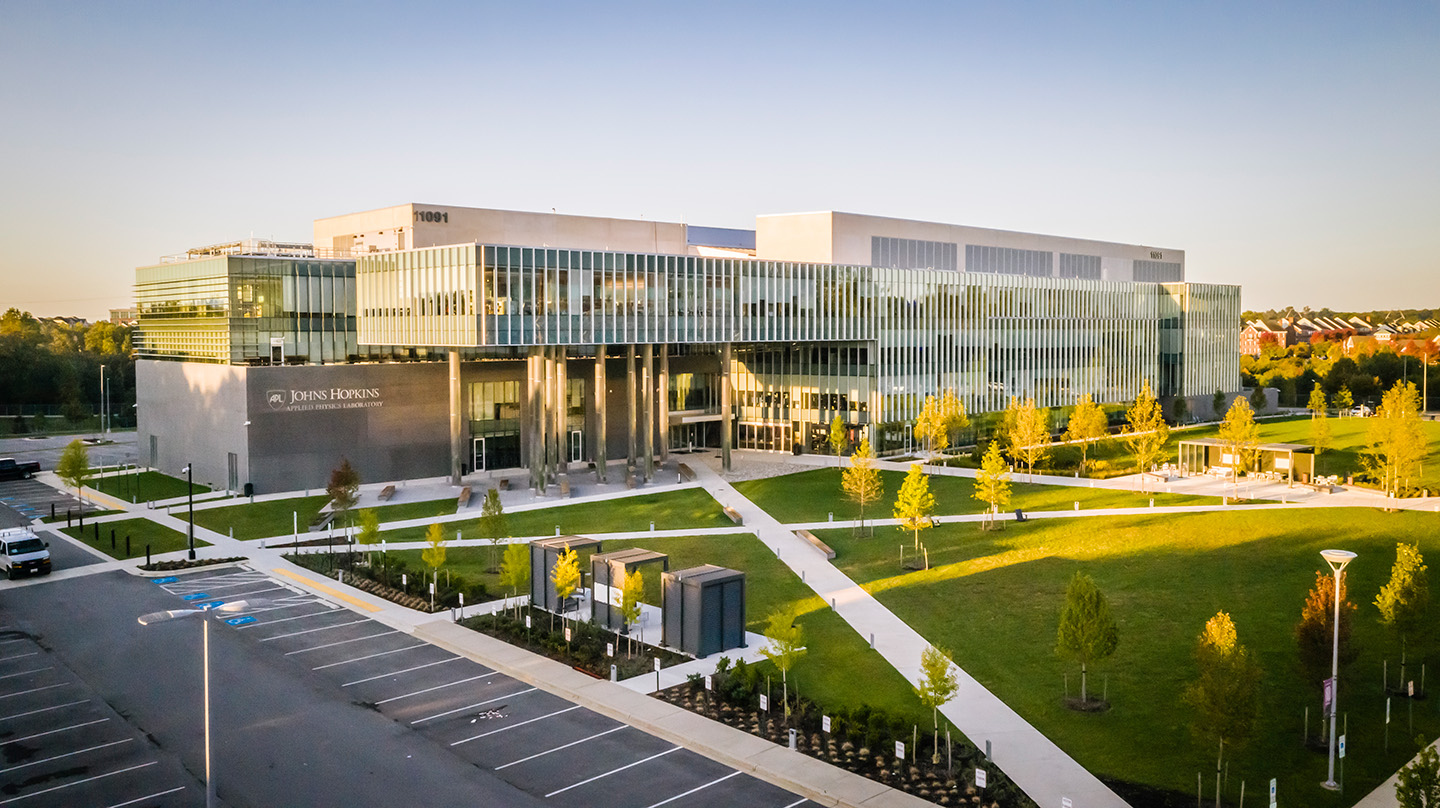
The Advanced Physics Laboratory (APL) at Johns Hopkins University was the first University Affiliated Research Centre. Since 1942, APL has contributed to substantial technological innovations including GPS and brain chip-controlled prosthetics. (Photo Credit: Johns Hopkins APL)
The Current Situation
Defence science in Canada is the purview of Defence Research and Development Canada (DRDC) where civilian public servants designated as Defence Scientists are employed at seven research centres across Canada. Depending on their location, DRDC scientists may develop relationships with local universities, some formally as adjuncts, although these are primarily driven by individual initiative not strategic organizational policy. As much of the research conducted at DRDC is classified, the resulting lack of publications for one’s CV hinders or completely obstructs any future return to academia for the average Defence Scientist. This has contributed in part to the lack of cross-pollination between defence research and Canadian academia.
The other primary source of defence research is the Division of Graduate Studies of the Royal Military College of Canada (RMC). This faculty more resembles the research apparatus of a Canadian university although with the dual purpose of training the next generation of CAF officers.
The financial challenges of many Canadian institutions of higher education likely need little introduction. Austerity measures abound across Canadian universities and colleges as a variety of revenue sources, including provincial government funding as well as domestic and international student tuition, have become stagnant or dropped as the result of a combination of government policies.
Benefits
The faculty, facilities, and equipment of a UARC are funded by the federal government to fulfill specific defence research requirements and could therefore be categorized as defence spending. The same human and physical capital would, however, be the employees and property of the host institution.
In addition to being free lecturers and graduate student supervisors (on a non-interference basis with their centre’s mission), the faculty of UARCs can still compete for other grants and contracts within their research mandate. As generators of grants and student tuition, a UARC is therefore, from the perspective of its host institution, a revenue source whose associated costs are paid for by the federal government.
For a government that has trumpeted the need for more Canadian innovations, the benefits of a UARC-like program are obvious, albeit likely not immediate. UARCs in the United States have developed technologies such as prosthetics and concussion detection which have contributed to medical advances that benefit the whole of society. Further, American defence research taken more broadly has developed almost every technology that has allowed for the modern aviation industry.
As a country constantly seeking more Shopifys and the accompanying new-economy jobs, the benefits of just one homegrown paradigm-shifting innovation could reap enormous economic dividends. One needs only to consider all the technologies and highly profitable firms that could not have emerged without the development and provision of free access to GPS by the US military.
Issues to be Addressed
Of course, something this substantial cannot be created overnight and UARCs would not be exempt from certain perennial challenges in the Canadian defence sector. Security clearances for UARC personnel – especially those who, like many academics, have lived abroad – could take months to years to be completed under the current system. Without a tailored solution, this would substantially increase the customary timeline for hiring a graduate student or post-doctoral researcher.
Further, the same obstacles to publication of classified research presently experienced by DRDC scientists would continue to exist hindering collaboration and career advancement. With a sufficiently robust UARC ecosystem, however, enough academics with the requisite clearance could be developed to assemble the bodies that facilitate the key milestones of an academic career such as thesis defence or tenure and promotion committees.
Finally, UARCs–even in the United States–are not without controversy as was the case when the Applied Research Laboratory opened at the University of Hawai‘i at Mānoa in 2004 and was renewed in 2024. While resistance from the science and engineering faculties which typically benefit from a UARC would be less likely, some organizations on Canadian campuses would potentially take umbrage with their institution supporting the development of weapons or weapons-adjacent technology.
Conclusion
A program which invests in Canadian innovation and further strengthens the infrastructure that generates a skilled labour force cannot be seen as anything other than a “nation-building project”. While fiscally conservative policymakers may bristle at funnelling any more money into the public sector, a cursory look across NATO shows Canada to be well behind in its defence science investments.
Whether or not UARCs can be fit into a budget of austerity and investment is therefore a problem of political messaging not good defence policy. Regardless of the ebbs and flow of government financial priorities, NATO’s 3.5% defence spending goal is likely to remain in this uncertain future. Developing Canadian technology with an added trickle-down benefit to Canadian students could be seen as a more worthy cause than giving a multibillion corporation to deliver another delayed and overbudget defence procurement project.
More on the Author(s)
Joseph Martin
Royal Canadian Navy
Weapons Officer
University of Victoria
Research Associate