
Legibility, answerability, and refusal: a humanities and social sciences framework for the age of automated judgment
Author(s):
Dr. Kem-Laurin Lubin
Dr. Helen Beny

Disclaimer: The French version of this text has been auto-translated and has not been approved by the author.
In June 2026, Canada released a national AI strategy assembled largely without the humanities and social sciences in the room. That same season, everywhere else, those disciplines were being summoned. The frontier AI laboratories were hiring philosophers at pace; the press was declaring the revenge of the humanities graduate; and the Pope’s first encyclical, a document on artificial intelligence, drew its deepest arguments from precisely the traditions our policy process had left in the lobby. The contradiction is impossible to miss: the disciplines being recruited to solve AI’s hardest problems inside the labs are still excluded from governing it in public.
This editorial answers the exclusion with a contribution. It sets out a policy framework, drawn from the social sciences and humanities, that centres what we call the structural minimum of personhood under automation: legibility, answerability, and refusal.
The framework is offered in deliberate kinship with Demos’s Verification, Deliberation, Accountability (VDA) model for democratic health, which names its trio the structural minimum of democracy. VDA asks what a democracy needs from its institutions; this framework asks the adjacent question the AI era forces: what does a person need from the systems that now judge them? The two questions can come apart, and that is the danger. A society could pass every democratic test and still deliver its citizens, one by one, into automated verdicts they cannot read, cannot contest, and cannot escape. The failure is not the technology. It is that personhood was never on the checklist, and every harm that follows gets minimized as a technical glitch rather than named as what it is: a person, erased from the ledger of things worth verifying.
What personhood needs under automation
Rights on paper become substance only when a person facing an automated system can answer three questions in the affirmative; a right you cannot see, argue, or exercise is a right in name only.
Legibility: can I read what reads me?
Automated systems compose accounts of people, scores, bands, categories, inferences, and act on those accounts. Legibility is the condition of being able to see the account: to know that a system is operating, what it has inferred, on what basis, and in language a non-specialist can understand. It is verification turned inward: not “can society establish what is true” but “can I establish what is being held true about me.”
Legibility fails in two directions at once. Downward, when the person cannot see the profile, the reasons, or even the system’s existence, judged at machine speed by evidence they are never shown. And upward, when the system’s own operators cannot explain it, the black-box alibi, so that opacity is claimed as technical fate rather than admitted as design choice. When legibility is robust, a person can inspect the account against their own life. When it collapses, the person becomes what one of us has elsewhere called a digital subaltern: endlessly described, never shown the description.
Answerability: can I answer back?
Answerability is the condition of being able to respond: to reach a human being with the authority to review and change an automated outcome, to contest an inference, to correct the record, and to have the contest matter. It is accountability translated from the institutional register to the personal one: not only “can the powerful be held to account by society” but “can this decision, about me, be made to answer.”
The classical tradition located judgment in the space of encounter, where the judged ones can appear and speak; automated systems relocate judgment to the one venue where the person cannot appear at all. Answerability is the demand that a door be built back into that room. Its tests: an explanation legible to its subject, a reachable human with power, a contestation route whose outcomes are consequential, and measured time-to resolution. A complaint box is often offered as redress, and an ombudsperson as oversight; but a complaint box is not answerability, and an ombudsperson who cannot alter the outcome is not a door. The test is whether answering back has ever changed a result.
Refusal: can I decline and still live?
Refusal is the deepest condition, and the one most often missing. It is the capacity to say no to a system, to decline the collection, exit the service, opt out of the inference, without forfeiting participation in ordinary life. It is deliberation’s hard edge: a voice that cannot say no is not a voice; it is a formality on the way to yes.
Refusal is where the present order is most degraded, by design. Consent has been engineered into theatre: the pre-ticked default, the unreadable terms, the enrolment that takes one click and the exit that takes an afternoon, the “agreement” extracted at the checkout of every necessity. And refusal is where the collective dimension becomes unavoidable: for many communities, and Indigenous data governance states this with the greatest clarity, consent is not an individual checkbox but a collective, ongoing relation, and no individual click can waive what belongs to a people. A framework that cannot handle collective refusal cannot govern data at all.
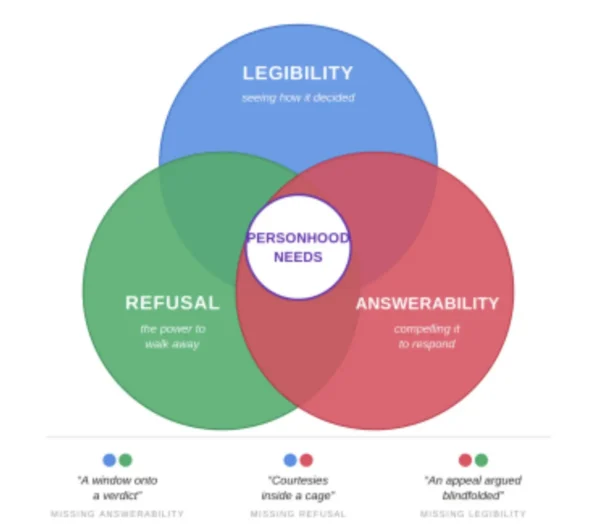
Figure 1: Personhood needs under automation
The three conditions hold only together, as Figure 1 shows. Legibility without answerability is a window onto a verdict: informed, but unheard. Answerability without legibility is an appeal argued blindfolded: heard, but without the information redress requires. And both together, without a genuine right of refusal, amount to courtesies inside a cage. The framework is therefore offered as a single standard, implemented in tandem or not at all.
The lineage: refusal has a history, and it is curriculum
Here the humanities contribute what no compliance regime can: the knowledge that all of this has been survived before, and how. Every community that has lived under hostile systems of description and control has built what this framework names. Policy habitually treats these histories as heritage: honoured, quoted, quarantined. This framework treats them as the tested engineering of legibility, answerability, and refusal under maximum adversity, the deepest expertise available on problems AI governance calls novel. The counterpublics that built these tools reconstructed personhood from below; ignoring their methods means relearning what the tradition already knows.
The case for the answerable society
The wager is simple. The AI question has been treated as a technical question with social side effects, to be managed by the disciplines that build, with the disciplines that understand people invited to comment afterward. Every failure catalogued here, the verdicts in absentia, the consent theatre, the strategies written without the humanities, follows from that ordering. The correction is not hostility to the technical disciplines, whose craft is necessary and often magnificent. It is the restoration of the older ordering, in which we build answers to what we owe each other, and the disciplines whose entire subject is what we owe each other hold structural, not ceremonial, authority over the systems now composing our characters and dispensing our fates.
Legibility, answerability, refusal: can I read what reads me, can I answer back, can I decline and still live. Three questions, one framework: an audit instrument, a design standard, and a public grammar for the age of automated judgment. A society whose systems can answer all three has nothing to fear from its machines.
AI use disclosure: the authors used an AI assistant for copy editing, and figure preparation; the framework, arguments, and final text are the authors’ own.