
Responding to Backlash to Defend Evidence-Based, Inclusive Research Funding
Author(s):
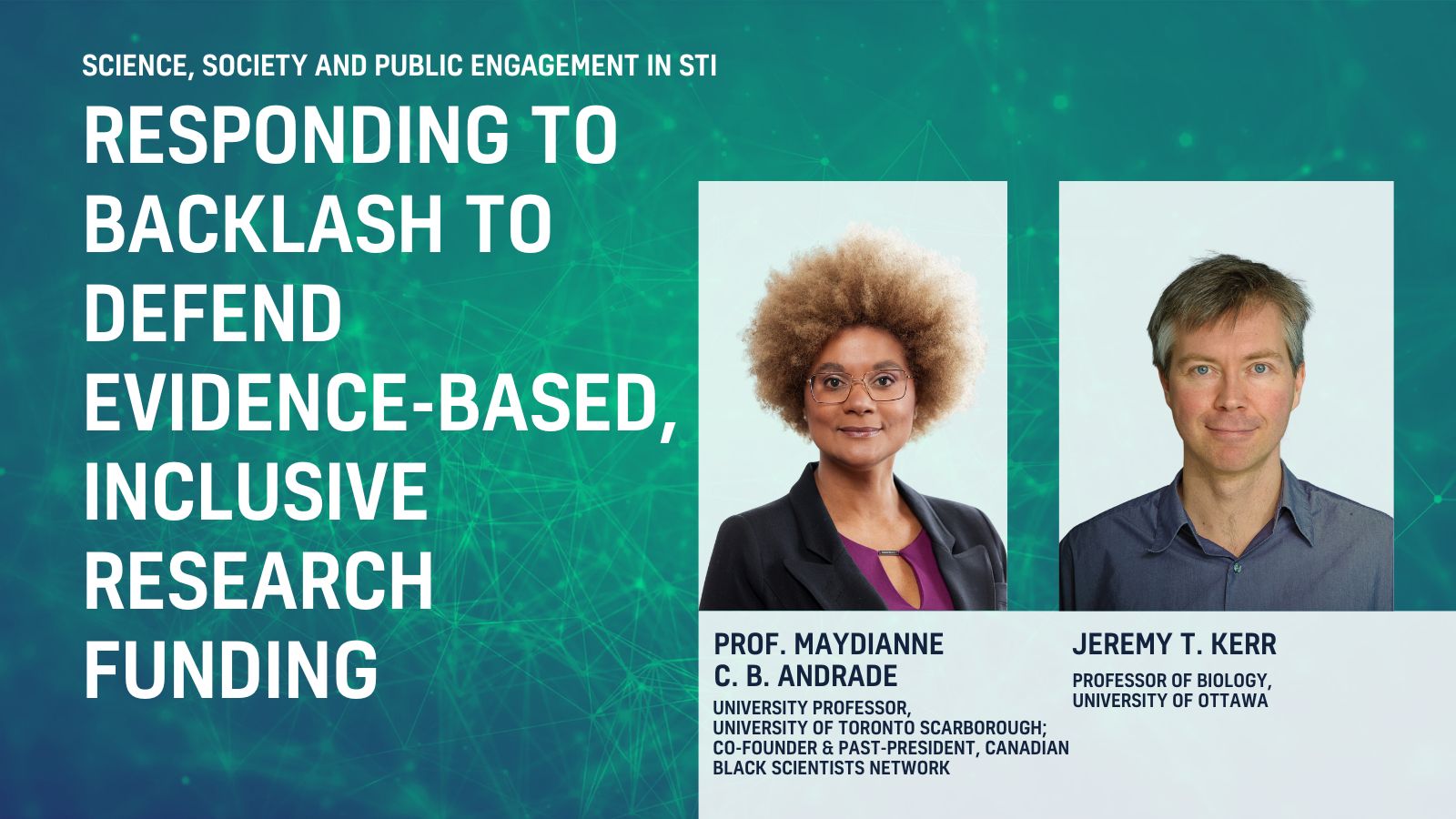
Prof. Maydianne C. B. Andrade
University of Toronto Scarborough
University Professor
Canadian Black Scientists Network
Co-Founder and Past-President
Jeremy T. Kerr
University of Ottawa
Professor of Biology
Disclaimer: The French version of this text has been auto-translated and has not been approved by the author.
Political Restrictions on Funding Decisions in the USA Started with Attacks on EDI
The dismantling of research infrastructure and funding from STEM (and other fields) has occurred at a precipitous rate in the United States since January 2025. Cuts started with a wave of rejections of research proposals and grant terminations mandated by the federal government if terminologies related to Equity, Diversity and Inclusion (EDI) were present, (infamously including ‘Women, Black, LGBTQ, and Disability’).1 Politically-dictated research funding decisions went beyond EDI, suppressing research on topics like vaccines and climate change.2
In Canada, objections to the treatment of EDI issues in federal research funding programs has emerged in several forms. For example, a recent anti-EDI opinion piece reported an increase over time in the relative frequency of words or phrases in NSERC grants that were categorized as ‘EDI terminology’, including: ‘gender, bias, Indigenous, sustainability, marginalized, and race’.3 This approach of flagging isolated words and phrases, taken out of context and presented as ‘evidence’, is a serious concern.
‘Anti-EDI’ Rhetoric: We’ve Heard it Before
As Canadian researchers and agencies look to ensure excellence and competitiveness, it is worth asking: What can be learned from watching the rapid erosion of the world’s research powerhouse?
A key lesson is the importance of directly challenging misinformation framed as scholarly critique of funding mechanisms.
Disagreement over policy and practice among granting councils and agencies is expected and necessary. The best approach to reliably support innovative, impactful research is not always clear. However, anti-EDI rhetoric that is now policy in the USA and becoming more visible in Canada precludes reasoned discussion.
Here, we spotlight two common ways that coded language sidesteps evidence.
Evidence-Informed Practices are not Ideology
Perhaps the most common form of attack is to claim that ensuring research and research grants are inclusive is an ideological crusade from some shadowy, left-wing group. This rhetorical device, deployed in newspaper editorials, think-tank publications, and even testimony at the parliamentary Standing Committee on Science and Research (SRSR)4, seems designed to trigger outrage. It conveniently dismisses decades of quantitative evidence demonstrating how inclusion amplifies research impact and benefits.5
It doesn’t take much effort to see through the charade. Ideology is “a systematic scheme of ideas…a set of beliefs governing conduct.” (OED 2010, emphasis added). In contrast, changes in tri-council practices and policy are based on data and analysis. The data demonstrate that funding success has never resulted solely from researcher excellence or from the brilliance of a proposal.
For example, studies on CIHR grant competitions have convincingly shown gender gaps in success rates.6 Women receive lower ratings from peer reviewers than do men, even when their record suggests similar merit, and the gender gap is strongest for the most high-performing researchers.7 CIHR analyses show that applicants who identify as visible minorities or as living with a disability also show lower success rates than expected.8 Publicly available data from NSERC reveal multi-year racialized gaps in granting success (Figure 1).9
It is unclear to us why the evidence-informed practices that emerge from the documentation of these patterns are called ‘ideology’.
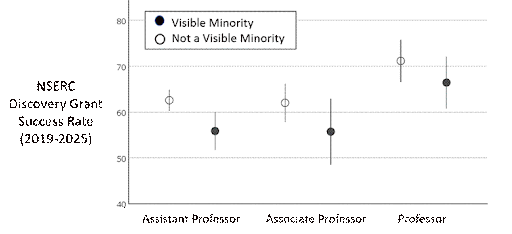
Figure 1. Mean success rate (95% confidence intervals) for NSERC Discovery Grant applicants as a function of racial self-identification and rank for competition years 2019 – 2025. Data extracted from NSERC EDI dashboard by M Tseng.9
Excluding Talent is a Losing Strategy for Competing on the World Stage.
Hidden in the shadows of the anti-EDI movement is the argument that these numbers are natural because women and ‘visible minorities’ include relatively few meritorious researchers.4
It is time to address this ideology directly. Being vocal in defense of the practices that recognize and redress funding gaps is essential, as without them, Canada will lose access to its full potential for excellent research. We are also at risk of losing excellent researchers who decline to compete against loaded dice.
The tri-councils have rightly modified practices to align with goals of funding research excellence. These initiatives align with Canada’s legal imperatives to remove negative impacts on designated groups across a range of contexts.
This is not ‘ideology’ or ‘politics’. Instead, it is an inescapable conclusion of evidence-based work from the research community itself. The imperative for EDI considerations in research reflects two clear goals: legal principles around human rights and Canada’s drive to field the strongest researchers and research teams possible.
What about Viewpoint Diversity?
Backlash is also aimed at practices that aim to improve inclusion of excellent researchers who have historically been excluded from research opportunities. This strategy decries an ostensible lack of “viewpoint diversity” among researchers as the most pressing crisis in representation4, often citing sources from the United States, or think-tank opinion pieces. In contrast, a peer-reviewed, large scale study examining this question across Canadian universities found heterogeneity in the political viewpoints of professors. Moreover, the distribution of ideologies among the professoriate was largely similar to the university-educated Canadian pool from which they are hired.10, 11
EDI in Training Drives Accountability
Anti-EDI activists contend that EDI requirements degrade research excellence.4 This argument misses the mark on many levels, especially because it arises in an evidentiary vacuum. Evaluation of EDI criteria for most fundamental research grants in STEM is separate from the proposed research. Rather, assessment credits well-designed training plans that recruit and support talented individuals who can come from any of Canada’s mosaic of communities. This is not an ideological exercise and certainly not a litmus test that researchers must meet. Instead, it is smart, modern people management.
In fact, EDI criteria in the natural sciences and engineering are almost entirely aimed at ensuring that researchers who are funded by the Canadian public provide opportunities for all Canadians to develop and share their talents. EDI criteria, in other words, promote excellence by enabling the broader recognition of promising scholars who are then included in the research enterprise.
The Gloves are Off
It may not seem worth the effort to address these and other predictable rhetorical tactics. That is a mistake. Labels such as ‘ideology’, parroted as fact, move easily from conversations to headlines. Engaging the anti-EDI agenda without addressing its profound underlying fallacies leaves the labels, and their emotional power, intact. We can look south, or to the past, and see where that leads. Maintaining and sharpening Canada’s competitive edge is best served by ensuring our research and innovation landscape is enriched by excellence from all of our communities. We urge you to actively counter outdated assumptions with evidence, each and every time you hear them. We cannot afford to let misinformation define Canadian research funding practices.
References
- Lee, B. Y. March 15, 2025. Forbes. https://www.forbes.com/sites/brucelee/2025/03/15/these-197-terms-may-trigger-reviews-of-your-nih-nsf-grant-proposals/ (Retrieved September 5, 2025).
- Halpert, M. August 5, 2025. BBC News. https://bbc.com/news/articles/c74dzdddvmjo (Retrieved August 10, 2025). Temple, J. June 2, 2025. MIT Technology Review. https://www.technologyreview.com/2025/06/02/1117653/the-trump-administration-has-shut-down-more-than-100-climate-studies/ (Retrieved August 10, 2025).
- Snow, D. February 2025. MacDonald-Laurier Institute (figure 8). https://macdonaldlaurier.ca/promoting-excellence-or-activism-equity-diversity-and-inclusion-at-canadas-federal-granting-agencies/ (Retrieved August 10, 2025).
- SRSR study: The Impact of The Criteria for Awarding Federal Funding on Research Excellence in Canada (44-1, 2024 and 45-1, 2025). https://www.ourcommons.ca/documentviewer/en/44-1/SRSR/meeting-111/evidence;
- AlShebli, B.K., et al. 2018. Nature Communications 9, 5163. https://doi.org/10.1038/s41467-018-07634-8; Freeman, R., Huang, W. 2014. Nature 513, 305. https://doi.org/10.1038/513305a
- Witteman, H. O., et al. 2019. The Lancet, 393(10171), 531-540. doi:https://doi.org/10.1016/S0140-6736(18)32611-4; Burns, K. E. A., et al. 2019. PLoS Medicine, 16(10), e1002935. doi:10.1371/journal.pmed.1002935
- Tamblyn, R., et al. 2018. Canadian Medical Association Journal, 190(16), E489-E499. doi:10.1503/cmaj.170901
- CIHR. Message from the Vice-President and Associate Vice-President, Research Programs (Operations), https://cihr-irsc.gc.ca/e/53907.html (Retrieved September 30, 2025).
- NSERC EDI dashboards: https://www.nserc-crsng.gc.ca/NSERC-CRSNG/EDI/data-donnees_eng.asp; Gender Based Analysis Plus in NSERC Programs: Summary Report 2024. https://www.nserc-crsng.gc.ca/NSERC-CRSNG/Reports-Rapports/GBA_Plus-ACS_Plus/2024/index_eng.asp (Retrieved July 10, 2025).
- Nakhaei, MR; Brym, RJ. 2011. The Ideological Orientations of Canadian University Professors. Canadian Journal of Higher Education. 41:18-33. https://journals.sfu.ca/cjhe/index.php/cjhe/article/view/2181/2130
- Smith, M. October 10, 2025. The viewpoint diversity debate in Canadian universities. University Affairs. https://universityaffairs.ca/opinion/the-viewpoint-diversity-debate-in-canadian-universities/ (Retrieved October 21, 2025)