
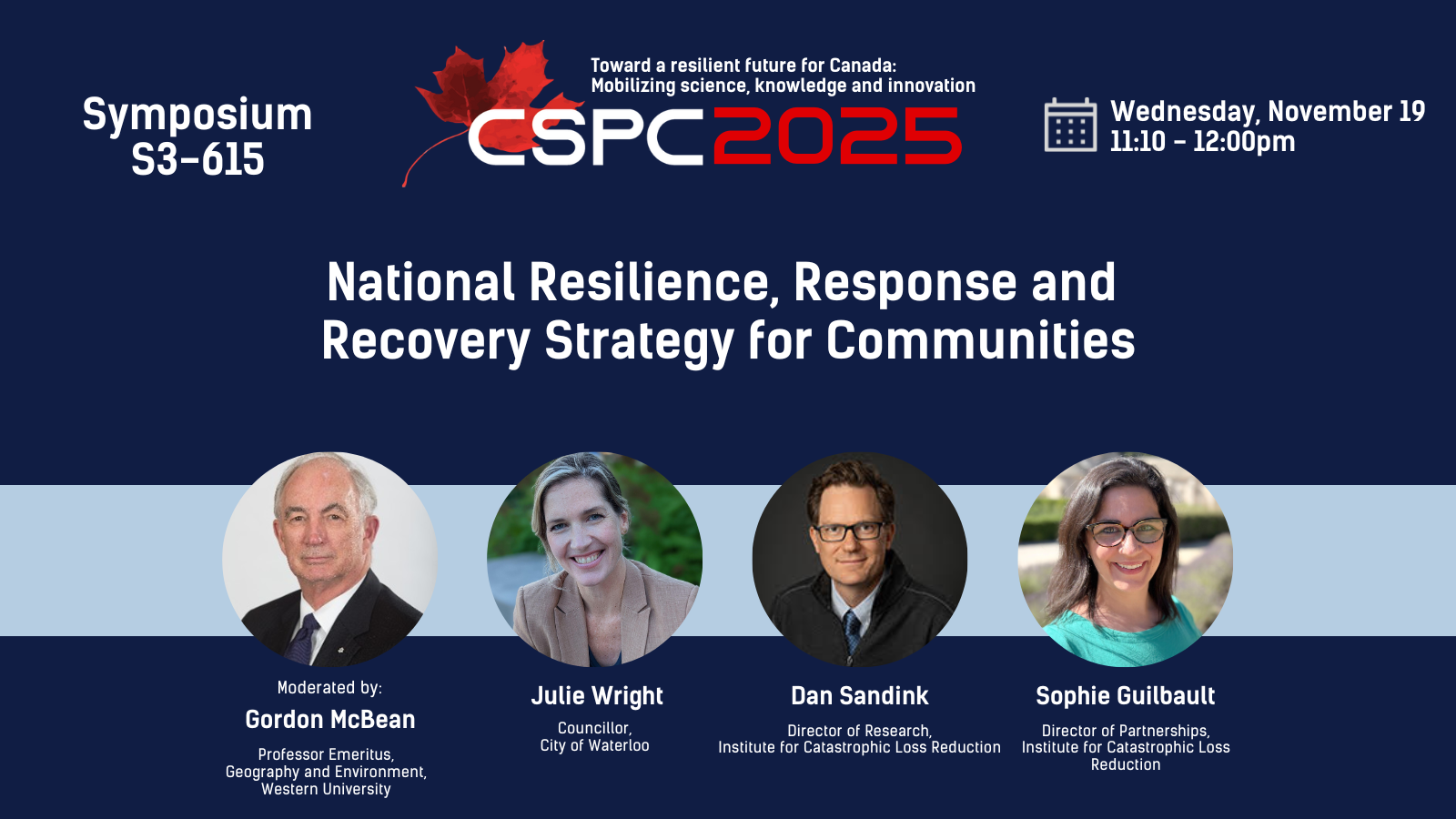
Abstract:
This Panel, with experts on climate change resilience and city issues, will address the issues of National Resilience, Response and Recovery strategy for Communities by bringing together community leaders and interdisciplinary science expertise to discuss, analyse and project the important issues of the grand challenges and emerging risks that the WEF’s 2025 Risk Assessment ranked the highest risks. These issues were also highlighted in the Elbows Up for Climate Action letter sent to national leaders from 230 of Canada’s local governance leaders, stating: the time to act boldly on climate change is right now – because later is too late.
Summary of Conversations
Research into disaster risk reduction demonstrates that adaptation leadership is highly effective at the local level, supported by over 120 community case studies analyzed across various hazards, including wildfire, extreme heat, and urban flooding. Key conversation highlights revolved around integrating climate risk reduction into municipal operations, often following a significant loss event rather than proactively. Examples included the successful integration of Indigenous cultural burning practices for wildfire management, the use of park redesigns in high-density urban areas for stormwater retention and flood mitigation, and the implementation of impervious surface-based stormwater utility charges to fund infrastructure rehabilitation. A key thematic takeaway was the necessity of multi-disciplinary collaboration, strategic partnerships (government, experts, industry), and enhanced public awareness to drive effective, scalable local action. The discussion stressed the importance of moving from talk and protocols to demonstrable, tangible actions for future resilience.
Take Away Messages/Current Status of Challenges
- Reactive vs. Proactive Implementation: Most local risk reduction actions are triggered post-disaster (e.g., severe flooding or wildfire loss events) rather than being implemented proactively through forward-looking policy.
- Complexity of Resilience Standards: Existing national resilience standards (e.g., for wind, flood, hail) are often perceived by the building and restoration industries as too complex, comprehensive, and restrictive for practical, immediate application.
- Low Implementation Rate in Construction: Despite the availability of detailed guidelines and standards for resilient low-rise residential construction across multiple hazards (wildfire, flood, wind, hail), the actual physical application rate by builders remains extremely low.
- Inconsistent Insurance Incentives: The lack of regulation and inconsistency in underwriting property insurance for disaster resilience makes it difficult for builders to reliably market insurance benefits (premium reductions) to homebuyers as an incentive for adopting resilient practices.
- Fragmentation of Governance: Canada’s multi-level governance structure (federal, provincial, regional, municipal, conservation authorities) often results in coordination challenges, hindering the unified implementation of national climate commitments at the local level.
- Affordability Overshadows Resilience: For the building industry, the immediate priority of housing affordability often completely overshadows investments in resilience, requiring clearer connections between lifecycle cost savings and initial outlay.
- Regulatory Barriers to Green Building: Municipalities in some jurisdictions (e.g., Ontario) face challenges in implementing high-performance development standards that exceed the provincial minimum building code, limiting local innovation.
- Insufficient Public Risk Literacy: There is a general lack of public awareness regarding personal property flood risk (e.g., living on a floodplain) and individual responsibility for property-level mitigation, shifting too much burden to the public purse.
Recommendations/Next Steps
- Develop Tiered Resilience Guidance: Streamline and simplify technical resilience standards (e.g., for hail, wind) into tiered, practical checklists (Good, Better, Best) with simple visuals and limited language reliance for immediate adoption by the building industry.
- Upscale Field Trial Projects: Conduct more pilot projects and field trials with tract and MURB builders across Canada to generate critical claims data that demonstrates the loss-reduction benefits of resilient construction to insurers.
- Strengthen Affordability/Resilience Link: Focus communication efforts on clearly articulating the long-term lifecycle cost savings, reduction in insurance premiums, and reduced disaster recovery time associated with adopting resilient building measures.
- Drive Consumer Demand: Implement robust educational campaigns targeting homebuyers to increase market demand for optional resilience packages in new construction, thereby incentivizing builders to incorporate these features.
- Integrate DFA with Mitigation: Leverage changes in federal disaster financial assistance (DFA) programs to support and incentivize mitigation and recovery planning, ensuring risk reduction is integrated into post-disaster rebuilding decisions.
- Improve Disaster Risk Governance: Foster multi-level governance collaboration to ensure that national frameworks like the Sendai Priorities for Action translate into clear, cohesive operational outcomes and synchronized policies at the municipal level.
- Enhance Public and Stakeholder Engagement: Utilize community engagement networks (such as Rotary Clubs) to hold local discussions and organize action, improving public awareness of specific local hazards (fire, flood) and encouraging personal mitigation.
- Mandate Climate-Informed Infrastructure Design: Ensure all critical municipal infrastructure replacement and capital projects incorporate future climate predictions into their design to guarantee long-term performance and lifecycle savings, despite a modest increase in initial costs.
* This summary is generated with the assistance of AI tools