
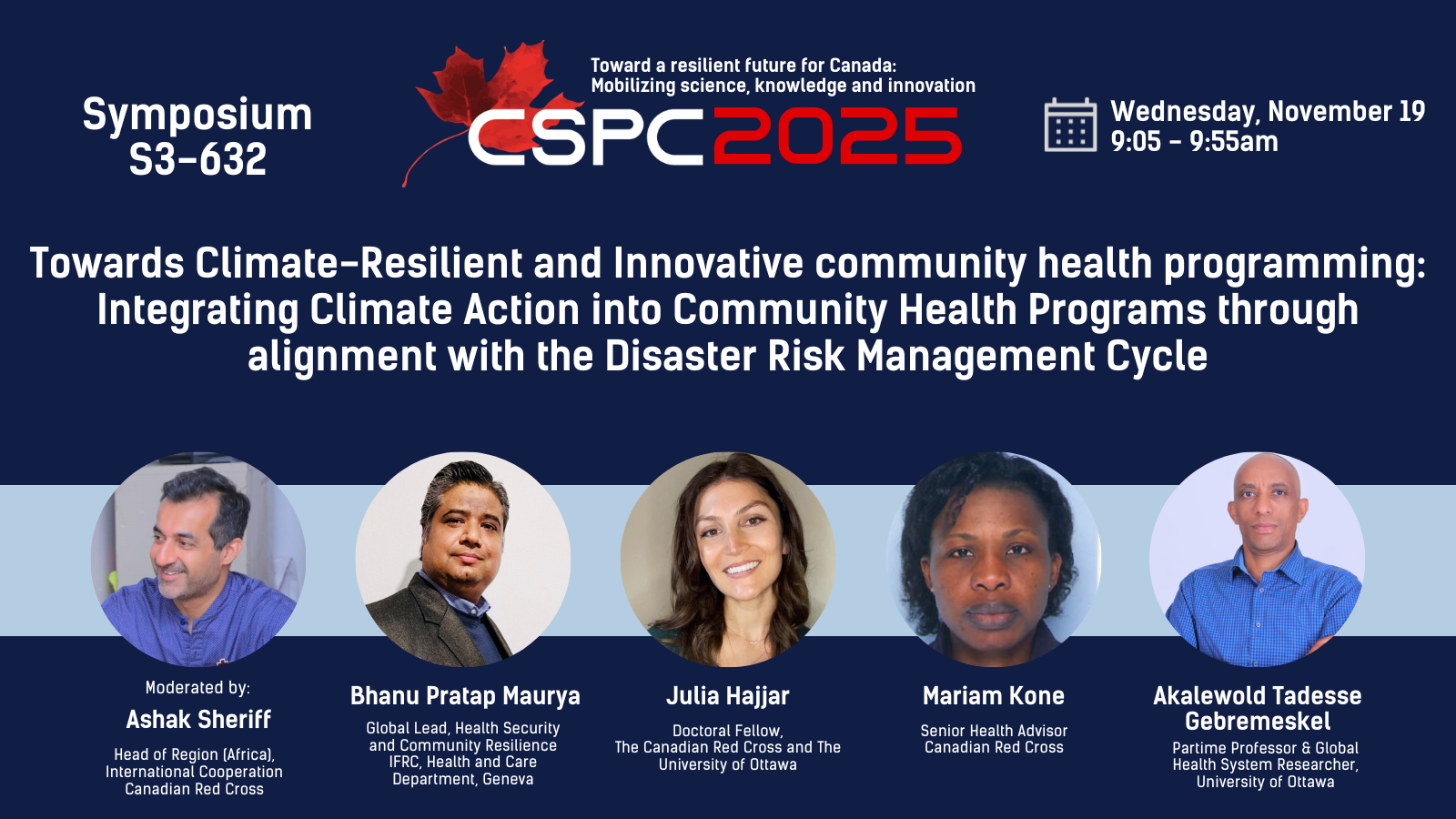
Symposium: S3-632
Towards Climate-Resilient and Innovative community health programming: Integrating Climate Action into Community Health Programs through alignment with the Disaster Risk Management Cycle
Abstract:
This panel critically examines the integration of climate action into community health programming as a strategic pathway to climate-resilient health systems. Drawing on empirical insights from Canadian Red Cross and IFRC initiatives in Canada and Africa, it addresses four core themes: framing climate change as a public health emergency; operational lessons from African community health interventions; the evolving role of Community Health (CHWs) under climate stressors; and policy mechanisms for embedding CHWs within the Disaster Risk Management (DRM) cycle. The panel aimed to inform policy and practice on integrating climate action into community health programming through the DRM cycle, as a strategic pathway to strengthen preparedness, response, and recovery, and to build climate-resilient community health systems that advance health equity.
Summary of Conversations
The discussion highlighted the urgency of integrating climate action into community health programs, viewing climate change as the defining health challenge of the 21st century. The global context reveals challenges like high maternal mortality and aging populations, compounded by climate-fueled conflicts and epidemics. In Canada, climate-related emergencies such as extreme heat and wildfire smoke are increasing in severity, impacting vulnerable groups and straining healthcare systems. A modular emergency response unit has been developed domestically to provide climate-controlled shelter and adaptable health services. Across Africa, local actors, including community health workers, are on the frontline of the climate-health intersection, engaging in early warning and response. Scaling impact requires investment in local leadership, preparedness, and alignment of health and disaster systems through multi-stakeholder collaboration.
Take Away Messages/Current Status of Challenges
- Climate Change as a Grand Health Challenge: Climate change is a current reality and is considered the greatest health challenge of the 21st century, fueling migration, displacement, conflicts, and epidemics.
- Strained Health Systems and Workforce Gaps: Health systems globally are under pressure and must adapt to rising climate-related risks, with Africa facing significant health worker shortages required to meet universal health coverage goals.
- Increasing Domestic Climate Health Emergencies: In Canada, extreme heat, cold, and wildfire smoke events are rapidly increasing in frequency and severity, exacerbating underlying health conditions and causing significant public health and economic costs.
- Disparate Impacts on Vulnerable Populations: Specific groups, including children, older adults, pregnant individuals, those with pre-existing cardiorespiratory illnesses, and Indigenous populations in Canada, face greater exposure and vulnerability to climate-related health crises.
- Funding Imbalances in Climate Action: Most climate financing disproportionately focuses on mitigation, overlooking local health systems, which serve as the essential first line of defense for adaptation and response.
- Policy and Evidence Gaps: There is a notable lack of emphasis and attention on integrating climate action into primary health programs and insufficient evidence to guide programming and planning in this nexus.
- Deficiencies in Local Actor Empowerment: Key barriers include the lack of formalization, training, and policy-level empowerment for community health workers, who are crucial local responders.
- Need for Integrated and Localized Approaches: There is a challenge in aligning community health programs with disaster management cycles to anticipate risks and ensure innovation is driven by the lived experiences of those most affected.
Recommendations/Next Steps
- Formalize and Empower Community Health Workers (CHWs): The training, role, support, and voice of CHWs must be formalized and included at the policy-making level, recognizing them as local links and the backbone of climate-resilient health systems.
- Integrate Community Health into Disaster Management: Community health programs and CHWs should be fully integrated across the entire disaster risk management cycle, from preparedness and response to recovery and resilience building.
- Increase Investment in Community Health Programming: The current moment necessitates increased investments specifically in community health programming to build stronger resilience against climate-related shocks. Supporting the IFRC and African CDC-led Resilient and Empowered African Community Health (REACH) program, marking a significant advancement in community healthcare. This program aims to substantially increase the number of Community Health Workers by 2029, bringing essential health services closer to underserved populations.
- Channel Flexible Climate Finance to Local Adaptation: Climate finance should be channeled to local adaptation efforts, ensuring flexibility and targeting early action initiatives such as forecast-based financing.
- Promote Multi-Stakeholder and Cross-Sectoral Collaboration: Genuine multi-stakeholder engagement across sectors, institutions, and communities is required to optimize approaches, share resources and responsibilities, and lead to better health outcomes.
- Adopt Evidence-Driven and Localized Policies: Strategies must be guided by evidence and grounded in localized principles, utilizing data-driven approaches to inform decision-making and programming.
- Develop Climate-Resilient Health Systems: Efforts should focus on tackling extreme heat, developing the capacities of local actors, and working to make health facilities and service delivery climate-smart and climate-resilient.
- Prioritize Early Warning and Anticipatory Action: Scaling up climate action should include prioritizing early warning systems, early action, and anticipatory action to save lives, protect livelihoods, and minimize loss and damage.
- Scaling And Integrating The Climate Hub For Broader Public Health Response: The Climate Hub acts as an enabler of other CRC services, and can also support; Rapid Response Outpatient Clinics for urgent medical needs during disasters; Public health and clinical services, health navigation, and health promotion; Disaster Risk Reduction and community education initiatives.
* This summary is generated with the assistance of AI tools