
Unknown Track
Abstract:
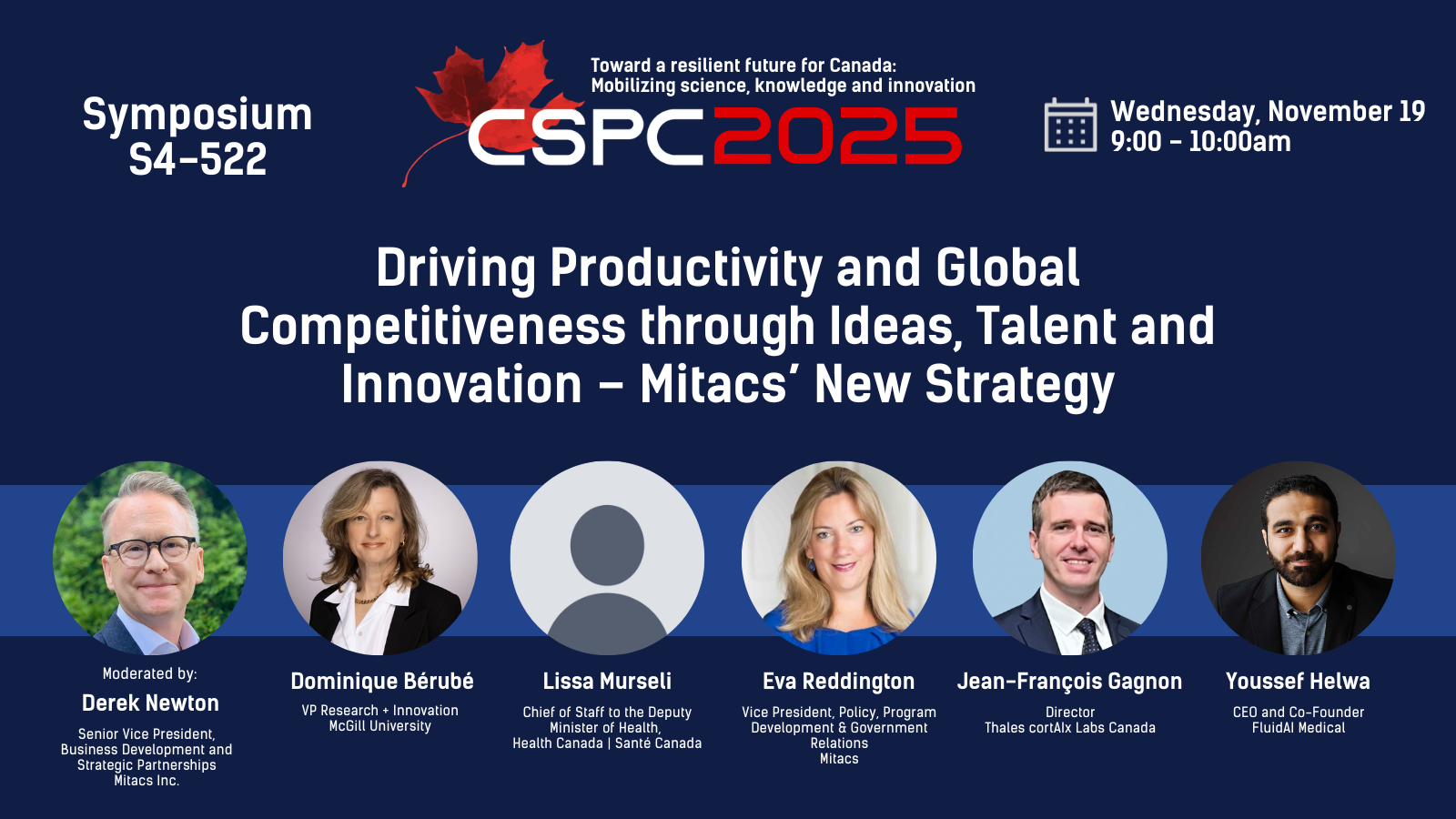
Canada’s global competitiveness and a strong, resilient economy in a time of uncertainty depends on our ability to translate research into market-ready innovation. Building on 25 years of experience driving industry-academic collaboration and deploying skilled talent, Mitacs is launching a new strategy to deliver positive impact with a continued focus on talent and research powering innovation. In this moderated discussion, leaders from business, academia and Mitacs will explore what it takes to strengthen innovation capacity, unlock opportunities for multidisciplinary collaboration, effectively bridge research to commercial success, and build talent pipelines to strengthen Canada’s productivity and global competitiveness.
Summary of Conversations
The discussion centered on the urgent need to bolster Canada’s economic resilience and productivity by bridging the gap between academic research and industrial application. Panelists emphasized that while Canada excels at producing high-quality technical talent and generating foundational research, the ecosystem suffers from a significant deficit in commercialization skills and business development expertise necessary to scale innovations domestically. Industry representatives highlighted the necessity for talent that possesses both deep technical knowledge—particularly in AI and quantum fields—and the ability to translate complex technologies into tangible customer value. The conversation underscored the role of strategic partnerships and work-integrated learning in de-risking innovation for startups and established firms, allowing for long-term talent evaluation. Furthermore, a new strategic plan for Mitacs was introduced, sharing strategic directions to help drive collaboration, support the journey of research to commercialization, and deliver impact for the economy, the workforce, and society.
Take Away Messages/Current Status of Challenges
- Disconnect Between Technical Skills and Commercial Needs: While Canada produces world-class talent in foundational sciences and engineering, there is a critical shortage of “connector” talent capable of translating technical specifications (such as AI equations) into commercial business value for customers.
- Loss of Intellectual Property and Brain Drain: The ecosystem struggles to retain high-impact innovations, often seeing technologies developed in Canada commercialized by foreign entities (e.g., in the medical device sector) because domestic firms lack the capacity to scale effectively.
- Evolving and Diverse Talent Needs: As startups grow from research-focused entities to commercial companies, their talent needs shift drastically from scientific roles to regulatory, quality assurance, and sales roles, creating pipeline gaps that are difficult to fill locally.
- Fragmented Innovation Pathways: The university environment does not provide clear pathways for students to transition from traditional academic disciplines into entrepreneurship, as students are rarely trained to view startup creation as a primary career option.
- Misalignment of Timelines and Risk: A structural friction exists where industry demands rapid delivery and short-term results, while universities require stability and long-term horizons for foundational research, creating difficulties in synchronizing collaboration.
- Declining Productivity and Investment: Canada is facing productivity and global competitiveness challenges, necessitating bold, coordinated action rather than relying solely on fragmented efforts.
Recommendations/Next Steps
- Implement Outcome-Based Impact Measurement: Mitacs, working with partners, will focus on delivering measurable impact for the economy, workforce, and society to see quantifiable outcomes in talent development, firm growth, productivity and commercialization resulting from its interventions with partners.
- Develop Strategic Partnerships: As part of supporting research commercialization, create and scale multi-institutional cluster programs within and across sectors that allow industry partners to access researchers and talent across the entire country to solve complex, multidisciplinary challenges.
- Embed Relevant Skills Training: academic and training programs must integrate skills relevant in industry and entrepreneurship—such as customer discovery, IP management, and entrepreneurship fundamentals—to prepare workers for the realities of the commercial market.
- Establish Stable, Long-Term Innovation Strategies: Clear, consistent governance and foundational strategies help give universities the stability required to support industry effectively.
- De-risk Innovation: Create supportive environments and funding mechanisms that mitigate the risks not only for industry firms but also for students and researchers venturing into entrepreneurship in promising innovative areas, ensuring they do not bear the full burden of failure alone.
- Utilize Internships for Long-Term Talent Recruitment: Industry can leverage work-integrated learning programs as platforms to assess candidates’ fit and to identify candidates for full-time permanent positions.
Leverage Networks for Ecosystem Growth: There is benefit to building a vast network of experienced professionals, including Mitacs program alumni, to unlock opportunities for multidisciplinary collaboration and to provide mentorship for new cohorts entering professional roles and entrepreneurship.
* This summary is generated with the assistance of AI tools