
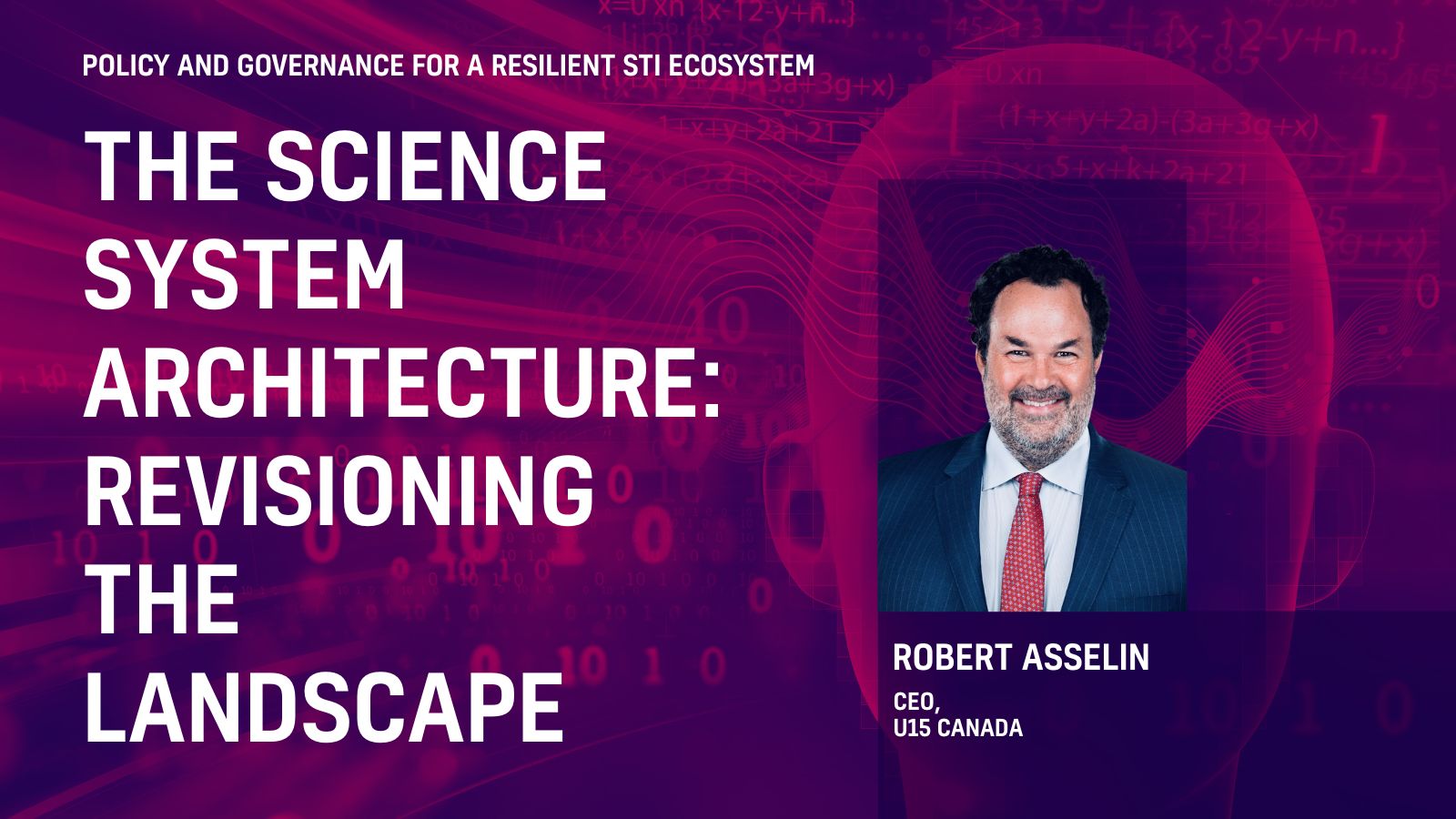
The science system architecture: Revisioning the landscape
Author(s):
Robert Asselin
U15 Canada
CEO
Disclaimer: The French version of this text has been auto-translated and has not been approved by the author.
Canada stands at a crossroads. We can no longer count on reliable trade access to the United States. The global world order is shifting rapidly around us. Evolving geopolitical risks pose fundamental challenges to our previously envious position of relative prosperity and stability.
In this more uncertain world, it is clearer than ever that sovereign capabilities and domestic capacity to innovate are critical. It underpins national security, economic resilience and the possibility for future prosperity.
Canadians are waking up to this new reality. Now, Canada’s science community must do the same, offering the solutions and innovations Canadians need to succeed in the uncertain times ahead. We all must be seized by the urgency of this moment and the need to respond with sufficient ambition, appropriate scale and a commitment to build mechanisms that can respond with the ability to do things differently.
That doesn’t mean that Canada must not remain internationally engaged. Sharing new knowledge and engaging with leading ideas, wherever they are generated, has always been a hallmark of free and open science. But in this new reality, we must be more serious about our own domestic capacity to produce and retain innovations here in Canada. Technological sovereignty will be a key determinant of our future prosperity.
In this new reality, shaping a resilient science and technology ecosystem will be crucial to realizing the solutions Canadians need to thrive in the future. Canadian research is in a strong position, home to world-class research universities, a deep pool of talent and excellent fundamental research, reflecting a legacy of important historic investments that have shaped highly successful programs, built vital infrastructure and elevated the excellence of the granting agencies in developing talent and deepening knowledge. Collectively, we have built a vibrant research ecosystem thanks, in part, to these strategic efforts from previous governments.
Now is the moment to leverage those strengths to address the challenges facing Canadians in this moment of transition. Building a more resilient science ecosystem means adapting the existing structure and governance of the systems architecture to adequately reflect the evolving needs of society and businesses. That should happen in a manner that builds on the success of historic initiatives and positions the excellence of Canadian research to be leveraged by government and industry. But we cannot afford to wait; we must move with the ambition and urgency that the moment requires.
Afterall, the issues in the current system identified by the Bouchard Report remain outstanding; the need to resolve fragmentation and develop a unified and coherent approach across a broad number of funding agencies, expand support for multi-disciplinary research to draw the widest expertise possible, streamlined approaches to international research partnerships and a continued need to harmonize funding programs across agencies to reduce the administrative burden on researchers.
However, given the fundamental economic shifts facing Canada, the recommendations on mobilizing the excellence of the research ecosystem towards mission-driven challenges are now critical. Revisioning the landscape requires developing governance mechanisms that are better able to react to the short-wave needs of Canadians, while developing the longer-wave capabilities for government, industry and civil society that will shape a more resilient and adaptable ecosystem.
Whether that happens through a mechanism such as the ‘capstone organization’ proposed by the previous government or through something similar, we must ensure that we continue to develop a science architecture that is more responsive and can successfully link the existing strengths of the system with advanced industries that can grow and scale those solutions into successful commercial products. Doing so will be critical to sustaining robust economic and social opportunities, but also to help develop the sovereign capabilities in critical dual-use technologies that will be vital to Canada’s national security.
Revisioning the landscape, therefore, requires embracing the opportunities of mission-driven programs that seek to address specific needs and focus on marshalling the deep expertise of the research ecosystem towards clearly defined goals. Developing a governance mechanism which allows for the strengths of the granting councils and other agencies to act responsively to clear strategic needs, while protecting the fundamental research and support for talent within each council, will require the overarching modernization outlined in the Bouchard Report and articulated by the government.
It will also require, however, a governance system that establishes a clear strategic vision for the entire sector, making it clear what these priorities are and giving researchers, universities and funding agencies the clarity to recruit talent, build infrastructure and design programs to meet these wider strategic goals. It should set these out with ambition, clear targets and a pathway to success for the ecosystem. Such a governance system should also clearly establish accountability and oversight mechanisms, including public reporting, to ensure all Canadians are clear about what is being achieved by the science community.
The proposed Council on Science and Innovation, with a diverse membership of representatives from across all disciplines and amongst academia, industry and civil society, is one potential method of achieving this goal. But again, what matters most is not the specific entity tasked with the role as much as realizing the clear objectives outlined by the Bouchard Report and the experience of many Canadians seeking to work with the ecosystem on the solutions they need to succeed.1,2
Lastly, as the government decides on the next steps towards a modernization of the architecture of the research system, it remains vital to ensure that the existing strengths of the system are protected; excellence in discovery-oriented research, a focus on fostering future talent, protection for discipline specific research, political independence of funding decisions and a clear commitment to academic freedom and the upholding of the peer review system. As Canadians are asked to respond with urgency to the challenges facing our country and our economy, now is the opportunity to retool the research ecosystem to meet this moment and deliver the solutions Canadians need in a time of crisis.
- Budget (2024), available at https://cihr-irsc.gc.ca/e/53894.html
- Chapter 4. Economic Growth for Every Generation, Budget (2024), available at https://budget.canada.ca/2024/report-rapport/chap4-en.html