
From Capacity to Readiness: Designing Industrial Strategy for Canada’s Defence and Health Security
Author(s):
Thomas Hansen

Disclaimer: The French version of this text has been auto-translated and has not been approved by the author.
Canada is re-engaging seriously with questions of sovereignty, resilience, and national capability. The release of the Defence Industrial Strategy (DIS), along with renewed investment in preparedness and supply chains, reflects an overdue recognition that in a more volatile and contested world, national security is shaped as much by industrial capacity as by military force.
But Canada faces a persistent risk. We continue to equate capacity with readiness, and they are not the same thing.
Capacity describes what exists: facilities, equipment, intellectual property, or a skilled workforce. Readiness, by contrast, is an outcome of thoughtful system design: the ability to deliver reliably, at scale, under stress, and on demand. Readiness depends not only on assets, but on governance, incentives, operational validation, and sustained use. Countries that fail to make this distinction often discover, often too late, that idle or fragmented capacity cannot simply be activated in a crisis. (This distinction is illustrated in Figure 1.)
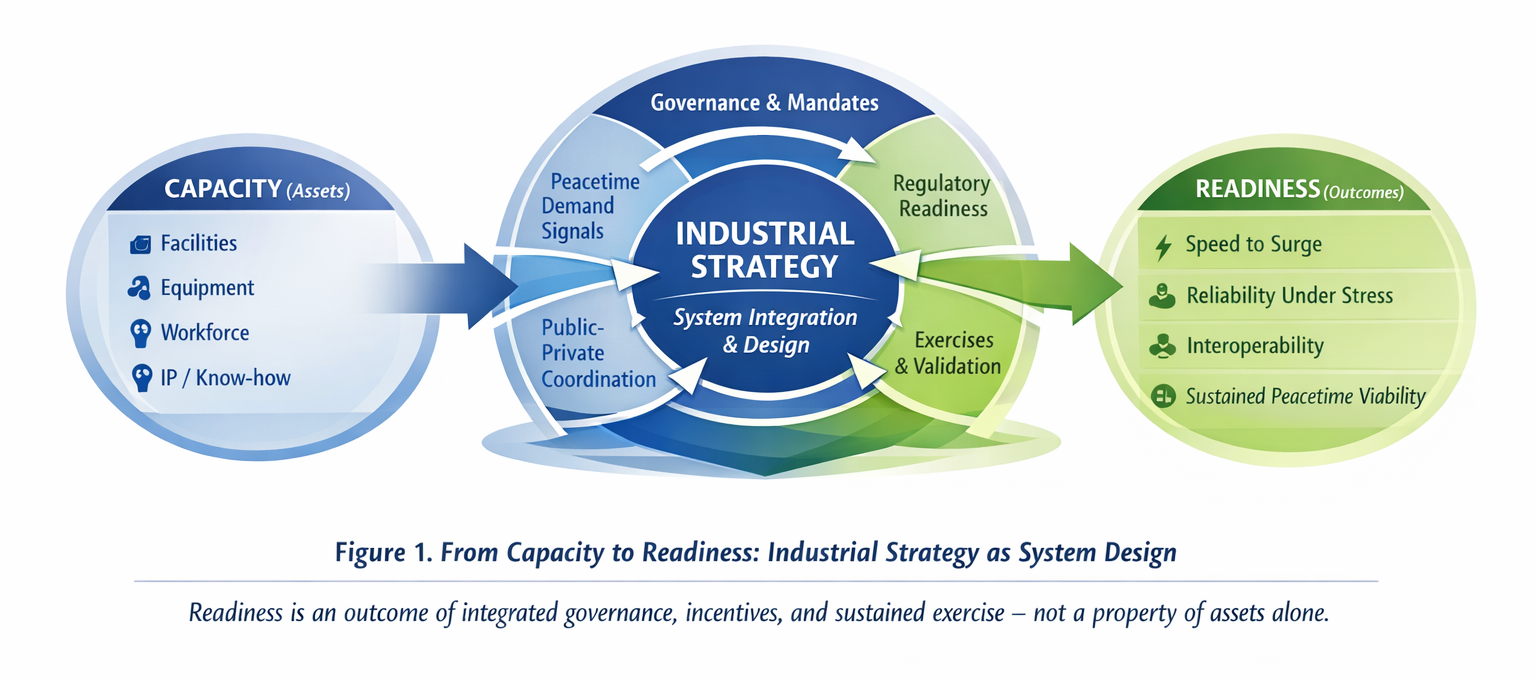
This distinction matters because Canada’s deepest vulnerability is not a lack of innovation or talent. It is systemic fragmentation, a result of post-World War II policy decisions, and has manifested in the form of fragmented mandates, misaligned incentives, and weak feedback loops between policy intent and industrial execution. If DIS is to become a pillar of sovereignty rather than a catalogue of investments, it must be treated as a design framework for readiness, not merely a spending plan.
Dual-use capability is the resilience test
Dual-use is not just the latest “it term”, historically the clearest test of readiness is dual-use capability through industrial systems that serve civilian needs in normal times and can surge or pivot in emergencies. Dual-use is often discussed as a niche or a specialization. In reality, it is a stress test of industrial strategy itself.
Life sciences and biomanufacturing illustrate this clearly. Medical countermeasures (vaccines, therapeutics, and diagnostics) are not only public-health assets. They are strategic enablers for force and community health protection, continuity of government, and societal resilience. This is why they now appear explicitly in discussions of defence supply chains and sovereign capability. Yet the lesson of COVID-19 was not simply that Canada needed more domestic production. The deeper lesson was that industrial systems that are economically idle or institutionally disconnected in peacetime cannot be relied upon in crisis…if they even continue to exist.
Readiness in this context means keeping platforms “warm”: maintaining regulatory compliance, workforce proficiency, validated processes, secure inputs, and trusted supply networks. These conditions do not arise organically. They must be designed, incentivized, and exercised.
Industrial strategy is societal, not sectoral
Many of Canada’s preparation efforts have struggled because industrial policy, defence planning, health security, innovation funding, and procurement continue to operate on parallel tracks. Industry is expected to be both commercially competitive and perpetually ready, yet is rarely given the demand signals or governance clarity required to do both. The result is predictable underinvestment in the unglamorous but essential foundations of readiness: quality systems, validation runs, surge testing, and continuity planning.
This is where industrial strategy must be understood not as sectoral policy, but as an instrument of whole-of-society resilience.
Calls for stronger civilian defence and citizen preparedness are also gaining traction in Canada, reflecting a growing recognition that resilience cannot rest on military institutions alone. However, without execution-ready industrial platforms, reliable supply systems, and exercised public–private coordination, civilian mobilization risks becoming symbolic rather than effective. Whole-of-society resilience begins not with last-minute activation, but with deliberate industrial and institutional design in peacetime.
Other countries make this connection explicit. Finland’s long-standing security-of-supply model coordinates public authorities and private-sector networks to safeguard critical functions in disruption. It combines mandatory and contractual stockpiling, permanent industry engagement, and regular preparedness exercises to ensure that capability remains viable, not just owned. Sweden’s “total defence” doctrine similarly treats civil preparedness, economic continuity, and military defence as an integrated system, planning explicitly for the continuity of essential societal functions in crises and heightened alert.
These systems differ in structure, but they share a decisive insight: readiness is a governance choice. It is sustained through clear responsibility, consistent incentives, operational testing, and integration across industry and society – it is not sustained through episodic mobilization.
Even at a supranational level, this logic is gaining ground. The European Union’s Health Emergency Preparedness and Response Authority (HERA) was created to span the full cycle from threat assessment to procurement, stockpiling, and industrial capacity for medical countermeasures. While more sector-specific, it reflects the same conclusion: preparedness must be institutionalized, not improvised.
A design test for Canada’s Defence Industrial Strategy
If DIS is to strengthen Canada’s R&D and innovation capacities in ways that matter for sovereignty, it should be evaluated against a simple but demanding test:
Does it move Canada from capacity to readiness?
That implies several concrete design choices. First, platforms must be prioritized over one-off projects. Platforms based on repeatable processes, validated infrastructure, and scalable systems are what enable rapid adaptation and surge. Point solutions may deliver outputs; platforms deliver capability.
Second, peacetime utilization must be treated as a condition of readiness, not a competing objective. Industrial assets that sit idle lose workforce, degrade quality systems, and become fragile. Readiness requires predictable demand signals through pilot procurements, standing arrangements, and exercise-linked testing that keep capacity active.
Third, feedback loops must be operational, not administrative. Readiness cannot be reported into existence. It must be exercised, audited, and stress-tested through real deployments, simulations, and surge scenarios.
Finally, fragmentation must be reduced by design. Health security, defence requirements, innovation programs, and industrial policy need to align around a shared readiness architecture that translates science and innovation into implementation.
Sovereignty by design requires assertive choices
Canada has the ingredients for success: innovative institutions, deep talent, and a strong industrial base. What has been missing is not intention, but integration.
DIS offers a genuine opportunity to close that gap if it is treated as a framework for whole-of-society resilience rather than a collection of initiatives. Investment is necessary, but design is decisive. Countries that take readiness seriously embed it into industrial governance in peacetime. Those that do not eventually discover that sovereignty cannot be mobilized on demand.
If Canada wants sovereignty by design, it must design for readiness.
References
- Government of Canada, Security, Sovereignty and Prosperity: Canada’s Defence Industrial Strategy
- Canadian Science Policy Centre, 2025–2030 Strategic Plan
- Canadian Science Policy Centre, CSPC 2026 Conference Theme and Tracks
- European Commission, Health Emergency Preparedness and Response Authority (HERA)
- National Emergency Supply Agency (Finland), Security of Supply
- Government of Sweden, Total Defence
- NATO, Chief Scientist Research Report: Resilience
AI Tool Use Acknowledgment
This editorial was conceived, written, reviewed, verified, and approved by the author. AI Tools were used for research/summarization, final copy editing and image generation (Co-Pilot).
More on the Author(s)
Thomas Hansen
Northern RNA, Calgary, AB
Co-Founder & Vice President