

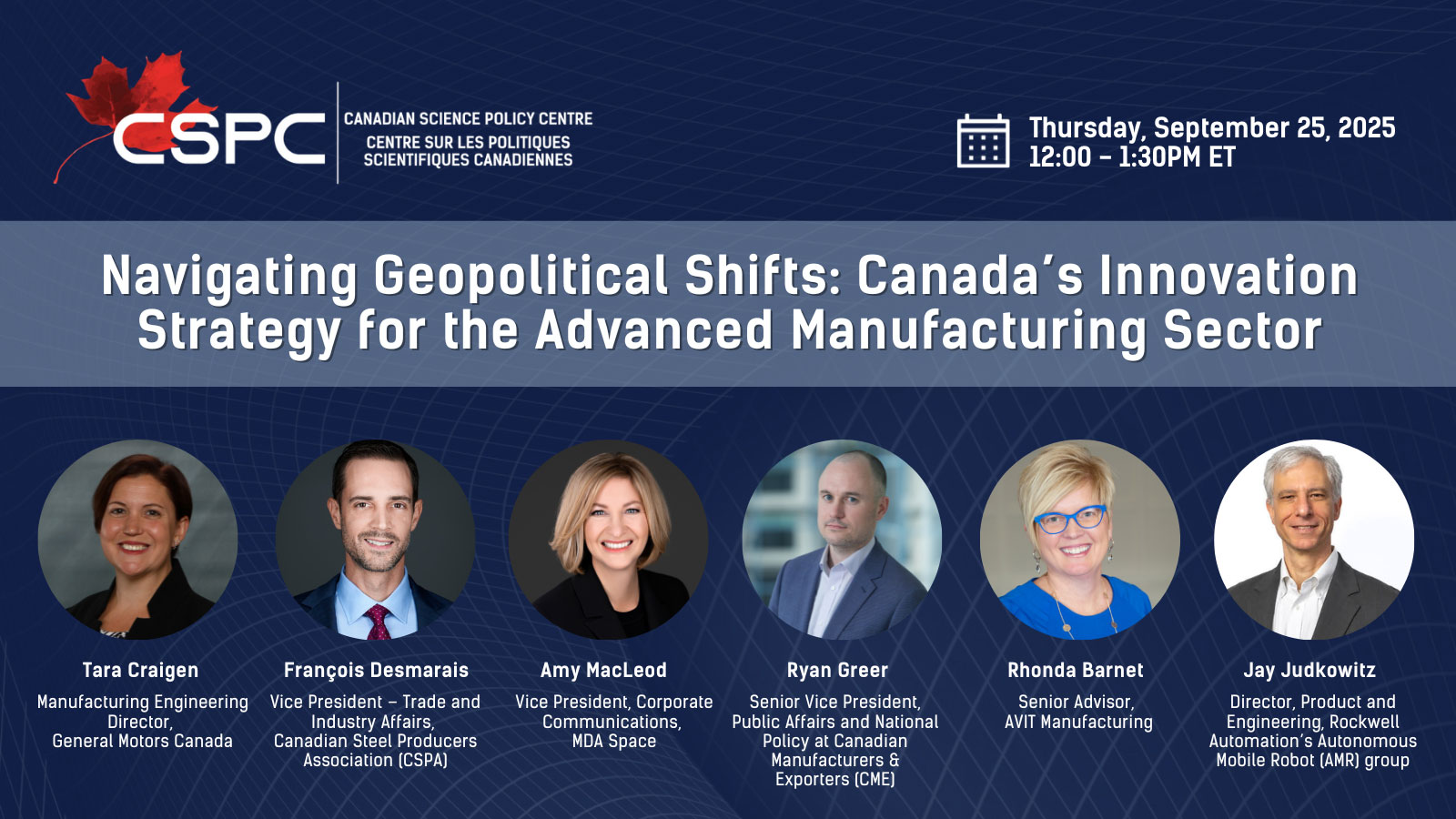
Navigating Geopolitical Shifts: Canada’s Innovation Strategy for the Advanced Manufacturing Sector
Sep 25, 2025 @ 12:00 pm - 1:30 pm EDT
Executive Summary
This virtual panel convened sector experts to diagnose barriers to innovation and recommend policy and industry actions to strengthen Canada’s competitiveness. Panelists identified three dominant, interlocking challenges: volatile global capital flows and heightened international competition that reduce investment predictability; an acute shortage of sustained late-stage and institutional capital that forces value and exits offshore; and regulatory and infrastructure constraints—slow approvals, fragmented clinical-trial and data systems, limited lab and scale-up capacity, and shortages of experienced executives. Participants also highlighted workforce ageing and skills gaps that undermine scale-up.
To address these, the panel recommended a coordinated, durable industrial strategy that aligns R&D, procurement, trade, talent, fiscal tools. Specific proposals included catalytic public co-investment vehicles to attract pension and institutional capital; expanded non-dilutive translational funding to bridge the “valley of death”; and modernization of fiscal supports (e.g., SR&ED and clinical-trial incentives). Panelists urged protecting and streamlining regulatory review capacity through faster review tracks and regulatory incentives, and using procurement as a market-maker to anchor domestic demand.
Industry actions identified included investing in differentiated platforms, accelerating AI adoption discovery and development, and speeding clinical-trial operations. Opportunities for Canada emphasized by the panel were leveraging world-class AI and ethical AI reputation, unlocking province-spanning health data for trials, doubling down on niche strengths in biologics and medtech, and using defence and sovereignty projects as demand anchors. The discussion closed with a call for near-term pilots (catalytic funds and procurement trials) and a two-year roadmap with measurable targets to retain IP, jobs, and economic returns in Canada.
Summaries from the panel (4–6 bullets per question — anonymized, ordered by emphasis)
Q — What are the top three challenges currently hindering innovation in your sector?
- Trade & geopolitical shocks creating extreme unpredictability — panelists described heavy reliance on the U.S. market (example: one speaker noted ~94% of a sub-sector’s exports to the U.S.), which makes firms vulnerable to sudden tariff or trade changes.
- Insufficient and uneven investment (esp. long-term / scale capital) — participants flagged under-investment per worker versus peer countries and difficulties attracting late-stage/pension/institutional capital to keep industrial returns and IP anchored domestically.
- Regulatory uncertainty and red-tape burden — speakers emphasised that unpredictable regulation (trade, carbon, other rules) and lengthy regulatory processes deter long-lived capital spending (example: investments like furnaces have 60–70 year horizons).
- Workforce and skills shortages plus an ageing labour pool — the sector skews older, with imminent retirements and large hiring/training needs; panelists stressed employer-led training and stronger ties with colleges/unions to close gaps.
- Low digital / automation adoption and infrastructure gaps — Canada lags in robot adoption and automation (low robot-to-worker ratios), limiting competitiveness versus low-cost rivals; also noted: constrained lab/production capacity in some segments.
Q — How should government and industry respond to enable long-term innovation and competitiveness?
- Create clear, fast industrial policy and durable signals for investment — panelists asked for decisive, time-bound policy direction (not multi-year uncertainty) so firms can commit capital (industries want “speed of need” similar to pandemic responses).
- Share risk via targeted public-private mechanisms — speakers recommended catalytic public capital, co-investment models, and programs that share downside risk so firms will invest in advanced manufacturing and scale-up.
- Invest in workforce (training + immigration) and worker-centred automation — suggestions included more STEM and trade modernization, employer-led upskilling, union partnerships, and immigration routes for mid-career talent to fill immediate technical roles.
- Modernize fiscal & program levers (SR&ED, SIF, procurement) — expand and sharpen commercialization-focused supports (examples mentioned: Strategic Innovation Fund, SR&ED) and use procurement/sovereignty projects as demand signals.
- Reduce regulatory friction and improve predictability — call for revisiting how regulation is made (better cost-benefit and economic mandates) so long-lived capital decisions aren’t undermined by shifting rules.
Q — Key recommendations / next steps to boost private-sector R&D investment in Canada
- Focus supports on scaling & commercialization, not just discovery — expand programs that help firms move from prototype to production and secure first commercial revenues (panelists cited gaps where incubator/accelerator innovations fail to reach market).
- Use catalytic public capital to attract private co-investment — create co-investment vehicles or carve-outs to bring pension funds and institutional capital into domestic industrial R&D and scale-ups.
- Prioritize predictability for long-horizon assets — clarify carbon, trade and sector mandates (example: EV glide-path clarity requested) so firms will commit to CAPEX and R&D with multi-decade payback profiles.
- Strengthen industry-academia-government partnerships and regional incubator learning — embed R&D into production environments, learn from successful incubators/accelerators, and scale employer-led commercialization supports.
- Invest in targeted infrastructure & platforms (automation, robotics, additive manufacturing) — deploy strategic funding for automation, co-bots, AMRs, 3D printing and centres of excellence that raise productivity and export competitiveness.
Q — What new opportunities / comparative advantages can Canada exploit?
- Leverage a strong manufacturing + space / aerospace base — Canada already has deep strengths (space heritage, manufacturing competence) that can be doubled down on through targeted investment and procurement.
- Use nation-building / defence projects as anchors — speakers noted defence, sovereignty and critical-minerals projects (and NATO commitments) create near-term demand signals to scale domestic industrial R&D.
- Capitalize on a “safer, sustainable” brand to attract investment — Canada’s political stability, labor/environment standards and education system make it attractive as a base for firms seeking resilient, ethical supply chains.
- Win by accelerating automation and advanced-manufacturing niches — focus on robotics/AI-enabled manufacturing, precision manufacturing (e.g., advanced vehicles, satellite components) and centres of excellence to create exportable know-how.
Exploit supply-chain reconfiguration (reshoring / north-America focus) — as firms rethink north-south supply chains, Canada can position to capture more domestic sourcing and North American integrated production—if policy/skills/investment align quickly.
This summary has been generated with the assistance of AI tools.