
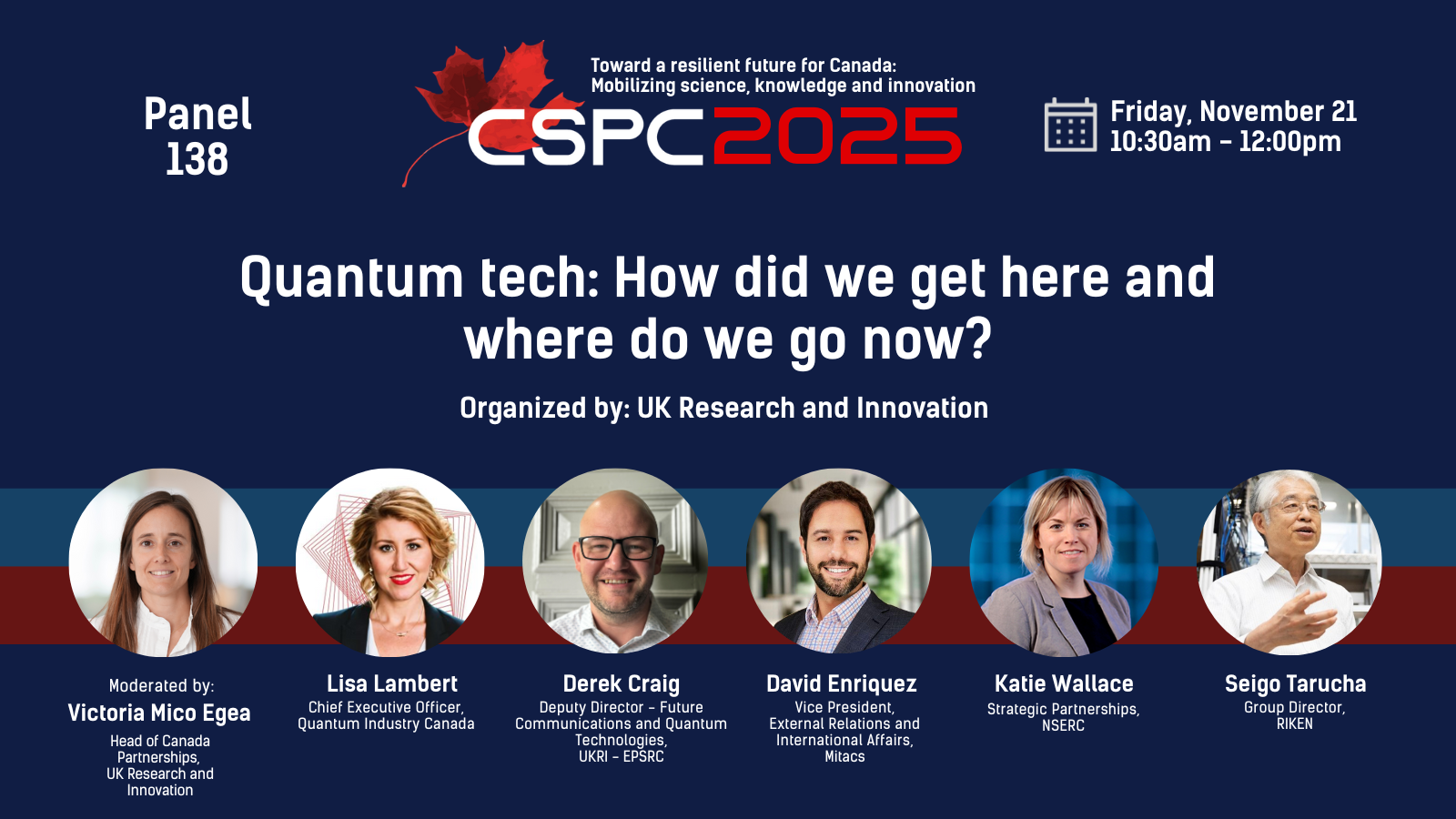
Abstract:
Harnessing the potential of emerging technologies such as quantum is key to building a resilient and prosperous future for Canada and its allies. And whilst international collaboration is critical for this, the shifting geopolitical context urges us to think further about how to best engage on sensitive technologies. Join us on this panel to explore impacts and potential of quantum technologies, reflect on the path that has taken Canada and some of its allies to their current international standing, and explore how to balance the benefits of international collaboration with dual use and knowledge sovereignty risks.
Summary of Conversations
The discussion centered on the evolution of quantum technologies from theoretical research to practical application, highlighting the strategic approaches of Canada, the UK, and Japan. Participants distinguished between established “Quantum 1.0” technologies, such as lasers and MRIs, and the emerging “Quantum 2.0” era, which involves engineering quantum effects for advanced sensing, computing, and communications. Key themes included the critical need for international collaboration to leverage shared values and complementary strengths, the urgency of developing a diverse workforce beyond just PhDs, and the economic and security imperatives driving global competition. Examples of current progress included quantum magnetometers for earth mapping and medical imaging advancements, illustrating that practical utility is already emerging alongside the significant challenges of scaling manufacturing and commercialization.
Take Away Messages/Current Status of Challenges
- Manufacturing Scalability: A primary barrier is the “artisanal” nature of current quantum device manufacturing; the sector lacks the infrastructure for mass production required to move from prototypes to widespread deployment.
- Workforce and Talent Gap: There is a massive disparity between current talent levels and future needs (e.g., a projected need for 200,000 jobs vs. a current workforce of 5,000 in Canada), with a critical shortage of engineers and technicians rather than just researchers.
- Security-Driven Competition: The global race for quantum leadership is largely driven by security threats, specifically the risk quantum computers pose to current encryption standards, necessitating domestic capability development.
- Technical Hurdles in Sensing: While sensing is a near-term application, challenges remain regarding the stability, uniformity of sensitivity across large areas, and the mass production of reliable sensors.
- Economic Value Capture: There is a risk that the majority of economic value (94%) will be captured by adopters rather than developers, challenging nations to create strategies that retain wealth within their local quantum ecosystems.
- Supply Chain Vulnerabilities: As the technology scales, there is a growing need to address resource circularity and secure supply chains for critical materials that may not be naturally sourced domestically.
- Public Perception vs. Reality: A challenge exists in overcoming the misconception that quantum is solely a futuristic “sci-fi” concept, which obscures the reality that quantum effects are already integral to current technologies.
- Integration with Existing Tech: The status of quantum is moving toward integration with High-Performance Computing (HPC) and AI, where quantum acts as a specialized accelerator rather than a standalone replacement.
Recommendations/Next Steps
- Shift to Industrialization: Strategies must pivot from a primary focus on research excellence to industrialization, emphasizing the construction of physical infrastructure and manufacturing capabilities to support commercial scale-up.
- Diversify Training Models: Talent development needs to expand beyond PhD tracks to include apprenticeships and technical training for engineers, ensuring a workforce capable of building and maintaining quantum systems.
- Deepen International Partnerships: Nations should formalize collaborations with trusted allies to share the heavy burden of development, harmonize standards, and leverage complementary strengths in areas like metrology and basic science.
- Foster Public-Private Collaborations: Governments are encouraged to fund programs where top academic researchers work directly within companies to refine science and test field applications, accelerating the path from lab to market.
- Leverage Existing Industrial Strengths: Countries should utilize established sectors such as photonics, telecommunications, and compound semiconductors to provide a foundation for quantum manufacturing and supply chain development.
- Promote Open Source Ecosystems: Supporting open-source quantum computing platforms is recommended to democratize access, bridge the digital divide, and allow for broader community engagement in technology development.
- Embed Research Security: Policies must integrate research security considerations early on to protect intellectual property and national interests while still facilitating necessary international cooperation.
- Focus on Citizen Benefits: Future initiatives should clearly demonstrate public utility, such as using quantum sensing for healthcare diagnostics or computing for energy grid optimization, to maintain public and political support.
* This summary is generated with the assistance of AI tools