
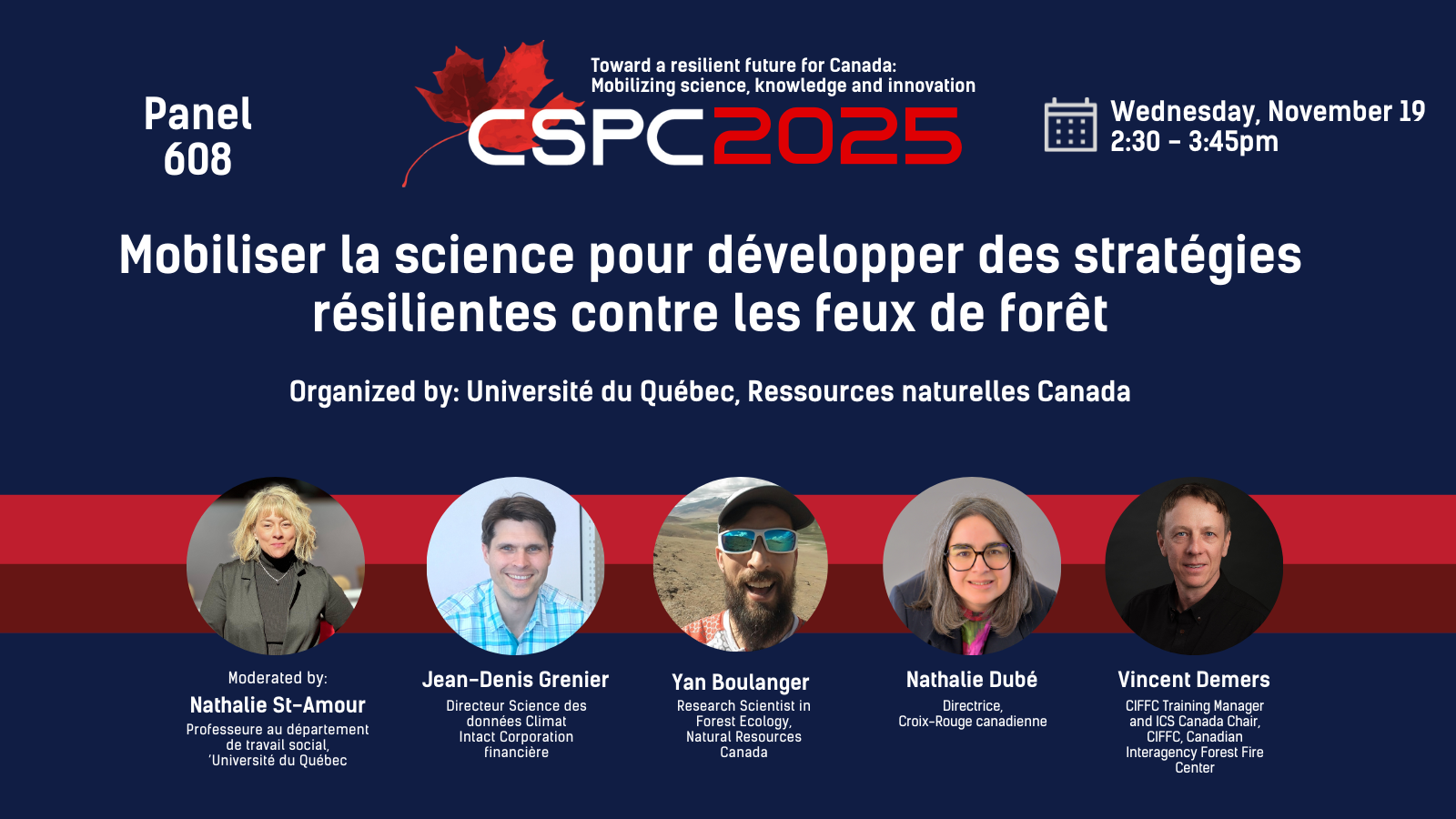
Abstract:
The frequency and severity of wildfires are increasing in Canada, with 2.8 million hectares burned each year, double the amount in the 1970s. With climate change, projections indicate that the area burned will continue to increase. Recent fires from Newfoundland to British Columbia illustrate this trend. In 2023, 6,623 fires burned approximately 15 million hectares, doubling the previous record. Despite initiatives to reduce them, these disasters affect populations and public health, forests, and economies. Fire specialists can influence public policy and improve risk prevention and mitigation.
Summary of Conversations
The discussion highlighted the dramatic increase in the frequency and severity of wildfires, widely attributed to climate change and extreme weather conditions. The last three years have been exceptional, far exceeding previous records, with significant ecological, economic (insured damage of over $100 million in unexpected regions such as Newfoundland), and social (smoke, evacuations) impacts.
Faced with this new reality, a paradigm shift is needed, moving from a reactive approach of total suppression to a strategy of anticipation, prevention, and risk mitigation. Science, including the dissemination of knowledge and the development of risk assessment tools, as well as cross-sector collaboration (emergency management, insurance, humanitarian support) are considered essential for developing resilient strategies adapted to the growing scale of the challenge.
Take Away Messages/Current Status of Challenges
- Fire intensity and intervention limits: The severity of fires is increasing, as is the number of days per year when fire intensity exceeds the maximum capabilities of traditional firefighting methods (water pumps, helicopters, water bomber aircraft), resulting in prolonged periods during which fires burn out of control.
- Insufficient domestic capacity: Canada has frequently and problematically relied on international assistance (five of the last seven seasons) to manage crisis spillovers, signaling a lack of autonomous national capacity.
- Inconsistency of action: There is a lack of overall cohesion and common vision among the independent actors (civil society, insurance, humanitarian, government) involved in risk management, leading to a primarily reactive approach.
- Threat to the built environment: Fires are increasingly threatening urban and suburban areas, causing human tragedy and considerable material losses in areas that have historically been relatively unaffected, requiring a reassessment of risks.
- Challenges in volunteer management: Maintaining volunteer teams over the long term is a challenge, particularly due to the training required to operate safely and effectively.
- Regional risk inequality: Protection tools and risk assessment are not sufficiently regionalized (building codes, urban planning), ignoring risk inequality within the same province and the need for more significant measures in critical areas.
- Importance of mental and social health: Fires have a significant impact on the physical and mental health of populations, as well as on Indigenous communities, which are disproportionately affected.
- Access to and dissemination of science: Research is evolving rapidly, but communicating and popularizing it among regional stakeholders and the general public in order to inform adaptation policies and practices remains an ongoing challenge.
Recommendations/Next Steps
- Shift from reaction to anticipation: Adopt a strategic approach that emphasizes prevention and mitigation, encouraging communities to implement risk reduction programs (e.g., FireSmart) before a disaster strikes.
- Increase training for municipal firefighters in forest firefighting: Work with municipal firefighter training schools to develop a micro-program dedicated to forest firefighting, prevention, mitigation, and passive infrastructure protection.
- Develop response management capacity: Create specialized response management teams to serve as “conductors” and effectively direct volunteer resources and national emergency agencies during overwhelming situations.
- Invest in specialized monitoring: Maintain and develop event monitoring teams comprising multidisciplinary experts (meteorologists, social scientists) to anticipate seasonal risks and enable the strategic pre-positioning of equipment.
- Enhance interoperability: Continue to establish common exchange protocols, operational standards, and training criteria for personnel and equipment among provinces, as well as with international partners.
- Reform codes and planning: Integrate risk assessment data into urban planning, residential development, and building codes to implement stronger protections and rules tailored to high-risk areas.
- Expand humanitarian partnerships: Support the development of humanitarian organizations and volunteers (such as Team Rubicon or Sarvac) as an alternative and complement to government resources, to provide assistance when capacity is overwhelmed.
- Continue cross-sector collaboration: Encourage ongoing discussions and actions between the public sector, the private sector (insurance), and academia to catalyze interdisciplinary solutions and greater consistency in strategies.

Simultaneous translation for these panels was provided thanks to the support of the Secrétariat du Québec aux relations canadiennes
* This summary is generated with the assistance of AI tools