
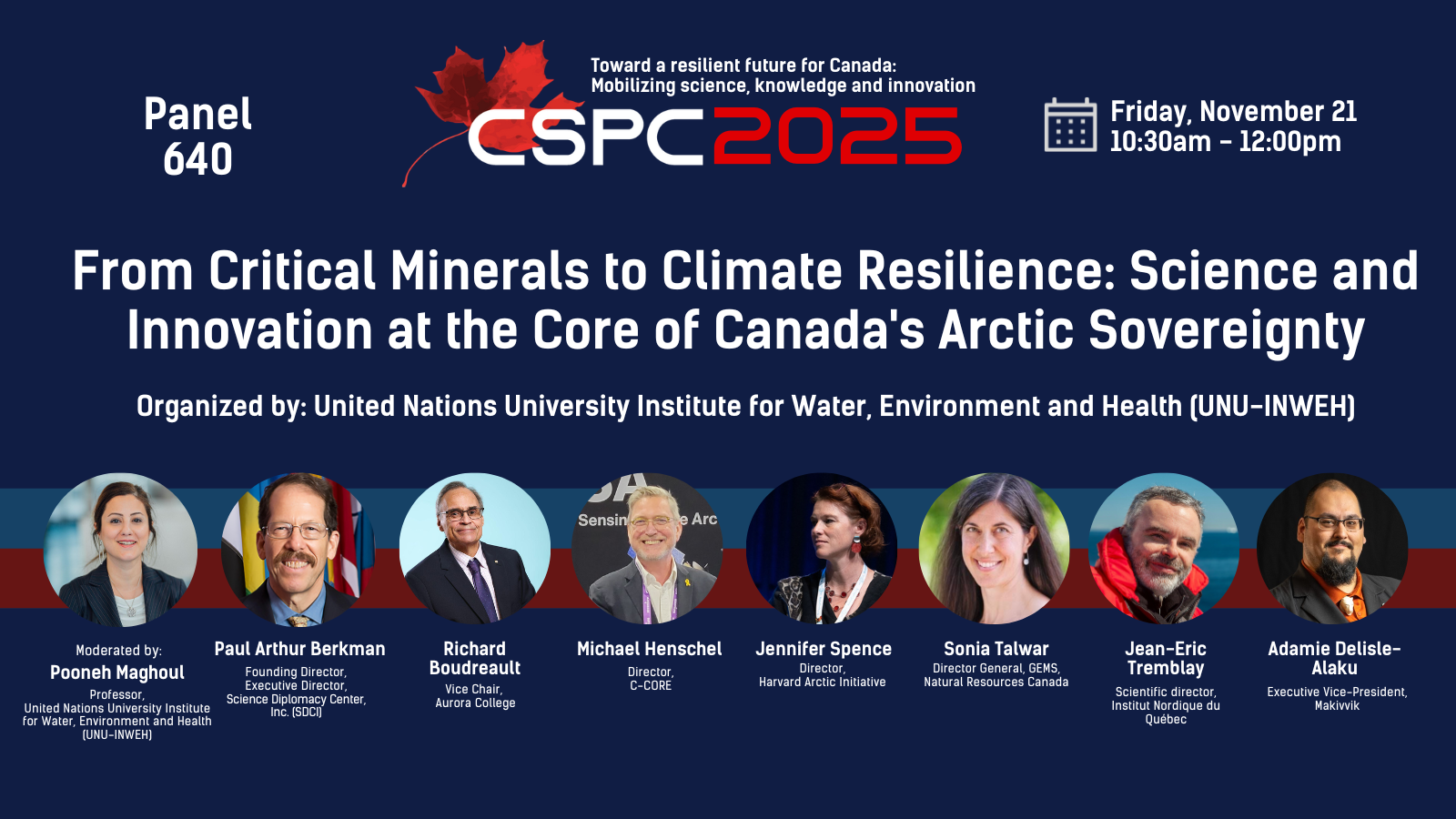
Panel: 640
From Critical Minerals to Climate Resilience: Science and Innovation at the Core of Canada's Arctic Sovereignty
Abstract:
This panel addresses the urgent need for a resilient and sovereign Canadian Arctic in the face of accelerating climate change, infrastructure vulnerabilities, and rising global interest in the region’s resources. Framing the Arctic as both a frontline of climate risk and a platform for innovation, the session explores how science, technology, and diplomacy can coalesce to advance sustainable development, peacebuilding, and inclusive governance. With a focus on ethical innovation, Indigenous leadership, and strategic foresight, the panel proposes a techno-diplomatic approach to Arctic resilience, positioning Canada as a global leader in navigating climate, geopolitical, and societal challenges in extreme environments.
Summary of Conversations
Discussions centered on the urgent need for a resilience-based approach to address profound and accelerating changes in the North. Key themes included the direct threat of climate change, with permafrost thaw destabilizing infrastructure and the significant global risk posed by the release of trapped permafrost carbon. The conversation emphasized that true sovereignty must move beyond militarization to prioritize collaborative efforts that deliver affordable essential services—such as housing, clean water, and reliable telecommunications—to Indigenous communities, addressing historical inequities. Participants highlighted the growing tension between global critical mineral demand and the well-being of local ecosystems and residents, advocating for development models that avoid past economic failures. Furthermore, science and technology were framed as crucial tools for diplomacy and to keep international communication open. An urgent call was made to “leapfrog” current diesel dependence for energy by adopting innovative, North-specific solutions like hybrid systems and nano-reactors.
Take Away Messages/Current Status of Challenges
- Geopolitical Fragmentation: The historical zone of cooperation in the Arctic has become a more fragmented and tense geopolitical space, with the 2022 pause of the Arctic Council demonstrating a failure to consistently use science as a practical diplomatic tool in times of security crisis.
- Permafrost Tipping Point: The thawing permafrost holds twice the amount of carbon currently in the atmosphere, posing a critical climate tipping point if released as highly potent biogenic methane (which is 86 times more powerful than CO2).
- Infrastructure and Economic Instability: Approximately 70% of northern infrastructure is built on permafrost, and thaw-related instability is projected to incur damages costing tens of billions of dollars across the circumpolar Arctic by 2050.
- Deficit in Essential Services: Despite constitutional protections and modern treaties, major gaps persist in essential services for Indigenous communities, including inadequate systems for drinking water, waste treatment, affordable housing, and a lack of basic telecommunications like cell service.
- Unsustainable Energy Dependence: Remote communities rely on diesel for 70% to 90% of their energy, resulting in costs up to 10 times higher than southern Canadian rates and generating micro-dust (PM 2.5) that accelerates local ice and snow melt.
- Development Tension: The drive for critical minerals, projected to increase 300% by 2040, creates a tension between global green transition needs and the necessity of ensuring development strengthens local ecosystems and communities rather than repeating past “boom and bust” cycles.
- Lack of Integrated Knowledge: The path to sustainable solutions is hampered by the incomplete “transdisciplinary integration” of natural sciences, social sciences, and Indigenous knowledge, which is necessary to understand and respond to invisible, systemic changes.
- Marine Safety Gaps: While Arctic shipping has tripled due to sea ice loss, the environment remains dangerous (“ice free is not safe”), with poor marine mapping, monitoring systems, and inadequate emergency response infrastructure to support safe navigation.
Recommendations/Next Steps
- Elevate Science in Diplomacy: Governments must actively invest in and understand how to use science as a practical diplomatic tool to maintain open lines of communication and cooperation with all nations, even during periods of geopolitical tension.
- Decolonize Sovereignty and Policy: Canadian policy must redefine “meaningful sovereignty” by fully addressing major gaps in essential services and investing in affordable infrastructure to empower and collaborate with Indigenous communities, recognizing their status as inhabitants and stewards of the land.
- Leapfrog Energy Technology: The North should bypass outdated systems by adopting a long-term vision for energy security that utilizes innovative technologies like small modular reactors (SMRs), nano-reactors, and wind/hybrid systems, prioritizing redundancy in the near term.
- Implement a Resilience Development Model: Critical mineral development must be anchored in a resilience approach, grounded in local voices and priorities, and supported by robust geoscience and social science to ensure community and ecosystem benefits.
- Invest in Foundational Geoscience and Monitoring: Foundational geoscience knowledge and monitoring projects must be enhanced to both de-risk mineral exploration and, critically, to measure and understand natural methane release from permafrost, informing urgent climate mitigation strategies.
- Develop “Techno-Diplomacy”: Sustainable development requires the intentional coupling of new built infrastructure (e.g., energy reactors) with effective governance mechanisms (policy, agreements, and regulations), a relationship described as techno-diplomacy.
- Mandate Regulations for Industrial Activity: New standards and regulations must be established for industrial and technological deployments, such as mandating the use of monitoring technology for mine tailings ponds and creating legislation to enable local communities to operate their own satellite communications.
- Center Marine Access Needs: Investment in marine infrastructure should prioritize improved mapping, safe shipping lanes, and emergency response capabilities that are developed in consultation with northern communities and align with their marine access needs and priorities.
* This summary is generated with the assistance of AI tools