
“AI for All” Names the Adoption Problem. It Doesn’t Fund the Fix.
Author(s):
Slavica Stevanovic

Disclaimer: The French version of this text has been auto-translated and has not been approved by the author.
Why Canada’s low business AI adoption is a change-management problem — and why “AI for All” should fund a grant program for SME process redesign, not just AI tools.
Canada helped invent modern AI. The 2017 Pan-Canadian AI Strategy was the world’s first funded national AI strategy, and it delivered: the research institutes it seeded in Toronto, Montreal, and Edmonton still anchor an ecosystem other countries study and try to copy [1]. Turning that research and innovation into productivity gains has been the hard part.
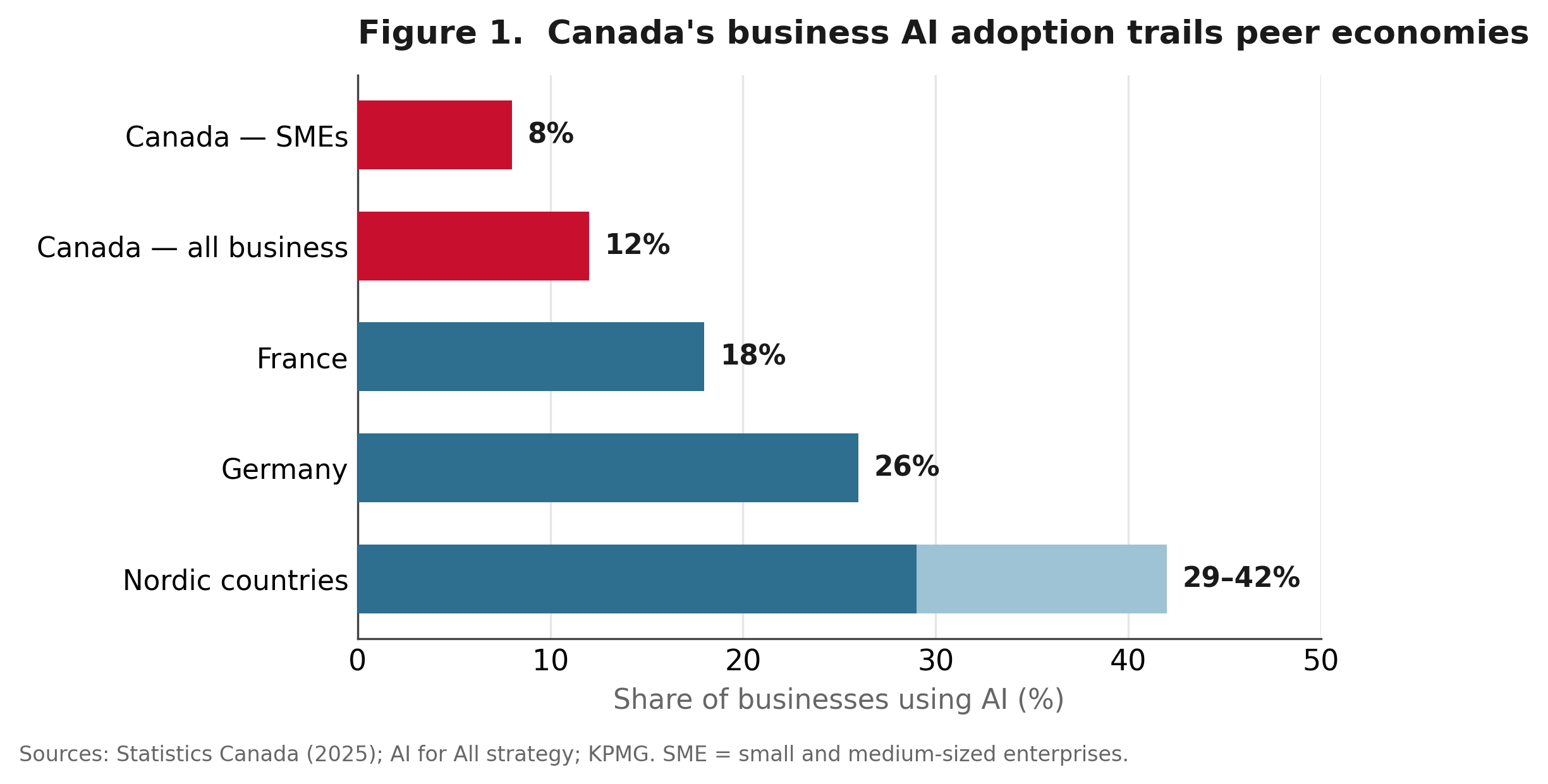
Business AI adoption sat at just 12 percent in mid-2025, and closer to 8 percent among the small and medium-sized enterprises (SMEs) that make up 99 percent of Canadian firms, well behind the Nordic countries, Germany, and France (Figure 1) [2]. A KPMG–University of Melbourne study ranks Canada 44th of 47 countries on AI training and literacy [3]. Canada’s National Artificial Strategy “AI for All” has set an ambitious target to address this problem: 60 percent adoption by 2034, a five-fold jump meant to add nearly $200 billion in GDP [4]. That is achievable, because the bottleneck is no longer in the models. It is organizational — mapping workflows, restructuring roles, and training people to use the tools well.
History repeats here. When the internet arrived commercially in the mid-1990s, most businesses approached it as another information technology by building websites, digitized brochures, and moving forms online. The productivity payoff came a decade later, once banks moved settlement online, retailers rebuilt supply chains around real-time data, and governments redesigned services instead of scanning the same paper. Economists call the lag the Solow paradox, after the 1987 quip that “you can see the computer age everywhere but in the productivity statistics.” [5] It broke only when firms restructured around the technology; Brynjolfsson and Hitt showed IT paid off mainly where it was paired with process redesign [6]. AI will repeat the pattern. Using it to answer email is not transformation; redesigning workflows, decision-making processes, roles, and training is.
AI for All warns that without robust change management, AI “can appear as a disruptor rather than an enabler,” and it promises hands-on support, adoption roadmaps, and a single advisory point of contact for SMEs [7]. But the money is aimed elsewhere. The headline instruments, a $500-million BDC financing program for AI tools, a $500-million Regional AI Initiative, a $700-million compute fund, and tax measures such as the Productivity Super-Deduction lower the cost of buying and running AI. None of it pays for the expensive human work the diagnosis calls for: redesigning how a business actually runs.
Canada has closed an adoption gap before. The Canada Digital Adoption Program (2022) paired SMEs with advisors and interest-free loans; its Boost Your Business Technology stream approved roughly 20,000 advisory grants before closing, proving SMEs will take hands-on support when it is simple and subsidized [8]. But it paid for choosing and installing tools, not for rebuilding the business around them.
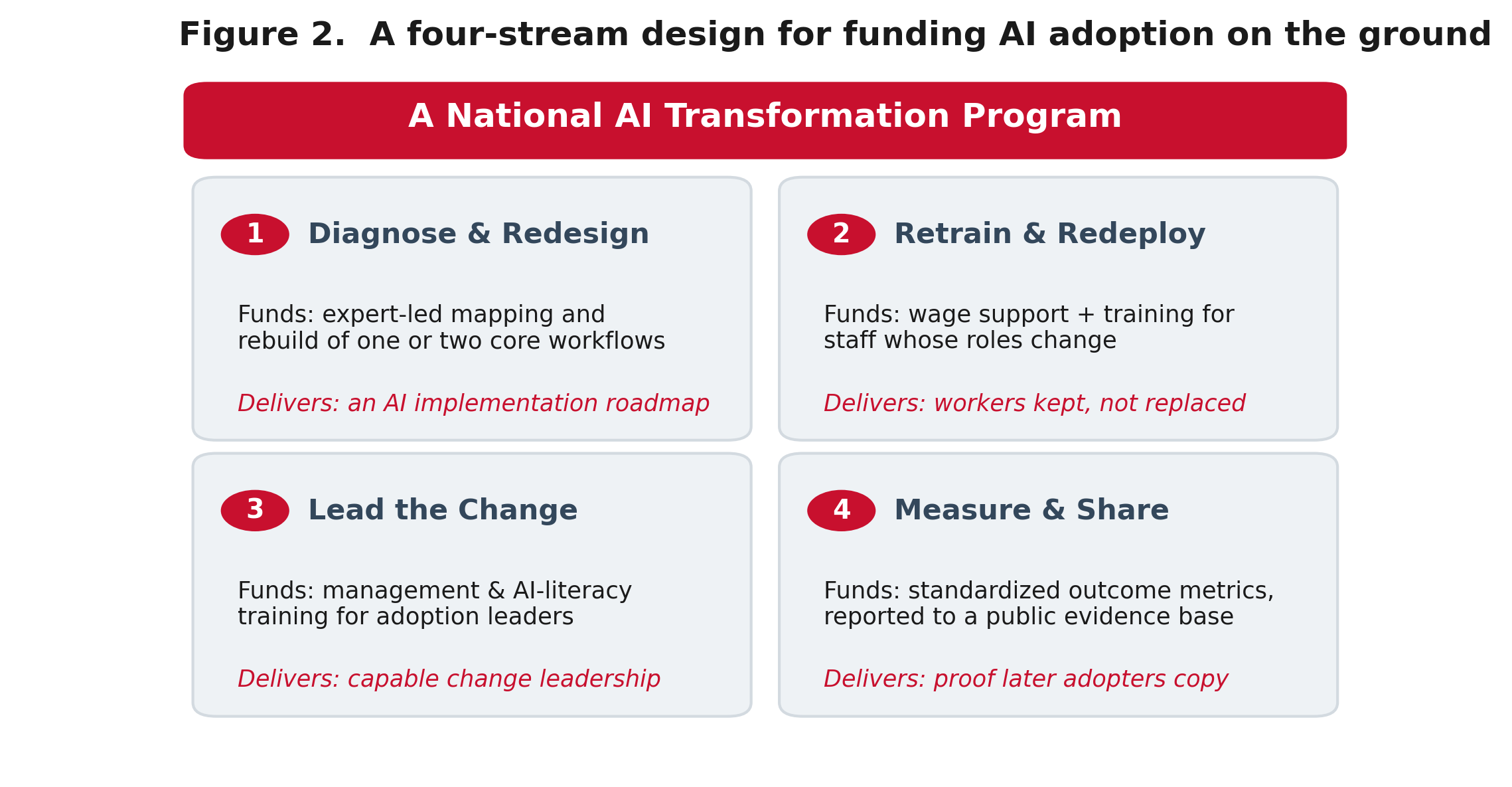
The fix is a national AI Transformation Program that funds the organizational work itself. It need not be a new bureaucracy: This can be coordinated through the advisory committee’s point of contact and leverage existing AI for All resources available through the Regional Development Agencies, with the readiness-assessment tool as the on-ramp. Four funding streams would cover what adoption actually requires on the ground (Figure 2).
- Diagnose and redesign. Matching grants that bring change-management and process expertise into a firm to map and rebuild core workflows around AI, with a written implementation roadmap and AI tool design (e.g skills, plug-ins, agents) as the deliverable.
- Retrain and redeploy. Wage support and training vouchers for staff whose roles change rather than disappear, tying public money to keeping workers and rebuilding their jobs around the technology.
- Lead the change. Management and AI literacy training for owners and managers who must first understand how to integrate AI into their business processes, build trust and then drive adoption. Their story to workers must focus on productivity and change management, not replacement of workers.
- Measure and share. Standardized outcome metrics and a requirement to report anonymized results into a public evidence base, so each funded project teaches the next and later adopters can copy what demonstrably works.
Canada has spent more than a decade investing in artificial intelligence. The next investment should be in artificial-intelligence reorganizations. AI for All commits real money to compute, capital, and skill development; without an equal commitment to the organizational labour of adoption, running the risk of the 60 percent target becoming another well-funded infrastructure story that Canadian businesses still don’t know what to do with.
AI acknowledgment: AI tools were used to support research, structure the argument, and edit this editorial. All ideas, judgments, and conclusions are the author’s own, and the final content has been reviewed, verified, and approved by the author.