
AI for All Needs Assurance for All
Author(s):
Leke Abaniwonda

Disclaimer: The French version of this text has been auto-translated and has not been approved by the author.
Canada’s new national AI strategy, AI for All, makes an unusually clear bet. “Trust is the north star of this strategy,” the document declares, and its logic follows in a straight line: Canadians benefit from AI only if they adopt it; they will adopt it only if they trust it; and they will trust it only if it is built and governed on Canadian terms. Released on June 4, 2026 after a national consultation that drew more than 11,000 submissions and the counsel of a 28-member expert task force, the strategy arranges six pillars around three values — trust, opportunity, and sovereignty — and sets a headline goal of lifting business AI adoption to 60 percent by 2034.
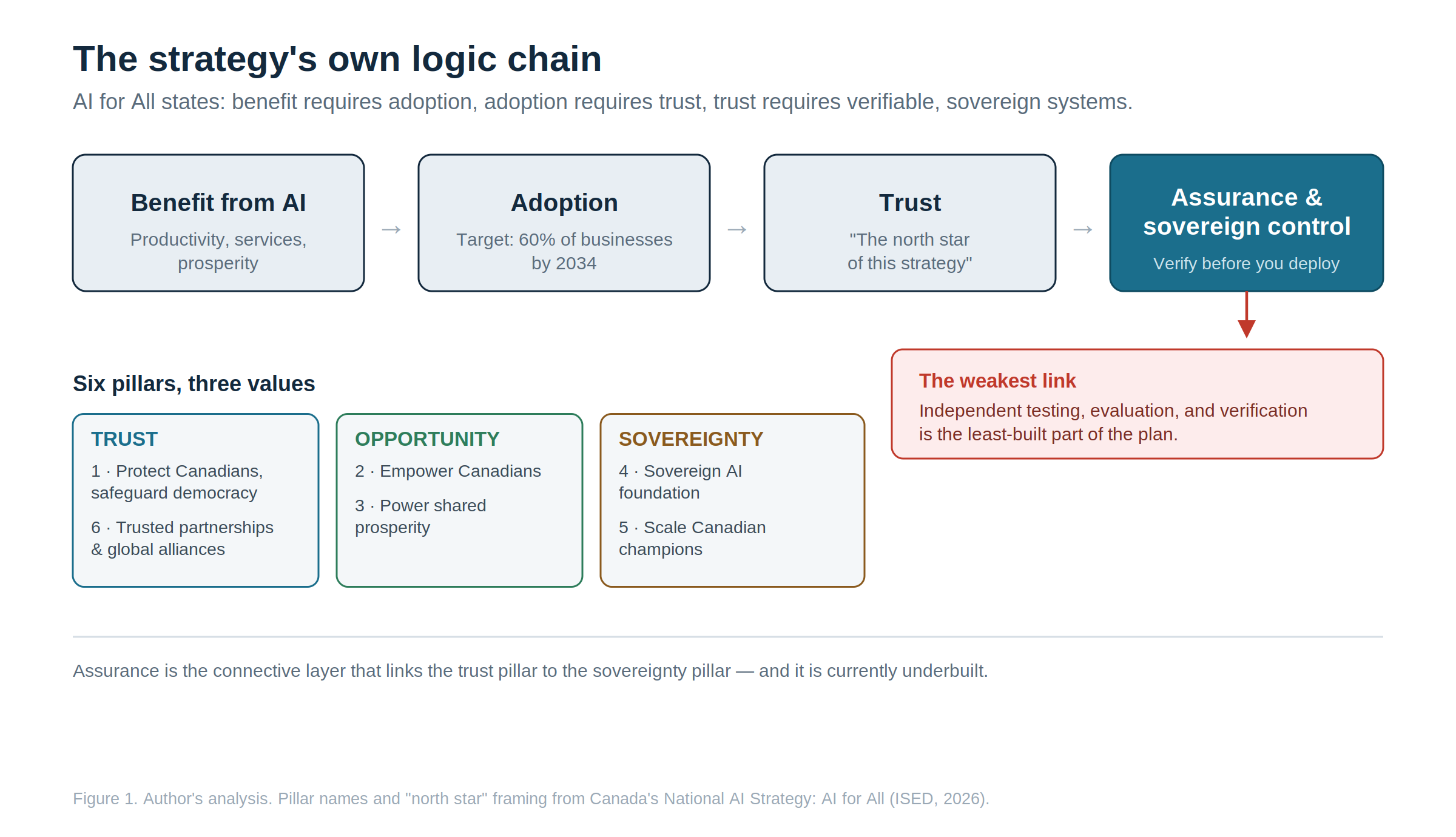
Figure 1. The strategy’s own logic chain — and where assurance sits as the weakest link. Author’s analysis.
It is a coherent and, in important respects, an admirable plan. It is candid about job security, privacy, and safety; it funds research; and it treats sovereignty as a serious national objective rather than a slogan. But it contains a quiet asymmetry. Trust is named the foundation, yet the machinery that actually produces trust at the moment that matters — when a hospital, a credit union, or a small manufacturer decides whether to deploy a particular AI system — is the least-developed part of the strategy.
Consider where the concrete commitments land. Canada is investing tangibly in compute, in scaling national champions, and in sovereign infrastructure. The trust pillar, by contrast, is delivered largely through rules and partnerships: promised privacy reform, online-harms legislation, and international standards work. These are necessary. They are not sufficient.
Here is the distinction that matters. Rules tell you what is prohibited—partnerships set shared principles. Neither tells a procurement officer in Saskatoon whether the model in front of them is safe, fair, and reliable enough to put into production next quarter. That is a question of assurance, independent testing, evaluation, verification, and it is precisely the capability Canada has not yet built as shared infrastructure.
The pieces exist, but they sit in isolation. The Canadian AI Safety Institute, launched in 2024, funds valuable safety research through CIFAR and the national institutes, but it is a research body, not an assurance service. From May 2027, the financial regulator’s Guideline E-23 will require federally regulated institutions to manage model risk, including third-party and AI models, but it places that burden on each institution individually. Canada has research on one side and rules on the other, with no operational layer in between that a deployer can actually use to verify a system before it goes live.
That gap is not a technicality. It quietly undercuts three of the strategy’s six pillars at once.
It undercuts trust, because trust that cannot be verified is merely branding. It undercuts shared prosperity and the empowerment of Canadians, because the strategy’s own adoption target lives or dies with small and medium-sized enterprises — and an SME cannot stand up a bespoke AI assurance function the way a major bank can. If every clinic, credit union, and shop must validate advanced systems alone, the climb from roughly one in ten businesses to six in ten stalls exactly where the Canadian economy actually lives. And it undercuts sovereignty most of all. If Canadian institutions cannot independently assess the systems they deploy, they will import trust from the self-attestation of foreign vendors, accepting a supplier’s word that its own model is safe. Outsourcing the judgment of whether a system is trustworthy is the precise opposite of the sovereign control the strategy promises.
Trust and sovereignty, in other words, are the same problem viewed twice. A country cannot be sovereign over technology it cannot independently evaluate.
The encouraging news is that Canada is unusually well-placed to close this gap, and the strategy’s own “build-partner-buy” doctrine points the way. The missing layer should be treated as public infrastructure and a shared assurance capability, much as the National Research Council already maintains the national measurement standards that every laboratory and manufacturer relies on rather than recreating. No hospital recreates the standard for the kilogram; none should have to rebuild AI assurance from scratch either.

Figure 2. Assurance as shared public infrastructure: a tiered national model. Author’s proposed model.
Concretely, this means a distributed, public-interest assurance capability that connects what Canada already has: the AI Safety Institute, the National Research Council, the three national institutes, and the Standards Council of Canada. It would offer tiered assurance — shared evaluation, red-teaming, and benchmarking for most systems; standards-aligned conformity assessment for higher-stakes ones; and, for the most critical applications such as clinical decision support or infrastructure control, the emerging frontier of formal, mathematically grounded verification. Smaller institutions would draw on a common utility instead of duplicating costs they cannot bear. And “assured in Canada” would become exactly what the sovereignty pillar calls for: a capability the country owns, a lever for public procurement, and an export in its own right as allied nations converge on shared standards.
None of this competes with the strategy. It completes it. AI for All correctly identifies trust as the precondition for everything else; it simply needs to fund the machinery that turns trust from an aspiration into something a Canadian can check. Adoption you cannot verify is not adoption; it is exposure. If Canada wants AI for all, it will need assurance for all.
Acknowledgment of AI use
Acknowledgment of AI use: The author used an AI assistant (Anthropic’s Claude) for research support, structuring, and drafting assistance. All factual claims were verified by the author against the primary sources listed below, and the final editorial was written, reviewed, and approved by the author, who is solely accountable for its content.
References
[1] Innovation, Science and Economic Development Canada, “Canada’s National Artificial Intelligence Strategy: AI for All,” Government of Canada, June 4, 2026.
[2] Innovation, Science and Economic Development Canada, “Canadian Artificial Intelligence Safety Institute (CAISI),” Government of Canada, 2026.
[3] Office of the Superintendent of Financial Institutions, “Guideline E-23 — Model Risk Management (2027),” September 11, 2025.
[4] RBC, “Sovereign AI: Shaping Canada’s Next Digital Chapter,” 2026.