
From Procurement Body to Industrial Architect: What Canada’s New Defence Investment Agency Can Learn from South Korea
Author(s):
Tae Yeon Eom

Disclaimer: The French version of this text has been auto-translated and has not been approved by the author.
Canada is at a rare inflection point. Prime Minister Carney’s Defence Industrial Strategy (DIS), backed by an 85% increase in defence R&D spending and CAD $180 billion in procurement over the next decade, is a generational bet on rebuilding Canada’s defence industrial base. At its centre stands the Defence Investment Agency (DIA), a standalone legislation slated for approval/ascent in spring 2026. South Korea’s Defence Acquisition Program Administration (DAPA), marking its twentieth anniversary in 2026, offers the most instructive comparison: a procurement agency transformed into a full-cycle R&D and industrial institution, with successes that command respect and failures worth equal study.
DAPA at Twenty: A Record Worth Reading Carefully
When DAPA was established in 2006, it consolidated acquisition authority scattered across eight military bodies. Defence exports grew from USD 300 million (CAD 410 million) to USD 17.3 billion (CAD 23.7 billion) by 2022, with 2025 figures pointing toward USD 23 billion (CAD 31.5 billion)— the second-largest arms supplier to NATO member states. Each achievement rested on sustained R&D: the K2 main battle tank, K9 self-propelled howitzer, and FA-50 light combat aircraft each began as long-horizon domestic research programmes before becoming export successes across Europe and Southeast Asia. However, three structural failures in this record translate directly into design requirements for the DIA.
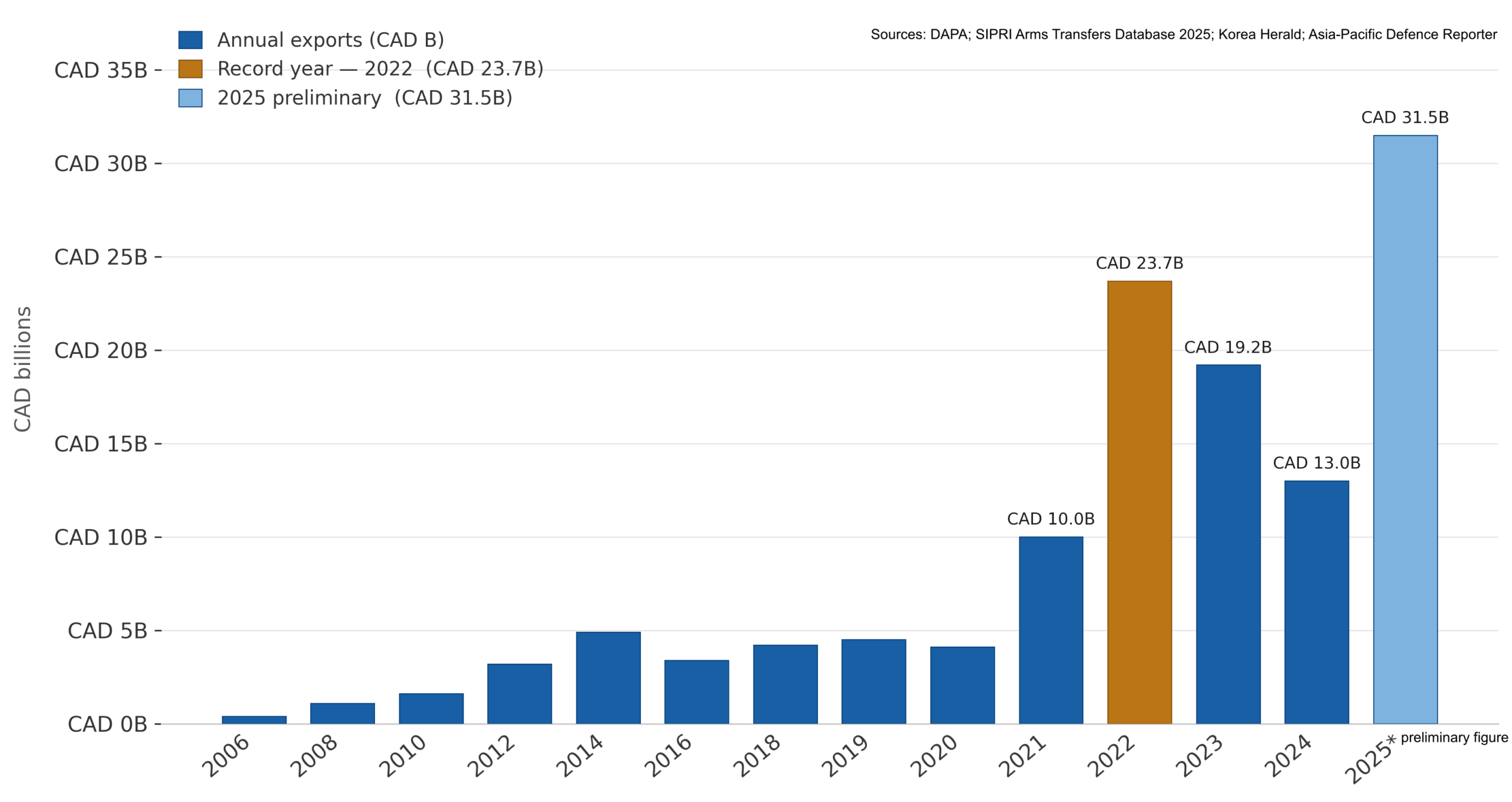
[Figure 1 — South Korea Export Trajectory, 2006–2025]
Lesson 1: Governance, Personnel, and the Ethics of Expertise
The most revealing governance challenge within DAPA is internal. DAPA’s workforce is approximately 70% civilian public servants and 30% military personnel, yet key leadership posts have historically been held by officers. Officers bring operational credibility but rotate on short tours. Civilian officials offer continuity but may lack the technical depth for R&D investment cases or complex weapons specifications. Neither group alone provides the interdisciplinary expertise, defence acquisition, systems engineering, or industrial economics that major programmes demand, leaving a structural gap that no current career track fills.
That vulnerability has an acute ethical dimension. The 2018 Cheon-gung missile programme audit, in which procurement officials directed contracts toward specific firms before accepting employment and benefits from those same firms, illustrates a collusion risk inherent to rotating generalists managing long-term, high-value contractor relationships. A December 2025 presidential proposal to elevate DAPA to ministry status bypassed the Ministry of National Defence without consultation, generating an institutional standoff; Commissioner Lee acknowledged the breach in March 2026 while maintaining the policy conviction. The proposal had real merit, but the lesson is that mandate and trust must expand together. For the DIA: establish a dedicated acquisition career classification—insulated from the generalist rotation cycle, spanning defence acquisition, systems engineering, and industrial economics; build transparent ethics frameworks; and cultivate relationships with DND and PSPC before standalone legislation is passed.
Lesson 2: From Procurement Cycles to R&D-Driven Capability
DAPA’s most significant strategic evolution has been separating its legal framework into two pillars: the Defence Industry Development Act, governing industrial policy and export, and the Defence Science and Technology Innovation Act, governing R&D investment. This separation, recognizing that R&D and procurement require different governance logics, is foundational to Korea’s export success. Procurement buys what exists; R&D determines what will exist a decade hence.
Canada’s R&D investment now matches this ambition in scale. The National Research Council (NRC) committed over CAD $900 million under the DIS, including over CAD $500 million for a Drone Innovation Hub (Ottawa-Mirabel) and a Bombardier Global 6500 defence research aircraft, as well as CAD $161 million for quantum technologies. BOREALIS simultaneously launched a Call for Proposals for Defence Innovation Secure Hubs in unmanned systems and quantum.
The scale is right. What must now follow is the structural lesson from DAPA’s failure: when Korea’s 2023 acquisition directive amendments allowed sole-source contracts for validated technologies but were not applied retroactively, 2022 cohort startups were stranded in a Valley of Death. DAPA is now trying to close that gap through its Defence AX Hub, opening military data and test infrastructure to civilian startups. Canada’s BOREALIS DISHs are structured similarly; the DIA must now lock in procurement fast-track legislation so that what BOREALIS validates, the Canadian Armed Forces can acquire. A December 2025 CGAI analysis also warns that the proposed Cybersecurity Program for Suppliers to the Crown (CPCSC) risks hundreds of millions in compliance costs for SMEs; the DIA should advocate for a tiered framework that defers full requirements until a firm enters a Programme of Record contract.
Lesson 3: Partnership as Permanent Industrial Strategy
DAPA’s deepest insight is structural: export success was a self-reinforcing R&D cycle. Sustained investment produced combat-proven platforms; performance generated export demand; revenues funded the next R&D cycle; and each iteration left Korea’s industrial base more capable. Canada’s DIA should be designed with this flywheel in mind: technology investment drives commercial returns, which finance the next wave of innovation and hiring.
The most compelling proof of that model is unfolding in Canada. Backed by DAPA’s whole-of-government support framework spanning six Korean ministries, Hanwha’s bid for the CAD $60 billion Canadian Patrol Submarine Project (CPSP) extends beyond shipbuilding: Hanwha signed a binding CAD $345 million agreement with Algoma Steel, teaming deals with GeoSpectrum Technologies, Aspin Kemp & Associates, J-Squared Technologies, and Des Nedhe Group—a Saskatchewan-based Indigenous-owned enterprise. On the R&D side, Hanwha partnered with Cohere on AI for submarine operations and smart shipyards, and with Telesat and MDA Space on LEO satellite communications—alongside university R&D agreements with UofT, Dalhousie, and UNB. This is the doctrine the DIA should formalize: use procurement scale to drive prime contractors into Canada’s AI, satellite, and deep-tech supply chains.
Sustaining that R&D-to-export flywheel requires a financial architecture that matches industrial ambition. Korea’s Poland experience illustrates the risk: emergency parliamentary legislation was required when the Export-Import Bank of Korea hit its statutory capital limits, and a presidential-government standoff over EU SAFE defence loans suspended billions in contracts in early 2026. Export Development Canada (EDC) must be structured as a built-in hedge with a defence-specific mandate—not a commercial-risk backstop.
An Accelerating Bilateral Opportunity
The groundwork was laid before the formal announcements. At an Asia Pacific Foundation of Canada event in December 2025, Captain Suoek Lee, Director for North America Cooperation at DAPA, signalled that South Korea was considering sharing its institutional acquisition and R&D expertise bilaterally. The Canada-Korea 2+2 Ministerial Meeting on February 25, 2026, then produced a Military Information Protection Agreement and opened negotiations for a comprehensive Defence Cooperation Agreement.
Canada’s BOREALIS investment in unmanned systems and quantum technologies is the R&D layer that South Korea’s Defence Innovation 4.0 framework is built to prototype and field at scale. Fused with Korea’s submarine and autonomous naval platform capacity, this could yield Arctic domain awareness systems neither country could develop alone at comparable speeds or costs. On the CPSP, Commissioner Lee assessed the contest as genuinely open—odds roughly even—and the R&D relationships, teaming agreements, and government frameworks now being built represent durable cooperation that generates returns well beyond any single contract cycle.
The creation of the DIA is the beginning of a transformation, not its completion. DAPA demonstrates that centralized acquisition, paired with sustained R&D investment and strategic partnership, can produce extraordinary results—and that the same institutions, without coherent governance and matching expertise, breed the paralysis they were designed to prevent. When R&D investment, technology sovereignty, and industrial partnership form a self-reinforcing cycle, the returns extend far beyond any single procurement. That is the architecture Canada now has the mandate and funding to build.
Tae Yeon Eom is a Project Manager and Researcher at the Asia Pacific Foundation of Canada, where his work focuses on Indo-Pacific security policy, defence industrial cooperation, and the governance of emerging technologies in AI and Cybersecurity.