
No policy is an island: Complex challenges demand many minds
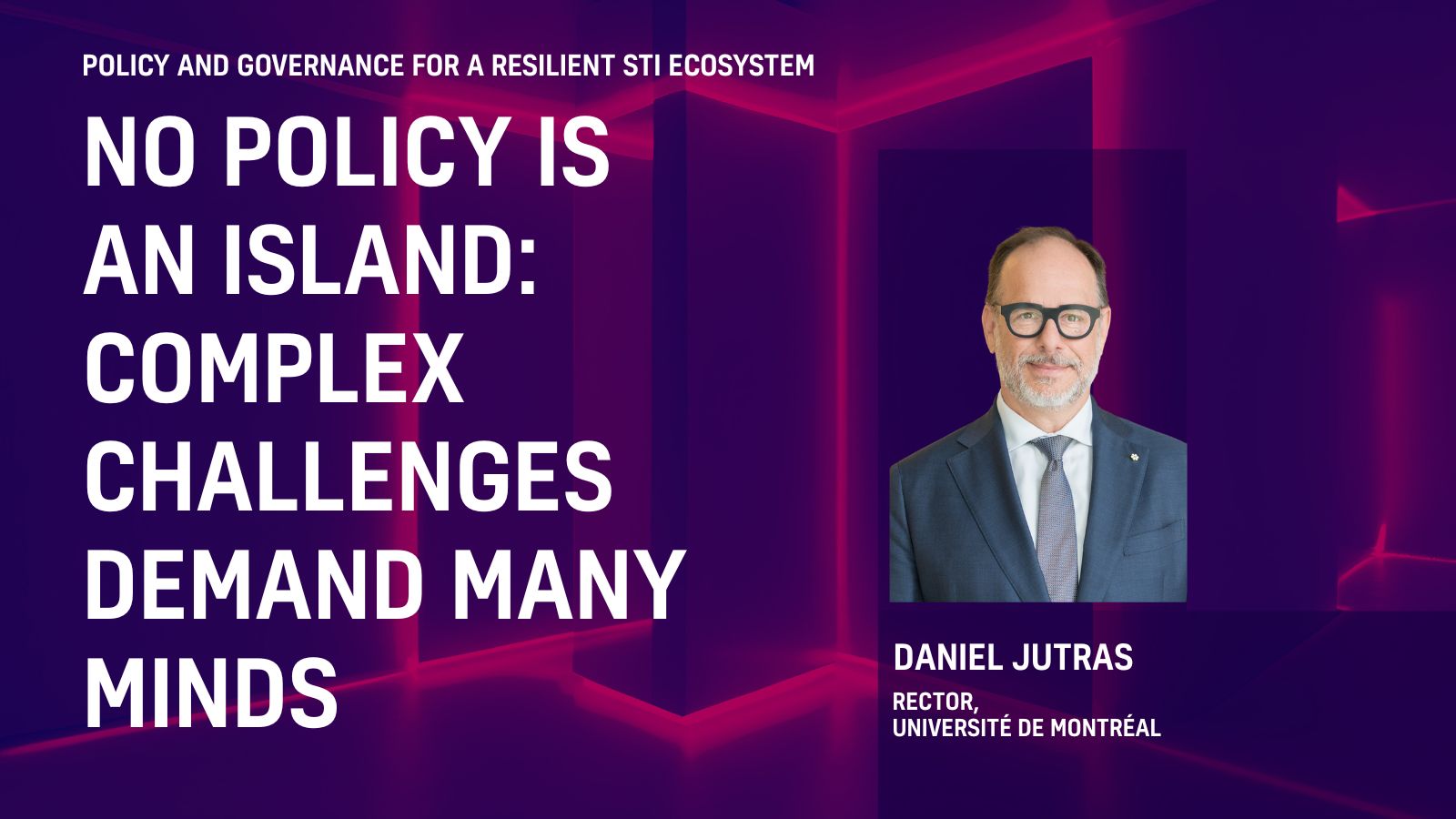
Author(s):
Daniel Jutras
Université de Montréal
Rector
Disclaimer: The French version of this text has been approved by the author.
On the 30th day of June, 2025, life changed for thousands of Quebec families. Until that day, assets accumulated by common-law spouses were not considered community property, as they are for married couples. If a common-law couple separated, one partner could be left destitute—often to the detriment of the children. Quebec’s new parental union regime has righted this wrong: when common-law couples have children, they begin accumulating community property de facto.
This change in public policy stands on solid social justice grounds, but it is also noteworthy for its genealogy: it was fathered by my colleague in Université de Montréal’s Faculty of Law, Alain Roy, who chairs the Quebec government’s advisory committee on family law and has in the past, advised the Ministry of Families on the issue. It’s a textbook example of an academic successfully applying his expertise beyond the walls of the university to serve the common good. Professor Roy was instrumental in adding a new brick to the edifice of public policy.
Examples of faculty members at my university and other institutions who are involved in developing and implementing public policy are legion. Some, like Alain Roy, spark change by drawing public attention to an issue and advocating for legal reform. Amid the breakneck development of artificial intelligence, experts in many fields are using their influence to foster public debate on ethical guardrails for AI. The issues are being approached from multiple angles—and some unusual byways. For example, my university was recently involved in staging a play about AI.
The articulation of public policy is perhaps the democratic process that brings the largest number of actors together to row towards a common goal: making society function better. If we want to rethink our relationship with government and social and economic stakeholders, encouraging participation of universities and their researchers in policymaking is a good place to start.
This question is particularly urgent as our country faces challenges of such scope and complexity that they cannot be addressed by civil servants alone. These include responding to the climate crisis, transitioning our economy, defending our national sovereignty in technology, health and culture, tackling growing inequality and finding a modus vivendi in our urban spaces. To rise to these challenges, we must harness all our forces of innovation.
Commendable efforts are being made to connect scientists and policymakers more closely, as recommended by the Quebec Science and Policy Forum. Organizations such as Policy Horizons Canada are producing valuable foresight analyses to inform proactive public policy. But these bridges between the research, political and business communities and civil society do not spring up spontaneously. They require relationships built on mutual trust and, sometimes, a healthy dose of institutional courage.
We must also clear away barriers in sectors where innovation happens. In academia, we have our work cut out for us. On our campuses, the culture of social engagement and scientific entrepreneurship is still too tentative. Co-construction is gaining traction in research but is still at an experimental stage. Internships, co-op programs and on-the-job training could and should be expanded to play a more strategic role as levers for networking and knowledge transfer to industry, community organizations and the public sector.
Canada has much to gain from capitalizing on some of its most valuable university-educated resources: PhD holders. Most work outside academia but their capacity for innovation is underutilized, even though they are ideally positioned to serve as the interface between their employers and the research community. PhD graduates can draw on their own scientific networks, their readiness to question accepted truth, their ability to produce fresh ideas, and the mindset that sets disruptors apart: the will to transform systems from within for the common good. Full recognition of their creative potential may be one of the missing pieces in our innovation ecosystem.
Major cross-cutting initiatives can also propel innovation forward. For example, the One Health approach, which recognizes the interdependence of human, animal and environmental health, provides an analytical framework that opens up new perspectives for tackling systemic challenges such as social inequality. It has the potential to become a powerful driver of Canadian resilience on the economic, health and climate fronts.
I will have the pleasure of moderating a panel on this topic at the 2025 CSPC conference. It will be an opportunity to explore ways to leverage knowledge to support public policy. As Cicero said, “We are not born for ourselves alone; our country, our friends, have a share in us.” This is a maxim to live by for everyone who plays a role in public affairs. We must all pull together, work together and act together to help frame the policies that will shape the Canada of the future.