
Science-fuelled innovation: putting the industry behind the innovation wheel
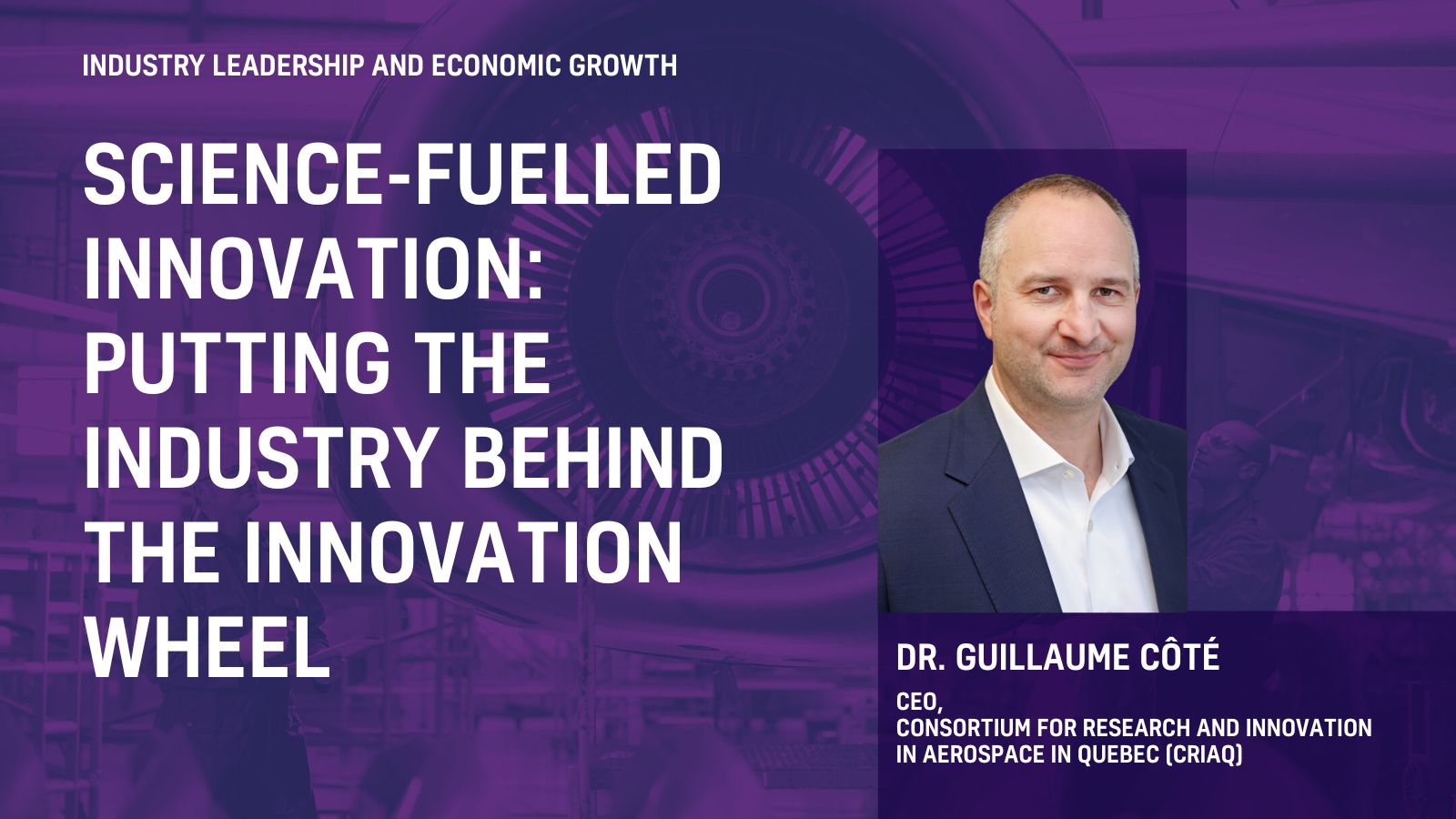
Author(s):
Guillaume Côté
Consortium for Research and Innovation in Aerospace in Quebec (CRIAQ)
CEO
Disclaimer: The French version of this text has been auto-translated and has not been approved by the author.
Governments, academics and business professionals are the key stakeholders of the virtuous triple helix of innovation. Generally eager to discuss economic growth policy drivers, they mostly agree on the importance of innovation and a strong industrial base for Canada. However, implementation has been often falling short of expectations. Perhaps it is time to realize that, compared to our peer group of nations, the Canadian innovation performance is a problem of strategic importance and that, at this stage, action should be prioritized over discussions.
One could suggest that too many (but not all by any means) innovation programs and industrial policies have proven to be either too cumbersome, ill-designed or de facto chasing too many objectives not fully supporting economic or industrial growth. It could be added that, rightfully, the foundation of the academic posture has been geared towards the strengthening of science, which is a necessary but not sufficient ingredient of innovation. While no argument can be made against the positive role of science in supporting economic growth and thus enabling quality of life, it appears that nowadays science as an innovation-related investment is a tougher sell than it used to be.
Observers have said that businesses across regions and sectors, may have misread the market tea leaves signalling prosperity and growth opportunities. However, businesses react to the environment, and we can trust they do commit forward when the balance of risk and return on investment is favourable. Trade turbulence can be best addressed by improving the business environment before creating new programs to fully harness private sector creativity. Government rules of accountability, transparency and stewardship – which are to be celebrated – often translate into rigidity, delays, and over scrutinization. On that front, expecting industry to do more to support national goals is a bit hopeful when it can translate to increased cost.
Ideally, Canada could count on larger, more innovative businesses, evolving in a larger domestic market, with more disruptive unicorns shaping new market segments to make the innovation challenge easier to tackle. In our context, academics, policy advisors, business executives and technology professionals all have a role to play to bring our innovative game to the next level, one that can sustain prosperity expectations. From diverse viewpoints I could analyse – and live – the Canadian innovation conundrum over three decades and I am convinced that industry is best placed to lead the next big innovation pull. After all, they have the greatest impact on job creation, especially given re-industrialisation is becoming an increasingly important focus in today’s complex world.
The corollary has four main implications. First, the industry should take the lead in determining which challenges are worth pursuing. Second, the academic sector needs to value research partnerships with industry — and its researchers — accordingly given that the ‘publish or perish’ paradigm is firmly established. Third, governments at all levels should improve the business environment, foster connection, alignment and trust, alongside more flexible funding to suit various industry sectors’ realities – focusing on policy instruments that can move the needle. Fourth, we need to take a closer look at the entire ecosystem of innovation, which include capable tools including associations, technology platforms, research and technology organisations, consortia, centres of excellence, incubators and accelerators – all of which have a key role to play between “science” and “innovation” and that can package up existing means as funding, expertise, equipment, collaborative research mechanisms, tax credits, internship and training. These organizations situated in between government, industry and academia are the bonds holding the three helices together, making sure they are self-reinforcing.
At CRIAQ, the Consortium for Research and Innovation in Aerospace in Quebec (CRIAQ), a proven model with demonstrable impacts, we strive to make innovation happen. We do not perform research, nor do we collect intellectual property, but we have mastered the art of meshing and leveraging expertise and the resources of our members to increase their innovation output and to accelerate commercialization.
Our collaborative research model is about coupling industrial and academic strengths. On top of supporting R&D consortia team forming, project scoping and financial arrangement, we also play a lead role in identifying priorities the ecosystem is equipped for and worth tackling. And it works marvels, in aerospace, and in other sectors where it has been tried. The key is to start with a business challenge. CRIAQ projects are purpose driven from the get-go: they are science fuelled rather than science based as the linear model of innovation has aged since the publication of “Science: the endless frontier” by Vannevar Bush in 1945.
Beyond accelerating technology innovation or adoption, businesses doing collaborative research have reported productivity gains, improved talent access, market diversification, new partnerships, and a clearer growth strategy. As the Canadian innovation performance is sub-par and re-industrialization, including in defense, a must, it is time to listen more attentively to industry’s voice and to focus on the best use of resources and assets we already have. As such, the Triple Helix and its bonds can strive and work in synchronicity to achieve higher goals.