
The Missing Pillar: Why “AI for All” Needs Mathematics
Author(s):
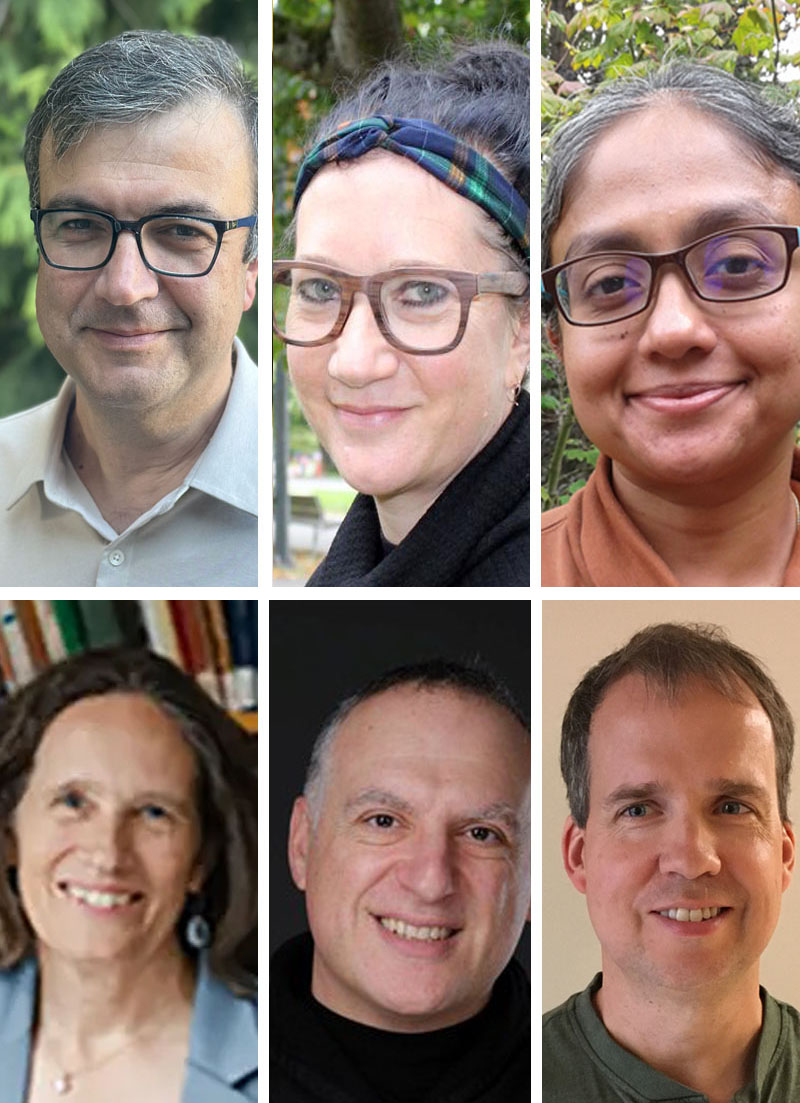
Özgür Yilmaz
Deanna Needell
Malabika Pramanik
Deirdre Haskell
Franco Saliola
Andrew Irwin
Disclaimer: The French version of this text has been auto-translated and has not been approved by the author.
Canada’s new national AI strategy, AI for All, is a landmark commitment: a multi-billion-dollar bet that artificial intelligence can lift productivity, improve public services, and reach every Canadian. We write as leaders of Canada’s five mathematical sciences institutes (AARMS, BIRS, CRM, Fields, and PIMS) to make one argument: the strategy’s ambition will stand or fall on whether Canadians can trust the AI systems it puts into the world. And making AI trustworthy is mainly a mathematical challenge.
“AI for all” is a promise of adoption, and the strategy names the prerequisite itself: safety, it says, is “the most fundamental form of trust,” and citizens and institutions “will not adopt technologies they consider dangerous.” But trust cannot be legislated into existence; it is earned through rigorous, verifiable guarantees about how a system behaves. A physician cannot act on an output that looks convincing but comes with no provable guarantee of how often, and for whom, it succeeds. A safety authority cannot approve a self-driving vehicle when no one can say precisely under what conditions it works and when it will fail. A bank, a hospital, a court: the greater the consequences of a decision, the more a system must be built and proven to be trustworthy before it is allowed to act on it. The most stubborn barriers to AI adoption, in Canada as everywhere, are not shortages of compute or enthusiasm. There are gaps in reliability, interpretability, efficiency, and safety. The countries that close them first will lead.
Importantly, these are not engineering afterthoughts to be patched onto finished systems. They are scientific questions, and their foundations are mathematical. When can we guarantee that a model’s performance on the data it was tested on will carry over to the patients, borrowers, and defendants it will actually serve? How do we quantify uncertainty so that a human decision maker knows when to overrule the machine? What does it mean, precisely, for a system to be fair, and which definitions of fairness can coexist? How do we ensure that an AI agent will stay within specified bounds, and prove it rather than merely hope? Every one of these questions is being answered with mathematics: statistical learning theory, optimization, high-dimensional probability, information theory, formal verification. This is not hypothetical: formal verification has already been used to prove that neural networks designed for aircraft collision avoidance can never issue certain unsafe commands, and differential privacy lets the U.S. Census publish its statistics with provable limits on what they reveal about any one person.
There is also a quieter economic argument. The current paradigm buys capability with scale: more data, more parameters, more energy. That path is expensive, environmentally costly, and structurally favours the largest players. Mathematical advances are the counterweight. The history of computing is, in large part, a history of mathematics substituting insight for brute force, and AI is due for the same transformation: a mathematical theory of learning that tells us what a system can learn and at what cost; models that are efficient, reliable, and understood by design, not by trial and error; capability that grows by understanding, not merely by scaling, and not at the price of ever more energy. The strategy’s investment in sovereign compute is necessary and welcome; mathematics is what will make every dollar of it count. Canada’s advantage has never been in size and scale alone, but in the depth of our ideas. Out-thinking, not just out spending, is the sovereign path.
And Canada is uniquely well placed to walk it. Its edge is structural: a research ecosystem that is unusually and genuinely connected, and strong enough to make a big impact. Canada also invented much of the modern AI playbook. CIFAR’s continued support of neural-network research, beginning in the 1980s, seeded the deep-learning revolution and Canada’s AI leadership. Around that early bet grew a dense network of institutions: CIFAR itself, the national AI institutes (Amii, Mila, and Vector), and our own five mathematical sciences institutes, spanning the country from the Atlantic to the Pacific. Few countries have all three of these ingredients, foundational mathematics, world-leading AI research, and real deployment, in such close proximity, with so few barriers between them. The distance from a theorem to a clinic, or from a proof to a policy, is shorter here than almost anywhere. That connectedness, not scale, is Canada’s comparative advantage, and trustworthy AI is precisely the problem it is built to solve.
Mathematics is the ingredient others are already treating as strategic infrastructure: from the U.S. National Science Foundation to the U.K.’s research councils, major funders are standing up dedicated programs in the mathematics of AI, treating foundational theory as strategic infrastructure. It would be a strange irony if Canada, having taught the world the value of such investment in foundational research, were to leave mathematics out of the playbook now. Our strategy places welcome emphasis on compute, adoption, talent, and safe and responsible AI. What it does not yet name is the mathematics on which those last ambitions rest. Mathematical scientists are hardly absent from Canada’s AI ecosystem; several hold Canada CIFAR AI Chairs. But presence is not a priority. Mathematics is what the strategy has yet to name, fund, and build on by design.
What would that look like in practice? Three things. First, dedicated support for foundational research on trustworthy AI: funding streams that let mathematical scientists work on reliability, interpretability, and safety as first-class research goals. Second, stronger bridges: CIFAR and Canada’s national AI institutes are world-class, our mathematical institutes are eager partners, and the strategy should make it easy for the two communities to build together, through joint programs, shared training, and collaboration that lets theory and deployment inform each other. Third, a seat at the table: decisions that consequential need mathematical expertise in the room. When AI strategy is set, reviewed, and governed, the mathematical sciences should be represented alongside computer science, industry, and civil society. Trustworthy AI is too important for any one discipline to deliver alone.
Our five mathematical institutes, from AARMS in the Atlantic through CRM in Quebec and Fields in Ontario to BIRS in the Rockies and PIMS in the Pacific, are committing to this agenda. The relationship runs both ways. AI systems today prove theorems, find counterexamples, and formalize arguments. And we are taking the conversation to where policy is made: this November, at the CSPC AI and Policymaking Summit in Ottawa, we will sit down with partners from government, medicine, AI research, and AI safety to ask what practitioners need from AI before they can trust it, and what science must deliver to meet that need.
AI for All is the right ambition. All Canadians should share in what AI can offer, and that means all Canadians deserve AI that can be verified, audited, understood, and improved by Canadian expertise. Sovereignty in AI is not only owning the computers. It is commanding the mathematics that makes the machines worthy of our trust.
More on the Author(s)
Deirdre Haskell
Fields Institute; McMaster University
Director
Franco Saliola
CRM; Université du Québec à Montréal
Director
Andrew Irwin
AARMS; Dalhousie University
Director