

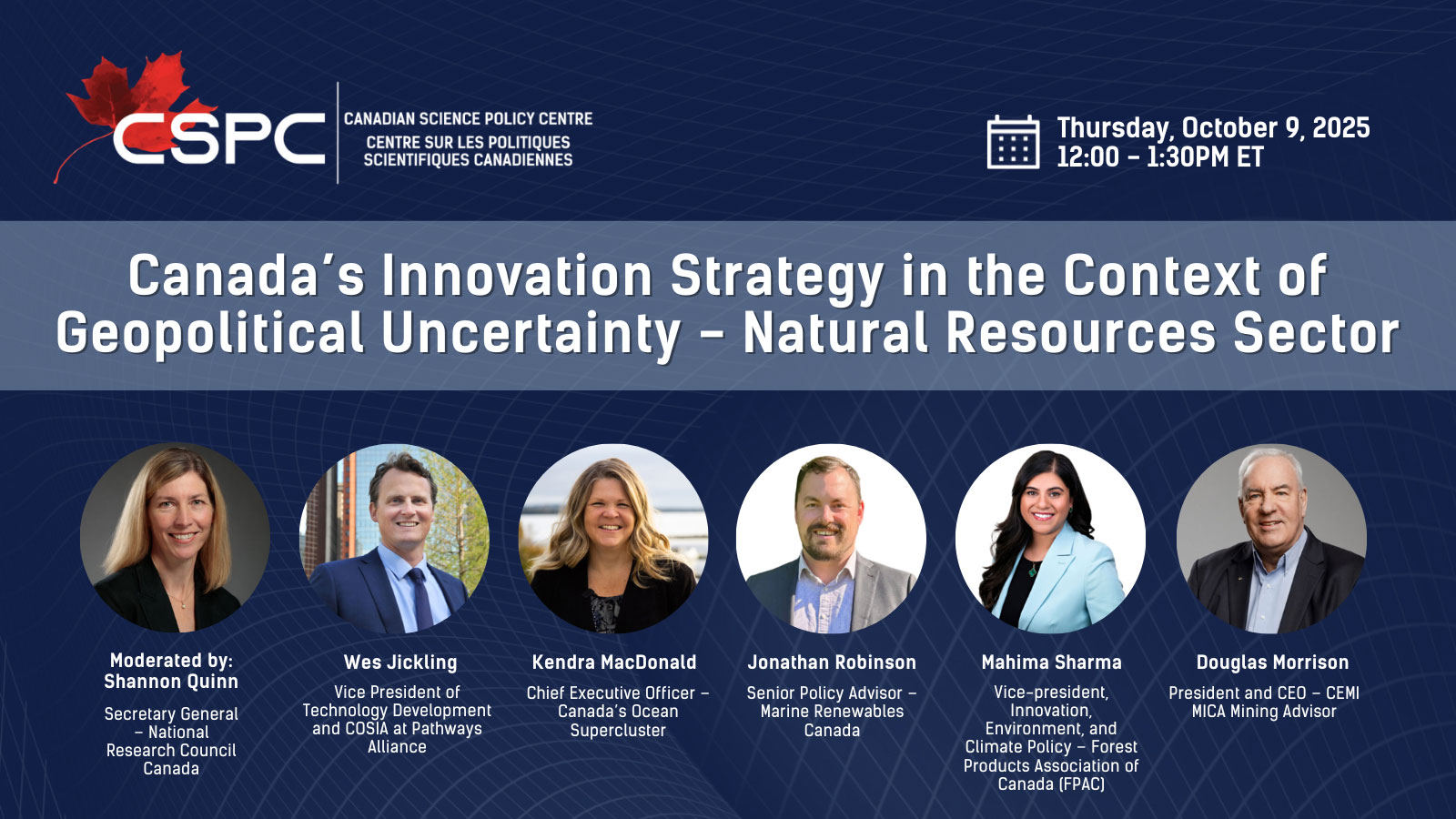
Navigating Geopolitical Shifts: Canada’s Innovation Strategy for Natural Resources Sector
Oct 9, 2025 @ 12:00 pm - 1:30 pm EDT
Executive Summary
This virtual panel convened sector experts to diagnose barriers to innovation and propose practical responses to strengthen Canada’s competitiveness. Panelists identified three interlocking challenges: geopolitical and trade volatility that undermines export markets and investment predictability; a persistent scaling gap where early-stage research fails to reach commercialization due to insufficient late-stage and institutional capital; and regulatory and infrastructure friction—slow, fragmented approvals and constrained scale-up capacity. Workforce ageing, cultural adoption barriers, and climate-related infrastructure risks were also noted.
Recommended public responses emphasize a durable, coordinated industrial strategy and targeted de-risking instruments: sustained co-investment vehicles to attract pension and institutional funds; rebalanced public funding toward later-stage commercialization and cluster scale-up; modernization of fiscal supports and tax incentives; and use of procurement as a market-making tool. Strengthening regulatory capacity, clarifying timelines, and creating faster review tracks were highlighted.
Industry steps include investing in differentiated platforms, accelerating adoption of AI and automation where appropriate, and using living labs and public testbeds to validate technologies. Panelists urged stronger industry-academia partnerships and employer-led training to address skills gaps.
Opportunities for Canada noted by the panel include exporting sustainably produced energy and critical minerals, scaling a bioeconomy (mass timber, biomass), developing offshore and community-scale marine renewables, and leveraging Canada’s reputation for trustworthy governance. The discussion closed with calls for near-term pilots for co-investment and procurement and a two-year roadmap with measurable targets to retain IP, jobs, and economic value domestically. Plus clear accountability and timelines for delivery. Panelists recommended pilots within twelve months and formal strategy.
Q — What are the top three challenges currently hindering innovation in your sector?
- Geopolitical and trade volatility that undermines investment decisions. Panelists described acute tariff shocks and shifting trade priorities (e.g., recent U.S. anti-dumping/countervailing duties and a Section 232 action on lumber) that create uncertainty about export markets and slow firms’ willingness to invest.
- A persistent “scaling gap”: strong early-stage research but weak commercialization and scale-up finance. Several speakers said Canada funds a lot of research but spends far less on commercialization, causing many innovations to “die on the shelf.” Public-private co-investment was portrayed as critical to close that gap.
- Regulatory uncertainty and friction (need for predictable, integrated rules). Large, multi-billion projects (e.g., carbon capture in oil sands, or major offshore wind) require regulatory and policy certainty; fragmented or slow approval processes deter investment.
- Cultural and adoption bottlenecks — slow industry uptake of available tech. The transcript flagged a “culture problem” where abundant existing tech isn’t adopted quickly enough; SMEs do most innovation but face integration barriers into incumbent operations.
- Sector-specific constraints (infrastructure, workforce, climate risks). Examples: offshore renewables need transmission and clear offtake arrangements; forestry must contend with wildfire-driven biomass challenges; mining faces ageing workforce and legacy production platforms.
Q — How should government and industry respond to enable long-term innovation and competitiveness?
- Provide clear, durable policy and regulatory signals for large projects. Panelists called for predictable rules and timelines so investors will commit to long-horizon CAPEX (ten-digit projects such as major emissions-reduction builds).
- Use public-private risk-sharing (co-investment, longer funding horizons). Speakers recommended scaled co-investment, cluster funding, and sustained multi-year programs (not short 1-year grants) so industry retains “skin in the game” while risk is de-risked.
- Create integrated, cross-departmental coordination for complex sectors. Example: an “Office/Secretariat for the Blue Economy” to coordinate Transport, Environment, Fisheries, etc., to reduce friction for ocean tech deployment.
- Speed commercialization by enabling living labs, testbeds and clearer market signals. Faster access to real-world pilots, procurement commitments (Buy-Canada style signals) and streamlined approvals will let firms validate and scale technologies domestically.
- Invest in workforce and place-based partnerships (including Indigenous equity partnerships). Recommendations included employer-led training, targeted immigration for mid-career talent, and true Indigenous equity partnerships in energy/community projects to support local deployment and skills development.
Q — Key recommendations & next steps to boost private-sector R&D investment in Canada
- Shift funding emphasis toward later-stage commercialization and scale. Multiple panellists urged rebalancing public funding from discovery research toward 3–5-year commercialization support so prototypes actually reach market.
- Expand and rationalize public programs that de-risk first commercial projects. Examples: more sustained cluster funding, expanded Strategic Innovation-style programs, and pragmatic co-funding for techno-economic assessments to screen early-stage vendors.
- Create clearer, aggregated funding pathways for community-scale pilots. For remote/Indigenous communities (e.g., tidal/wave pilots), panellists recommended resource assessments and consolidated capital programs so projects aren’t left cobbling many small grants.
- Leverage procurement and government demand as market-making tools. Using procurement (or contracts for difference for electricity) to guarantee offtake was offered as a practical way to make projects bankable and attract private R&D capital.
- Target tax and incentive fixes for sectoral opportunities (e.g., biomass inclusion). The forestry sector suggested including biomass in existing clean-tech manufacturing / electricity tax credits to unlock bioeconomy investments and reduce wildfire risk.
Q — What new opportunities or comparative advantages can Canada exploit?
- International reputation and trust as a soft power advantage for market entry. Panelists said Canadian firms and experts are welcomed globally — that goodwill can be leveraged to export tech and secure partnerships.
- Position Canada as a sustainable, low-risk supplier (energy and resources). Canada’s emphasis on regulatory standards, human rights and environmental stewardship was presented as a selling point for sustainably produced hydrocarbons and minerals.
- Mass-timber, bioenergy and the bioeconomy — link to housing and wildfire mitigation. Forestry can help address affordable housing (mass timber/modular construction) and convert low-grade biomass into heat/energy, if incentives and markets align.
- Offshore and community-scale marine renewables as place-based opportunities. Atlantic offshore wind and tidal/wave for remote communities were highlighted — but only realizable with transmission, clear buyers and streamlined project packaging.
Critical minerals, advanced manufacturing and cleantech finance—a moment to capture global capital. With global industrial policy elsewhere, Canada can leverage critical-minerals supply, advanced manufacturing capacity, and a strong cleantech ecosystem to attract investment—if it moves quickly.
This summary has been generated with the assistance of AI tools.